

Endoscopic Mastectomy: Advancing Minimally Invasive Breast Surgery
On 28 May, teams from the Department of Anaesthesia, Surgery and Interventional Procedures performed the 60th endoscopic mastectomy at Gustave Roussy. This technique, carried out under continuous visual guidance using a camera, enables the removal of the breast through a very short incision, thereby improving the aesthetic outcomes of breast reconstruction. This approach enhances Gustave Roussy’s surgical offering, alongside robotic surgery, and helps widen access to less invasive techniques for a greater number of patients.
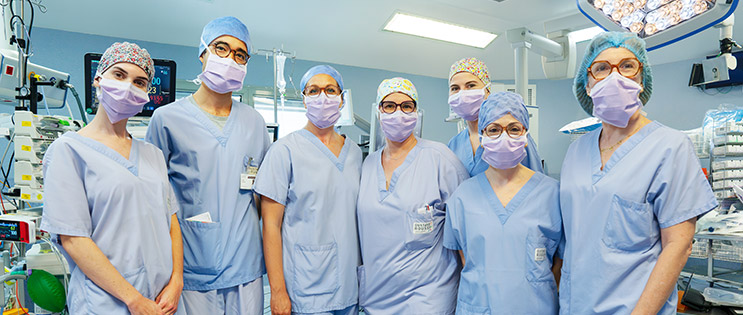
With 2,376 plastic and reconstructive breast surgeries performed in 2024, Gustave Roussy is France’s leading centre for breast surgery and reconstruction, according to data from the French National Health Insurance’s Visuchir ranking. To continue innovating and to offer the latest clinical advances, teams from the Department of Anaesthesia, Surgery and Interventional Procedures of Gustave Roussy have been offering selected patients endoscopic mastectomy since 2025.
When breast size allows, this approach requires only a short incision concealed within a natural fold, such as the armpit or the inframammary fold, compared with the longer scar on the breast associated with conventional mastectomy.
Continuous visual control
“Significantly reducing the size of the incision helps preserve the breast skin and its blood supply,” explains Dr Anne Puchar, breast surgeon at Gustave Roussy and specialist in endoscopic mastectomy.
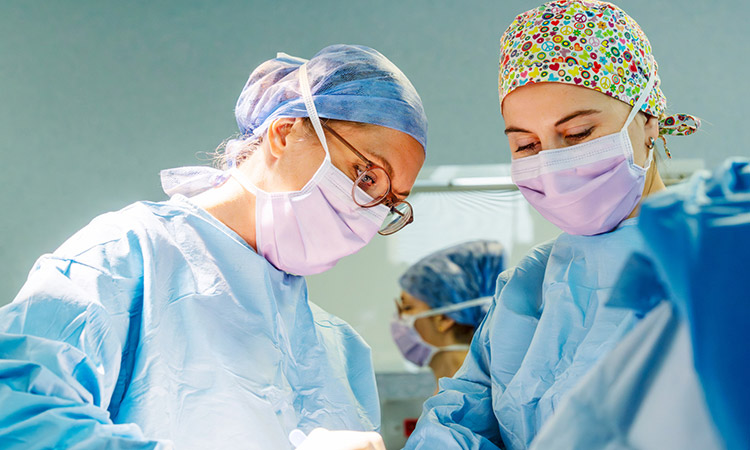
Once the incision has been made, a camera is introduced along with the endoscopic surgical instruments required for the procedure. The breast is then insufflated with gas to improve visibility. This endoscopic approach allows the mastectomy to be performed under continuous visual control and requires little specialised equipment. Endoscopic mastectomy uses the same instruments as laparoscopy, a minimally invasive surgical technique commonly used in various types of cancer.
Compatible with immediate reconstruction
In addition to the continuous visual control provided by the camera, endoscopic mastectomy offers improved visualisation of dissection planes and tissues. “All of these factors allow the surgeon to remove the mammary gland with great precision, particularly around the nipple–areola complex, which is a particularly delicate area where the dissection plane can be difficult to identify. This highly precise approach also helps limit trauma to the skin and improves the quality of breast reconstruction for our patients,” concludes Dr Puchar.
At Gustave Roussy, where the 60th endoscopic mastectomy has just been performed, this approach is compatible with all immediate reconstruction techniques: a single operation is required to remove the patient’s mammary gland and reconstruct the breast, either through the placement of an implant or by fat grafting.