

From Gene Discovery to Treatment: How LAG‑3 Opened a New Path in Immunotherapy
“Great Advances in Oncology” – Episode 2/4. Discovered more than three decades ago at Gustave Roussy, the LAG‑3 gene is now at the heart of the development of new anticancer treatments. By targeting it, scientists aim to remove one of the brakes that can limit the immune system’s ability to fight cancer cells.
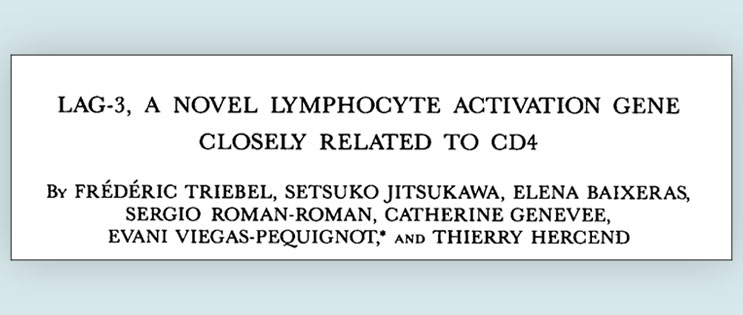
First publication reporting the discovery of LAG-3, published in the Journal of Experimental Medicine. Link.
“We have identified a novel human gene of the Ig superfamily, designated LAG-3.” In 1990, a team of French researchers led by Professors Frédéric Triebel and Thierry Hercend, then heads of the Cellular Immunology Laboratory at Gustave Roussy, reported in the Journal of Experimental Medicine[1] a breakthrough that would go on to play a major role in the future of oncology.
Based on the 12th floor of the hospital, the team had been working since 1986 on an innovative project. Their objective was to decipher how NK (Natural Killer) cells function. These are immune system lymphocytes that can rapidly recognise and destroy abnormal cells, including certain cancer cells. Alongside T lymphocytes, they play an essential role in the body’s defence mechanisms.
Meticulous Laboratory Work
To uncover the specific features of NK cells, the researchers sought to identify the genes that become active when these cells are triggered. To do so, the team used a technique known as subtraction hybridisation. Highly innovative at the time, this approach involved comparing two cell populations: on the one hand, the NK cells under investigation; on the other, reference cells. The researchers then removed from their analysis everything the two populations had in common, allowing the distinguishing features of activated NK cells to stand out.
In the late 1980s, this comparative work relied on lengthy and painstaking laboratory procedures. DNA fragments had to be copied, sorted, and then visualised using radioactive markers. Catherine Gaudin, then Genevée, a laboratory manager at Gustave Roussy and co-author of the study describing the discovery of LAG‑3, took part in the work that led to the identification of these new genes.
“Radioactivity was used to label DNA so that we could track gene activity. Once labelled, the samples were run through a gel, which was then developed: DNA bands appeared and allowed us to interpret the results. Today, many of these steps are automated; at the time, everything was done by hand,” she recalls.
Using this approach, the team succeeded in identifying a new group of genes associated with the activation of these cells: LAG‑1, LAG‑2 and LAG‑3, standing for Lymphocyte Activation Gene. LAG‑3 would prove particularly important, as it was subsequently found in other types of lymphocytes. “Expression of this gene is undetectable in resting lymphocytes, whereas it is found in activated T and NK cells,” noted the 1990 publication describing the discovery of LAG‑3.
This observation was significant. It demonstrated that LAG‑3 was not confined to NK cells but was also present in T lymphocytes, another key component of the immune response. The gene and the protein it encodes thus became a new gateway to understanding the immune system: by studying them, researchers could gain insight into how immune responses are organised, but also how they can be restrained or regulated.
Following its identification in 1990, it would take several years to understand the precise role played by LAG‑3. Studies[2] published in the 2000s showed that this molecule can suppress certain immune responses, notably by limiting the activity of T lymphocytes[3]. LAG‑3 was therefore gradually recognised as an immune checkpoint.
Already Used in Melanoma
Since these discoveries, numerous drugs targeting LAG‑3 have been developed and are now being evaluated in clinical trials. Anti‑LAG‑3 therapies are particularly being tested in combination with immunotherapies targeting PD‑1, another immune checkpoint. The objective is to enhance the effectiveness of these therapies by acting on several immune system brakes simultaneously.
In melanoma, this approach has become a clinical reality. A combination treatment involving nivolumab, which targets PD‑1, and relatlimab, which targets LAG‑3, has been approved in Europe for certain advanced forms of the disease when surgery is not possible or when the cancer has metastasised. Clinical trials[4] have shown that this dual immunotherapy can slow disease progression compared with nivolumab alone. With longer follow‑up, the data also suggest a survival benefit for patients, although these findings still require confirmation.
Thirty Years After the Discovery
Research nevertheless continues to better understand which patients are most likely to benefit from LAG‑3 blockade. The current challenge is therefore to refine the use of these treatments: identifying the patients most likely to respond, improving the management of side effects, and developing combinations capable of strengthening immune responses.
More than thirty years after its identification at Gustave Roussy, LAG‑3 illustrates the journey of biomedical research. Discovered as a lymphocyte activation gene, it has gradually become a closely watched therapeutic target in oncology. Its story demonstrates how a scientific discovery can, years later, open a completely new avenue for the treatment of certain cancers.
“When you take part in the early stages of a research project, you do not always realise what it will become. Looking back, I feel that this work has had an impact far beyond anything we could have imagined at the time. There is inevitably a sense of pride in seeing that this discovery helped, years later, to open new possibilities for patients,” concludes Catherine Gaudin.
“Great Advances in Oncology” – Gustave Roussy Summer Series
Throughout the summer, Gustave Roussy is showcasing four major advances developed at the Institute that have had a significant impact on the care of millions of cancer patients worldwide.
Episode 1: The TNM classification
Episode 2: The discovery of LAG-3.
Episode 3: The foundations of precision medicine.
Episode 4: The birth of modern paediatric oncology.
[1] Triebel F., Jitsukawa S., Baixeras E., Roman-Roman S., Genevee C., Viegas-Pequignot E., et al. “LAG-3, a novel lymphocyte activation gene closely related to CD4”, J. Exp. Med. 1990
[2] L. Maçon-Lemaître, F. Triebel, “The negative regulatory function of the lymphocyte-activation gene-3 co-receptor (CD223) on human T cells”, Immunology, 2005.
[3] RA. Mariuzza, S. Shahid, SS. Karade, “The immune checkpoint receptor LAG3: Structure, function, and target for cancer immunotherapy”, J Biol Chem. 2024
[4] H. A. Tawbi, F. S. Hodi, E. J. Lipson, et al., “Three-Year Overall Survival With Nivolumab Plus Relatlimab in Advanced Melanoma From RELATIVITY-047”, Journal of Clinical Oncology, 2025.