

Robotic surgery: a French first in oesophageal cancer
Following several pioneering procedures carried out in 2025 on the colon, pharynx and liver, the teams from the Department of Anaesthesia, Surgery and Interventional Medicine (DACI) at Gustave Roussy are continuing to drive innovation in robotic surgery. Using the da Vinci Single Port system, they successfully removed a patient’s diseased oesophagus without opening the chest, accessing it via a subcostal approach—an unprecedented achievement in France.
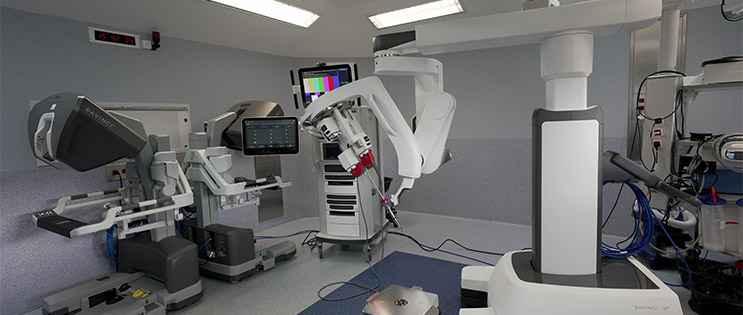
Gustave Roussy was among the first centres in France to be equipped with the da Vinci Single Port surgical system in early 2025. This technology makes it possible to perform complex procedures through a single incision of just a few centimetres, or even via natural orifices where feasible.
Supported by this technology, Dr Léonor Benhaim and her team performed a transdiaphragmatic oesophagectomy in April on a patient with oesophageal cancer. The procedure aimed to remove the diseased organ and reconstruct the digestive tract using a gastric pull-up.
Typically, access to the thoracic oesophagus requires several incisions between the ribs, an invasive approach that can be painful and is associated with a risk of postoperative pulmonary complications. In this case, thanks to the da Vinci Single Port system, the operation was carried out through a single incision of just a few centimetres at the level of the diaphragm, the muscle beneath the lungs and rib cage that separates the chest from the abdomen.
This significantly less invasive robotic approach helped reduce surgery-related complications. “Postoperative recovery was straightforward, with very little pain associated with this new approach,” notes Dr Léonor Benhaim. “This French first highlights the potential of robotic surgery to reduce postoperative complications and to offer patients increasingly less invasive treatments,” she concludes.