

The TNM Classification: An Invention Born at Gustave Roussy, Now the Universal Language of Cancer
"Great Advances in Oncology” – Episode 1/4. Developed in the 1940s by Professor Pierre Denoix, the TNM classification has gradually become the tool that enables oncologists worldwide to determine the stage of their patients’ cancer within a unified framework. Still in use today, it reached its 9th edition in 2025.

T for tumour, N for nodes, and M for metastases. Three letters that enable oncologists around the world to describe the extent of cancer in their patients using a common language.
By combining tumour size and spread, possible lymph node involvement, and the presence or absence of metastases, the TNM classification allows clinicians to establish a stage, most often from I to IV depending on the cancer, directly influencing prognosis, treatment strategies, and therapeutic options.
Born from the visionary mind of Professor Pierre Denoix, Director of Gustave Roussy from 1956 to 1982, this classification remains an essential tool in oncology today, from clinical care to research.
The Visionary Idea of Professor Denoix
A surgeon specialising in breast cancer, Director-General for Health, and a member of the Resistance decorated with the Croix de Guerre and Commander of the Légion d’honneur, Professor Denoix was a leading figure in global oncology, at the heart of the discipline’s major transformations in the second half of the 20th century.
As a young surgeon, Pierre Denoix was tasked in 1943 by the National Institute of Hygiene (the precursor of INSERM) with studying cancer incidence in France and analysing how advanced cancers were at diagnosis, based on records from “anti-cancer” centres across the country. This initiative was called the “Enquête permanente cancer”[1].
The problem: at the time, neither in France nor internationally did a classification system specifically suited to cancer exist. Initial findings compiled in 1944 showed that each clinical team described the disease and its progression using different criteria, making comparisons difficult1.
Pierre Denoix therefore proposed a new classification system based solely on factual clinical observations[2]. Independent of prescribed treatments, this classification was designed to allow comparisons between patients from different hospitals worldwide, establishing a “common language”.
Three Factors to Determine a Stage
In Six Years of the Permanent Cancer Survey, published in 1950, Denoix explained that it was “essential to define malignant tumours as clearly and as simply as possible, according to their stage of local and lymphatic extension”[3].
His central idea was to classify cancers according to their extent, focusing on three key parameters: tumour size, lymph node involvement, and the presence and number of metastases. Initially introduced in France under the acronym TGM (tumeur, ganglions and metastasis), this method laid the foundations for the modern TNM system.
Another crucial innovation was to translate this extent into stages, giving physicians a clear overall view of disease progression. This concept evolved into today’s TNM logic, where combinations of T, N, and M define the stage.
This classification, used as early as 1947 in the Permanent Cancer Survey, was refined through several scientific publications by Prof. Denoix in the 1940s and 1950s. In 1954, in The Importance of a Common Classification for Different Forms of Cancer, he firmly established the approach that still underpins TNM: describing cancer according to its spread within the body.
“A clinical classification must group the various characteristics of a tumour based on its extension,” he wrote, specifying three domains: “local extension, regional extension, and distant extension or metastasis”[4].
From France to the International Stage
 Gradually, this French innovation spread internationally and became known as the TNM classification (tumour, nodes, metastases). In 1951, experts from the World Health Organization visited Denoix’s teams in Paris. The following year, the WHO adopted an updated cancer classification acknowledging the importance of regional spread.
In 1953, at the International Congress of Radiology, the approach was recognised as a common framework for cancer staging, and it progressively became a global standard.
At the same time, the Union for International Cancer Control (UICC), founded in Madrid in 1933, took an interest in this new classification system. In 1953, it established a Special Committee on the Classification of Clinical Stages, chaired by Professor Denoix, who later served as UICC President from 1973 to 1978.
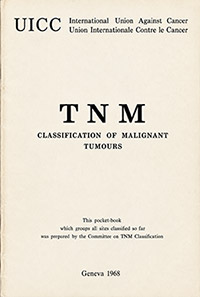
After several years of international collaboration, the committee published its first TNM classification in 1958, initially focusing on breast and laryngeal cancers. Ten years later, the first complete edition was released. Since then, the UICC has continued to update it through its TNM Prognostic Factors Project. The 9th edition was published in 2025.
“Since its development by Professor Pierre Denoix, the TNM classification has transformed cancer care by providing a common language for staging disease. Under the stewardship of UICC and the global cancer community, it has continually evolved to reflect advances in science and practice. Today, TNM remains essential to improving patient outcomes and advancing equity in cancer care worldwide,” says Dr Cary Adams, current CEO of the UICC.
Towards a Biology-Based Classification
At the same time, advances in molecular medicine and precision oncology are paving the way for a new way of classifying cancer. The Cancer Genome Atlas, a major US research project launched in 2005, has identified common molecular alterations across different cancer types, regardless of their organ of origin, thanks to genomic analysis of thousands of tumours.
In a 2024 editorial published in Nature[5], five physician-researchers from Gustave Roussy called for moving beyond organ-based classification in favour of a biological approach, particularly for metastatic cancers. The aim is to better distinguish patients according to the biological, molecular and immune characteristics of their tumours—now crucial in selecting many treatments and sometimes shared across multiple cancer types.
“With the TNM classification, Professor Pierre Denoix laid the foundations of a universal language for cancer that still structures oncology practice worldwide. At a time when precision medicine is opening new avenues, particularly towards biology-based classification, Gustave Roussy remains true to its history and spirit of innovation. Our ambition is to continue advancing our understanding and treatment of cancer for the benefit of patients,” concludes Professor Fabrice Barlesi, Chief Executive of Gustave Roussy.
“Great Advances in Oncology” – Gustave Roussy Summer Series
Throughout the summer, Gustave Roussy is showcasing four major advances developed at the Institute that have had a significant impact on the care of millions of cancer patients worldwide.
Episode 1: The TNM classification
Episode 2: The discovery of LAG-3.
Episode 3: The foundations of precision medicine.
Episode 4: The birth of modern paediatric oncology.
[1] M. Ménoret, « The Genesis of the Notion of Stages in Oncology: The French Permanent Cancer Survey (1943–1952) », Social History of Medicine, 2002.
[2] R. Rami‑Porta, « The TNM classification of lung cancer, a historic perspective », Journal of Thoracic Disease, 2023.
[3] MINISTÈRE DE LA SANTÉ PUBLIQUE, Bulletin de l’Institut national d’hygiène, numéro spécial à l’occasion du Ve Congrès international du cancer (Paris, juillet 1950), Paris, Masson & Cie, 1950.
[4] P. F. Denoix, « Importance d’une classification commune aux différentes formes de cancer », Acta Radiologica, Supplementum, 1954.
[5] André, F. et al., « Forget lung, breast or prostate cancer: why tumour naming needs to change », Nature, 31 January 2024.