

Welcome to the new Gustave Roussy website
A new website designed to offer you a simpler, clearer, and more intuitive experience. Patients, caregivers, healthcare professionals, and donors: find information, news, and services more easily.
Health Alerts
Health Safety Measures
Health monitoring applies to all the care you receive.
Patient Identification Safety
Patient identification safety is a system for monitoring and preventing errors related to patient identification. It aims to ensure that all patients are correctly identified throughout their care in the hospital and in the exchange of medical and administrative data. The goal is to ensure the reliability of patient identification and the documents pertaining to them throughout their care.
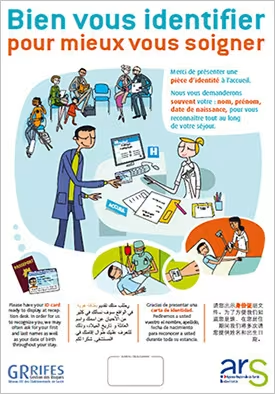
Identification security is a shared responsibility between the patient and healthcare professionals:
- The patient presents a national ID card or passport and their health insurance card, reports any data entry errors regarding their identity or any changes to their name or status, and provides proof of address dated within the last 3 months.
- Gustave Roussy assigns you a unique, permanent number and uses additional measures (identification wristbands, photos during radiation therapy, checklists in the operating room)
Healthcare professionals verify the patient’s identity before any medical procedure and report errors so they can be corrected.
Infection Surveillance
Nosocomial infections are infections contracted during a hospital stay. They are caused by microorganisms (bacteria, viruses, parasites, or fungi) that a patient may acquire during their hospital stay, but which they may also have been carrying prior to admission.
In light of the risk of nosocomial infections, Gustave Roussy remains vigilant:
- The Committee for the Prevention of Hospital-Acquired Infections (CLIN) organizes infection surveillance and prevention by regularly bringing together representatives from the various professional groups involved in these efforts;
- hygiene measures are implemented: proper use of antiseptics, hand hygiene for healthcare staff, sterilization of medical equipment, etc.;
- the most vulnerable patients are cared for in units specially equipped to provide them with a protected environment (stem cell transplants);
- Surgical areas are carefully isolated from areas where patients and their families circulate;
- The hospital’s internal water system undergoes regular bacteriological testing.
Hemovigilance
Hemovigilance is defined as the set of monitoring procedures organized from the collection of blood and its components through to the follow-up of recipients, with the aim of collecting and evaluating information on adverse or unexpected effects resulting from the therapeutic use of labile blood products (red blood cell and platelet concentrates, plasma) and preventing their occurrence.
Hemovigilance constitutes a transfusion information system and is an integral part of the transfusion safety system.
The hemovigilance coordinator at Gustave Roussy is responsible for ensuring the transfusion safety of patients treated at the facility and for ensuring the optimal use of labile blood products.
Blood donations save lives.
Transfusion is essential for a wide range of medical and surgical treatments. Many children and adults treated at Gustave Roussy may experience a platelet shortage during their treatments (such as chemotherapy). A platelet transfusion is essential for them.
Platelets are very fragile and have a shelf life of only 5 days after donation. Therefore, to ensure the quality and availability of this blood product, we have a significant need for new donors.
If you’d like to donate blood, please visit the website of the Établissement Français du Sang (EFS): www.dondusang.net
Pharmacovigilance
Any medication can cause unexpected or unwanted side effects.
To minimize the risk of adverse drug reactions, you should always inform your doctor of all medications you are taking. It is also important to mention any known drug intolerances each time you visit (e.g., allergy to penicillin).
If you notice an unusual reaction during your treatment, never hesitate to ask the healthcare team, who will tell you whether this reaction is normal or not. Your vigilance is especially valuable to us if you are receiving a new treatment or one that is currently being studied.
When it comes to medication risks, Gustave Roussy remains vigilant: every reported incident is forwarded to the local pharmacovigilance liaison, who decides whether to report the event. Such a report can thus lead to significant changes in medical practices.
Medical Device Vigilance
The medical devices used in patient care are highly varied. A problem may be related to the device itself or to its use. It is identified when it causes an accident, an incident, or a risk of an incident.
Gustave Roussy’s vigilance regarding risks associated with medical devices takes several forms:
- Selection of devices based on rigorous criteria (CE marking, etc.);
- Regular maintenance and inspection of its equipment inventory;
- Development of traceability for the equipment used in your care;
- Regular training of technical and healthcare staff on the maintenance and use of devices;
- Monitoring and reporting of incidents involving medical devices.
Please feel free to ask the healthcare team about any risks and immediately report any abnormalities or malfunctions with a device.
Biovigilance
Biovigilance involves monitoring incidents and the risks of incidents related to cell, tissue, or organ transplants.
Given the risks associated with transplants, Gustave Roussy remains vigilant:
- you will receive comprehensive information during a pre-transplant consultation;
- the transplant is subject to strict regulations;
- the preparation and storage of the graft are carried out under conditions designed to prevent any risk of incidents, ensuring the transplant proceeds under the best possible conditions;
- full traceability of all procedures from donor to recipient is ensured.
Reagent Vigilance
Reagent vigilance allows us to analyze and keep track of any incident or potential incident related to the use of a device, laboratory reagent, or specimen collection tube provided to you. The main risk is that it could harm your health by leading to an erroneous result.
In light of the risks associated with the use of laboratory equipment or reagents, Gustave Roussy remains vigilant:
- Gustave Roussy uses only equipment and reagents that meet quality standards (CE marking).
- The equipment is used and/or maintained by qualified personnel and companies.
Traceability (recording) is ensured at all levels.