Welcome to the new Gustave Roussy website
A new website designed to offer you a simpler, clearer, and more intuitive experience. Patients, caregivers, healthcare professionals, and donors: find information, news, and services more easily.
Pediatric Research
In the fight against pediatric cancers, Gustave Roussy is involved in several research initiatives.
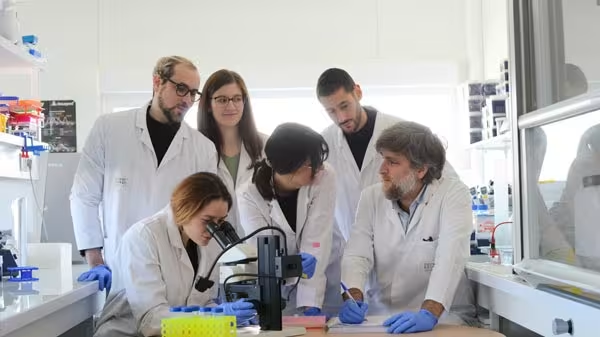
Cancers in children and adolescents are rare diseases that often have biological characteristics different from those observed in adults. While therapeutic advances over the past few decades now make it possible to cure nearly 80% of young patients, about one in five children still cannot be cured.
Some tumors remain particularly aggressive or are associated with a poor prognosis in the event of a relapse. In this context, academic research plays an essential role in better understanding these diseases, identifying new therapeutic targets, and developing more effective and less toxic treatments.
Through research programs, innovative clinical trials, and the Paris Kids Cancer initiative, Gustave Roussy is helping to advance knowledge and open up new possibilities for children and adolescents with cancer.
Paris Kids Cancer, an integrated research center
In partnership with the Assistance Publique - Paris Hospitals (AP-HP), the Curie Institute, four universities, several research organizations and partner centers, as well as three parent associations, Gustave Roussy co-leads Paris Kids Cancer, an integrated research center.
Through its collaborative approach, this program of excellence aims to identify and develop new solutions to combat pediatric cancers.
Paris Kids Cancer brings together 15 partners:
-
Gustave Roussy
-
Curie Institute
-
AP-HP
-
Imagine for Margo – Children without Cancer
-
Hubert Gouin – Childhood and Cancer
-
Laurette Fugain Association
-
Cordeliers Research Center
-
Imagine Institute
-
French Atomic Energy Commission (CEA)
-
Inserm
-
CNRS
-
Paris Cité University
-
Paris-Saclay University
-
Paris Sciences et Lettres University (PSL)
-
Sorbonne University
MAPPYACTS2: A Clinical Trial Using Molecular Profiling
Gustave Roussy is currently conducting a clinical trial in which Dr. Birgit Georger, a pediatric oncologist, serves as the principal investigator: MAPPYACT2, or “Molecular Profiling for Pediatric and Young Adult Cancer Treatment Stratification 2.” This precision medicine program is based on an in-depth molecular characterization of tumors to identify the most relevant innovative treatment options for each patient.
MAPPYACT2 aims to better understand each patient’s cancer by analyzing their genes, in order to offer them the most appropriate treatment.
MAPPYACTS
The MAPPYACTS2 study was preceded by the MAPPYACTS clinical research program, which analyzed the patient’s entire genome using high-throughput sequencing. The goal of this analysis was to identify one or more abnormalities that could be specifically targeted by new drugs. From 2016 to 2019, 600 patients participated in this trial.
BIOMEDE: A Large-Scale Clinical Trial
Conducted in several phases since 2014, the BIOMEDE clinical trial focuses on infiltrating brainstem gliomas (IBSG). These highly aggressive, inoperable tumors affect about 100 children and adults each year.
Sponsored and coordinated by Gustave Roussy, BIOMEDE is the largest clinical trial ever conducted on infiltrating brainstem gliomas. It aims to analyze the tumors’ DNA using a biopsy taken at the time of diagnosis, specifically to identify the presence of abnormalities and tailor treatment based on the results.
A New Perspective
In 2026, the results of the BIOMEDE 1 study were published in the journal *Nature Medicine*. They shed new biological light on GITCs by identifying the main factor determining patient survival: the TP53 gene mutation. These findings open up concrete avenues for future therapies.
BIOMEDE 2: An Encouraging Trial
In 2022, Gustave Roussy launched the BIOMEDE 2 clinical trial, which builds on the results of BIOMEDE 1. The goal of this study is to compare a promising drug, ONC201, with everolimus, a targeted therapy considered the current standard of care.
BIOMEDE AI: AI as an analytical tool
Whole-genome sequencing of tumors and medical imaging follow-up of patients enrolled in the BIOMEDE trial provide a vast amount of data; analyzing this data will lead to a better understanding of infiltrating brainstem glioma and its variations. Using artificial intelligence (AI), the BIOMEDE AI study identifies and correlates certain factors that have not yet been determined through supervised human analysis.
Key Figures
-
1st
GITCs are the leading cause of death from brain tumors in children
-
100
new cases are diagnosed each year in France
-
10 to 15%
Malignant brain tumors in children are infiltrating brainstem gliomas
Medical and scientific programs
Gustave Roussy also conducts several medical and scientific programs to develop new approaches to the fight against pediatric cancers.
DECRIPT (Decipher Cancer Risks in Pediatric Tumors patients) aims to better understand the genetic factors involved in cancers affecting children and adolescents. In particular, the program seeks to identify hereditary predispositions that may increase the risk of developing cancer and to better assess the risk of developing a second cancer later in life. This research helps improve patient care and tailor prevention strategies for patients and their families.
The INSPIRE program studies the mechanisms of treatment resistance observed in certain pediatric cancers. To this end, researchers are developing innovative experimental models using tumor cells collected from patients. These models provide a better understanding of why certain treatments lose their effectiveness and help identify new therapeutic approaches to overcome these resistances.
FOSTER-CabOS: A Clinical Trial to Improve the Treatment of Osteosarcoma
The FOSTER-CabOS project is a European Phase III clinical trial focused on osteosarcoma, the most common malignant bone cancer in children, adolescents, and young adults. Coordinated by Dr. Nathalie Gaspar, a pediatric oncologist at Gustave Roussy, the trial aims to evaluate cabozantinib, a targeted therapy already used to treat other cancers. The goal is to determine whether this treatment improves outcomes for patients with high-risk osteosarcoma and reduces the risk of relapse.