Welcome to the new Gustave Roussy website
A new website designed to offer you a simpler, clearer, and more intuitive experience. Patients, caregivers, healthcare professionals, and donors: find information, news, and services more easily.
Thyroid Cancer
Director: Dr. Julien Hadoux
+33 (0)1 42 11 42 57
+33 (0)1 42 11 44 96
+33 (0)1 42 11 42 42
+33 (0)1 42 11 63 61
+33 (0)1 42 11 50 25

Understanding the Disease
Thyroid cancer is the abnormal growth of cells within the thyroid gland, which eventually form a tumor. There are several types of thyroid cancer:
- Papillary and follicular cancers (85% of cases).
- Medullary cancers.
- Anaplastic cancers.
The most common types of thyroid cancer, known as “differentiated” cancers (papillary and follicular), generally have a good prognosis. Other, rarer forms of the disease are more aggressive and require more intensive treatment.
Thyroid cancers are often diagnosed at an early stage, following the detection of a thyroid nodule during a clinical examination or imaging test. In most cases, the disease progresses slowly, and treatments yield very good results, with high survival rates.
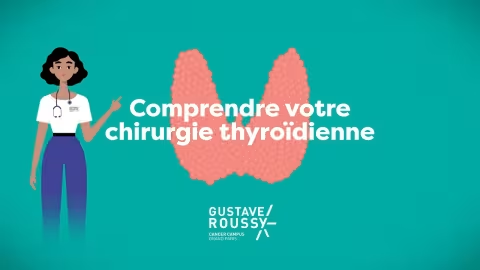
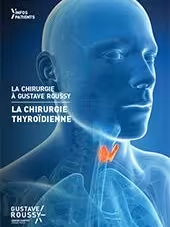
Treatment for thyroid cancer primarily involves surgery to remove all or part of the thyroid gland, sometimes supplemented by radioactive iodine therapy depending on the type of tumor and its extent. Long-term follow-up is essential to monitor for any recurrence and to adjust the necessary hormone replacement therapy following surgery.
What is the thyroid gland?
The thyroid is an endocrine gland located in the lower part of the neck, below the larynx. Its main function is to secrete hormones. It consists of two lobes located on either side of the trachea, which are connected by a horizontal anterior portion called the isthmus.
The thyroid secretes two hormones into the bloodstream:
- Triiodothyronine (T3).
- Thyroxine (T4).
These hormones are essential for the functioning of all the body’s cells. If the gland is removed due to a benign condition or cancer, these hormones can be replaced without causing any biological disturbances by taking synthetic thyroxine daily (in the morning on an empty stomach).
Thyroid function is controlled by another endocrine gland, the pituitary gland, which stimulates its activity through a hormone called TSH (thyrotropin).
Thyroid Cancer by the Numbers
-
7,684
new cases in France each year.
-
73%
New cases are being diagnosed in women.
-
58 years old
median age at diagnosis.
Figures: National Cancer Institute.
Prevention and Risk Factors
Thyroid cancers are generally linked to a combination of factors, some of which have been clearly identified, while others are still being studied. Understanding these risk factors provides insight into which populations are most at risk and allows for tailored screening when necessary.
Exposure to radiation, particularly during childhood (radiation therapy to the neck or accidental exposure), is the main identified risk factor. It significantly increases the risk of developing thyroid cancer several years after exposure. It is important to note that the administration of radioactive substances for diagnostic purposes (such as scintigraphy) in adults does not increase the risk of thyroid cancer.
Certain forms of thyroid cancer may be linked to genetic predispositions: a mutation in the RET gene has been identified as a factor that promotes the development of medullary thyroid cancer. Thus, having an affected parent—particularly in the context of rare familial forms—can increase the risk and warrant specific monitoring. Finally, certain rare genetic disorders (Cowden syndrome, Carney syndrome, or familial polyposis) increase the risk of developing follicular-type differentiated thyroid cancer.
Thyroid nodules are common and mostly benign. However, some may develop into cancer, which is why appropriate follow-up is necessary when they are detected.
Symptoms
Thyroid cancer often progresses silently, especially in its early stages. In many cases, it does not cause any specific signs. When symptoms do appear, they are most often related to the presence of a nodule or an enlargement of the gland. A lump in the neck, or a feeling of tightness, may indicate the presence of a thyroid nodule. These nodules are very common and benign in more than 90% of cases. If nodules are detected, it is necessary to determine whether they are benign or malignant.
In addition to the appearance of a nodule or lump in the neck, other symptoms of thyroid cancer may include:
- Swollen lymph nodes in the neck.
- Changes in the voice, particularly persistent hoarseness.
- Difficulty swallowing or a sensation of discomfort when swallowing.
- Difficulty breathing—though less common—due to compression of the airways.
- A feeling of pressure or pain in the neck, sometimes radiating to the ears.
Diagnosis
Thyroid nodules are very common. Gustave Roussy offers an InstaDiag thyroid care pathway designed to determine the nature of these nodules and, if necessary, recommend appropriate treatment. All necessary appointments with a multidisciplinary team are scheduled within a half-day.
The goal is to quickly determine the nature of the thyroid nodule and, if necessary, recommend treatment. All appointments are scheduled during a half-day at the Gustave Roussy outpatient clinics.
You will be cared for by a multidisciplinary medical team composed of various thyroid specialists: endocrinologists, oncologists, surgeons, radiologists, cytopathologists, nurses, and nursing assistants. This team will work with you to make the necessary decisions to reach a diagnosis and, if needed, recommend treatment.
The InstaDiag thyroid care pathway is organized into several steps:
- A medical consultation, during which you will meet with the doctor to whom you were referred.
- A nursing consultation.
- A thyroid ultrasound and a fine-needle aspiration biopsy.
- A medical consultation to discuss the results.
Instadiag Thyroid
The goal of the InstaDiag Thyroid program is to determine, over the course of a half-day, the nature of your thyroid nodule. All appointments are scheduled during this half-day at the Gustave Roussy outpatient clinics.

Coverage
Gustave Roussy is a center of excellence recognized by the National Cancer Institute for the treatment of endocrine cancers.
Numerous specialized multidisciplinary consultation meetings are held at the Institute to determine the best course of treatment for thyroid tumors. Cases of tumors that do not respond to standard treatment (refractory thyroid cancers) are discussed during consultation meetings organized as part of the French TUTHYREF network.
Management involves a number of specific therapeutic approaches:
- Thyroid surgery.
- Radioactive iodine therapy (thyroid) and other metabolic radiotherapies.
- Chemotherapy.
- Targeted molecular therapies.
- Radiation therapy.
- Radiofrequency ablation, chemoembolization, and other locoregional treatments.
These cancer treatments can be administered on an outpatient basis, during a day-hospital stay, or in the Department of Nuclear Medicine and Endocrine Oncology.
Treatments and Clinical Trials
Treatment for thyroid cancer can be provided in your local community or at Gustave Roussy, either as an outpatient or during a stay in the Department of Nuclear Medicine and Endocrine Oncology. Partnerships are often established with centers near your home.
Join a clinical trial
Many clinical trials are open to patients with cancer. Participating in a clinical trial provides access to innovative treatments while contributing to the development of new therapies.

Contact
Head of the Endocrine Diseases Committee:
Dr. Julien Hadoux
Phone: +33 (0)1 42 11 42 57
+33 (0)1 42 11 42 57
+33 (0)1 42 11 44 96
+33 (0)1 42 11 42 42
+33 (0)1 42 11 63 61
+33 (0)1 42 11 50 25
Appointments and Second Opinions

Search
All of the team’s physicians are deeply involved in clinical research on thyroid tumors, contributing to French multicenter cohort studies and national and international clinical trials for these tumors.
Patient Information Booklet
Le cancer médullaire de la thyroïde
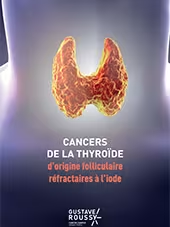
Cancers de la thyroïde refractaires

Appointments and Second Opinions