
Welcome to the new Gustave Roussy website
A new website designed to offer you a simpler, clearer, and more intuitive experience. Patients, caregivers, healthcare professionals, and donors: find information, news, and services more easily.
Brain Tumors
Director: Dr. Sophie Bockel
Contact: 33 (0)1 42 11 62 20

Understanding the Disease
Gustave Roussy’s Expertise
Gustave Roussy treats several types of brain tumors in adults, including gliomas, meningiomas, ependymomas, brain lymphomas, certain brain metastases, chordomas, and other skull base tumors. The treatment strategy is developed through a multidisciplinary approach and may involve collaboration with neurosurgery teams from partner centers.
A brain tumor is an abnormal growth of cells inside the skull. It can originate in the brain or its membranes, or it can be a metastasis from cancer in another organ.
Brain tumors are therefore a highly heterogeneous group. Their progression, symptoms, and treatments depend largely on their location, cell type, grade, and molecular characteristics.
Not all brain tumors are cancerous. Some are considered benign because they do not invade neighboring tissues. However, they may still require treatment if they compress a region of the brain or disrupt a neurological function. Malignant tumors are more likely to invade surrounding tissues and can progress rapidly.
What is the brain?
The brain is part of the central nervous system, along with the spinal cord. It receives, analyzes, and transmits information that enables us, among other things, to speak, remember, move, perceive our environment, and regulate many of the body’s functions. Its various regions do not all serve the same purpose. This is why the symptoms of a tumor vary depending on its location and its impact on nearby structures.
The Main Types of Tumors
They develop from the meninges, the membranes that surround the brain and spinal cord. Many grow slowly, but their location, size, and grade may warrant monitoring or treatment.
These are lymphomas that develop in the central nervous system. Their diagnosis and treatment differ from those of gliomas and rely primarily on appropriate drug therapies.
These occur when cancer cells from a tumor in another organ spread to the brain. Treatment takes into account the primary cancer, the number and location of the lesions, symptoms, and the patient’s overall health.
The brain and adjacent structures may be affected by other tumors, including ependymomas, medulloblastomas, chordomas, and certain skull base tumors. Each requires specific diagnostic and therapeutic expertise.
Risk Factors and Prevention
For the vast majority of primary brain tumors, no specific cause has been identified, and there are no specific preventive measures. These tumors are not caused by individual behavior. However, some risk factors have been established or are suspected in specific situations.
Previous radiation therapy to the skull to treat another condition may increase the long-term risk of certain brain tumors. This risk remains rare and should be weighed against the benefits of the treatment received.
Certain hereditary diseases can increase the risk of central nervous system tumors. A genetic counseling consultation may be recommended when personal or family history warrants it.
A significant decline in immune function can contribute to the development of certain types of central nervous system lymphomas. This applies to specific medical conditions.
Symptoms
Symptoms depend on the tumor’s location, size, and rate of growth. They may develop gradually or appear more suddenly. None of these signs is specific to a brain tumor, but if they persist, worsen, or occur in combination, you should seek medical attention.
- Unusual, persistent, or progressively worsening headaches, sometimes accompanied by nausea or vomiting.
- A first seizure or a change in the nature of previously experienced seizures.
- Weakness, numbness, or difficulty coordinating an arm or leg.
- Difficulties with speech, comprehension, memory, attention, or behavior.
- Problems with vision, balance, hearing, or sensation.
- Unusual drowsiness or a gradual decline in overall health.
When Should You Seek Emergency Care?
The sudden onset of neurological deficits, speech difficulties, loss of consciousness, or a first seizure requires an immediate call to emergency services. These signs can have many causes and must be evaluated without delay.
The Diagnosis
The diagnosis is based first on a clinical and neurological examination, followed by brain imaging. In many cases, analysis of a tumor sample is essential to accurately identify the disease and guide treatment.
The doctor looks for signs of nervous system damage. In particular, the doctor assesses muscle strength, sensation, reflexes, balance, coordination, speech, and certain cognitive functions.
Magnetic resonance imaging is the gold standard for locating a lesion, assessing its relationship to nearby structures, and identifying multiple sites. A contrast agent may be injected. A CT scan may be performed in certain situations, particularly in emergency cases or when an MRI is not possible.
When indicated and feasible, a biopsy or surgical procedure is performed to obtain tumor tissue. The procedure is planned based on the location of the lesion, the symptoms, and the balance between the expected benefit and the neurological risks.
Examining the tissue under a microscope determines the nature and grade of the tumor. Molecular analyses are now used to supplement the diagnosis of many brain tumors. They help to better classify them, assess their likely progression, and, in some cases, guide treatment.
It is appropriate for the suspected diagnosis. When a brain metastasis is suspected, tests are performed to identify or reassess the primary cancer. For certain tumors, imaging of the spinal cord or analysis of cerebrospinal fluid may be considered.
The Diagnostic Process
Neurological consultation and examination, brain MRI, appropriate additional testing, neurosurgical consultation if necessary, biopsy or surgery, pathological and molecular analysis, followed by a multidisciplinary team meeting.
Care at Gustave Roussy
Treatment is tailored to the type of tumor, its location, grade, molecular characteristics, extent, symptoms, and the patient’s overall condition. The treatment plan is discussed during a multidisciplinary team meeting, which brings together the specialists needed for each specific situation.
Depending on the treatment pathway, care may involve neurosurgery, medical oncology, radiation therapy, neurology, neuroradiology, pathology, molecular biology, and supportive care. Certain neurosurgical procedures are performed at partner institutions as part of a care pathway coordinated with Gustave Roussy.
Comprehensive Care
Neurological symptoms, fatigue, pain, cognitive difficulties, anxiety, and nutritional, social, or rehabilitation needs may require specialized care. Supportive care is integrated into the care pathway and tailored to each patient’s situation.
Treatments and Clinical Trials
Surgery, radiation therapy, and drug treatments may be offered alone, sequentially, or in combination. Their goal may be to remove the tumor, reduce its size, limit the risk of recurrence, control its progression, or relieve symptoms. The choice depends on the specific diagnosis and each patient’s individual situation.
When possible, surgery can remove all or part of the tumor and provide the tissue needed for diagnosis. The extent of the procedure is determined based on the tumor’s location and the need to preserve neurological function. In some cases, only a biopsy is indicated.
Radiation therapy uses radiation to destroy tumor cells while minimizing exposure to healthy tissue. The treatment areas, dose, and number of sessions are tailored to the type of tumor and the patient’s clinical condition. Stereotactic radiation therapy may be recommended for certain well-defined lesions, particularly certain brain metastases.
Chemotherapy can be administered alone or in combination with radiation therapy. The medications, schedule, and duration of treatment vary depending on the type of tumor. For some gliomas, temozolomide may be used, but it is not suitable for all cases.
Treatments targeting a molecular abnormality may be recommended for certain tumors when there is sufficient evidence supporting the target and the drug. Immunotherapy has a role in certain brain metastases, depending on the primary cancer. For primary brain tumors, its use remains limited to selected cases or clinical research.
Corticosteroids may be prescribed to reduce swelling around the tumor. Antiepileptic medication is indicated in the event of a seizure, based on a medical evaluation. Rehabilitation and supportive care help maintain independence and quality of life.
Research and Innovation
Research on brain tumors aims to better understand their biological diversity, improve their classification, and identify new treatment strategies. It relies in particular on molecular analysis of tumors, imaging, the study of the tumor microenvironment, and the development of clinical trials.
At Gustave Roussy, patients may be referred to a clinical trial if their condition meets the criteria of a protocol. Participating in a trial can provide access to a treatment strategy currently under evaluation. This option is discussed with the medical team, which explains the objectives, limitations, expected benefits, and known risks.
Join a clinical trial
Many clinical trials are open to patients with cancer. Participating in a clinical trial provides access to innovative treatments while contributing to the development of new therapies.

Contacts
Head of the Neurology Committee: Dr. Sophie Bockel
Phone: +33 (0)1 42 11 62 20
Appointments and Second Opinions

-
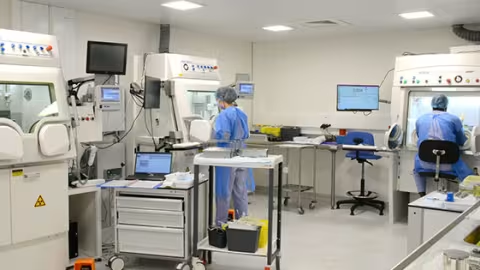
La médecine nucléaire, nouvel espoir thérapeutique dans les tumeurs cérébrales
Gustave Roussy participe à l’essai clinique LUMEN-1, qui entend évaluer l’efficacité de la radiothérapie interne vectorisée dans le traitement des méningiomes, la forme la plus courante de tumeur cérébrale chez l’adulte. Il n’existe actuellement pas de standard unique de traitement pour les patients atteints d’un méningiome en rechute après échec définitif de la chirurgie et de la radiothérapie. Cet essai représente ainsi une première en neuro-oncologie, et ouvre la voie dans le cadre de tumeurs cérébrales réfractaires.

Frequently Asked Questions
No. Some tumors are benign and others are malignant. A benign tumor can nevertheless cause significant symptoms due to its size or location. An accurate diagnosis is based on imaging and, when possible, on analysis of the tumor tissue.
Unusual and persistent headaches, a first seizure, weakness in a limb, or problems with speech, vision, balance, or behavior should be evaluated. These symptoms often have another cause, but a medical examination is necessary.
A brain MRI is the gold standard imaging test. A biopsy or surgery can then be performed to analyze the tumor. Pathological examination and molecular testing help determine the type of tumor and guide treatment decisions.
Depending on the disease, treatment may combine surgery, radiation therapy, and medication. Treatments designed to control symptoms and supportive care may also be offered. The treatment strategy is discussed during a multidisciplinary team meeting.
A primary tumor originates in the brain or its surrounding structures. A brain metastasis is formed by cells from a cancer located in another organ. The treatments and follow-up care are not the same.
Yes. A second opinion can be helpful in confirming a diagnosis, discussing a treatment strategy, or evaluating eligibility for a clinical trial. The request must be accompanied by a complete medical record, in accordance with the guidelines provided on Gustave Roussy’s dedicated platform.