The Future Research Building
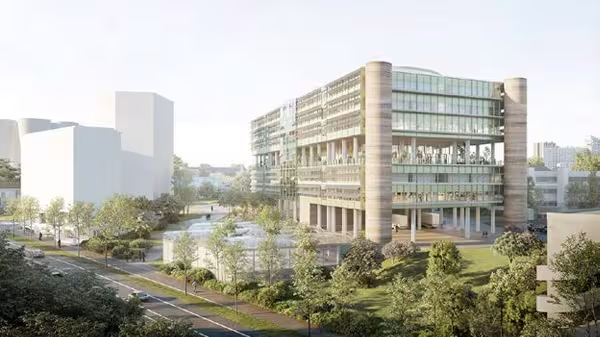
Since February 2025, Gustave Roussy has been constructing a new research building designed to foster collaboration among researchers.
30,000 m² dedicated to research
Scheduled for completion in 2028, this new building will strengthen Gustave Roussy’s research capabilities and become part of the Paris-Saclay Cancer Cluster ecosystem, Europe’s largest campus entirely dedicated to oncology. The construction of this new center reaffirms the Institute’s position as Europe’s leading cancer research center.
With a floor area of 30,000 m², up from the current 18,000 m², the future center will achieve the goal of doubling the number of research teams housed at Gustave Roussy. Designed as a functional facility, it will provide researchers and clinicians with a work environment conducive to accelerating translational research and rapidly transforming scientific discoveries into therapeutic innovations for patients.
-
30,000 m²
building area
-
6
floors and 2 basement levels
-
60
research teams
-
12
technology platforms
Two buildings to complete the project
This new research center complements another construction project for a 13,600 m² building that will house the Interception prevention program and the Instadiag rapid diagnostic pathways. It will also serve outpatients and international patients.
It will be accompanied by a third building, with a floor area of 32,000 m², which will house support and teaching functions, a lecture hall, and a multi-level parking garage.
Prof. Fabrice Barlesi
Chief Executive Officer of Gustave Roussy
“This new research facility, designed to foster innovation and scientific synergies, embodies our ambition to transform discoveries into tangible progress for patients. With the support of government authorities and our partners, we are reaffirming our position as a European leader in oncology and our determination to tackle the major challenges of the future.”

A loan from the Banque des Territoires to support the project
In 2025, Gustave Roussy secured a “green loan” of 110 M€ from the Banque des Territoires. With a 30-year term, the loan supports the financing of the future research building and supplements the €40 million in equity invested by the Institute.
The investment benefits from regional support, with four local authorities having committed to jointly guaranteeing 100% of the loan: the Val-de-Marne Department (54.5%), the Greater Paris Metropolis (27.3%), the City of Villejuif (9.1%), and the Grand Orly Seine Bièvre Regional Public Authority (9.1%).