
Welcome to the new Gustave Roussy website
A new website designed to offer you a simpler, clearer, and more intuitive experience. Patients, caregivers, healthcare professionals, and donors: find information, news, and services more easily.
Testicular Cancer
Director
Prof. Pierre Blanchard
Contact
Phone: +33 (0)1 42 11 47 99
Email

Understanding the Disease
Testicular cancer is a rare disease, but it is the most common cancer among young men, particularly those between the ages of 15 and 35. It accounts for about 1 to 2 percent of all cancers in men, with just over 2,000 new cases each year in France. Thanks to advances in treatment, the prognosis is now very favorable, with a 5-year survival rate exceeding 95%.
In the vast majority of cases, this cancer develops from germ cells, which are responsible for sperm production. These are referred to as germ cell tumors, which account for more than 90% of testicular cancers.
There are two main types of germ cell tumors: seminomas, which generally progress more slowly and often occur at a slightly older age, and nonseminomatous tumors, which tend to grow more rapidly and affect younger men.
Testicular cancer occurs when a cell undergoes abnormalities and begins to multiply uncontrollably. This proliferation forms a tumor within the testicle, which can then spread to other parts of the body if left untreated.
In most cases, the disease is discovered following the appearance of a mass or lump in the testicle—often painless—detected by the patient himself or during a clinical examination.
What are the testicles?
The testicles are two organs of the male reproductive system located in a pouch of skin called the scrotum. They play an essential role in reproduction and the functioning of the male body.
Their primary function is twofold. First, they produce sperm, which are necessary for reproduction. Second, they secrete testosterone, the male hormone that plays a key role in the development of secondary sexual characteristics (voice, body hair, muscle mass).
These organs become active at puberty and function continuously throughout life. Their location outside the body helps maintain a slightly lower temperature, which is essential for sperm production.
Testicular Cancer by the Numbers
-
2,300
new cases each year in France.
-
85%
Men who have been diagnosed are between the ages of 15 and 49.
-
1st
Cancer in men between the ages of 15 and 35.
A type of cancer that responds well to treatment
Testicular cancer is one of the most curable cancers, with a cure rate of over 90% across all stages. It is one of the few cancers that can be cured even when it has metastasized. This exceptional responsiveness to treatment is due to the nature of the cells that form the tumor: germ cells. These reproductive cells have a high potential for differentiation and retain a very immature cellular program. This immaturity makes them particularly sensitive to chemotherapy.
Nevertheless, early diagnosis remains a major challenge: the earlier the tumor is detected, the less intensive the treatment will be, with fewer side effects. For this reason, it is essential that men aged 15 to 40 make a habit of performing monthly testicular self-exams and consult their primary care physician as soon as they detect any abnormalities.
Prevention and Risk Factors
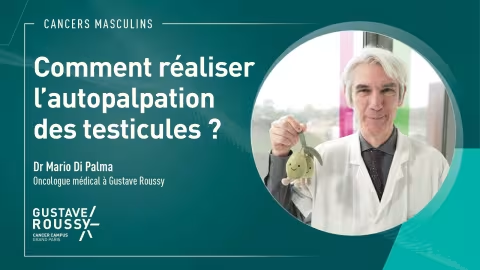
Prevention of testicular cancer relies on regular self-examination. Men, particularly those aged 15 to 35, are encouraged to perform a testicular self-exam once a month to detect any abnormalities, such as a lump or painless swelling.
Family history and cryptorchidism (undescended testicle)—even when surgery has been performed—are risk factors for testicular cancer.
This video requires a cookie from the website: youtube.com
Symptoms
Testicular cancer generally causes few clinical symptoms, which is why it is most often discovered incidentally during self-examination or a routine checkup.
While the causes of testicular tumors are not always identifiable, several risk factors that may contribute to the development of this type of cancer have been identified:
- Cryptorchidism, a congenital abnormality that affects 1 to 3% of newborn boys.
- HIV infection.
- Testicular atrophy.
- Family history.
- A history of cancer in one testicle increases the risk of developing cancer in the opposite testicle.
Furthermore, as testicular cancers have become increasingly common in recent decades, several studies are underway to shed light on the impact of exposure to certain modern chemical pollutants on the development of the disease.
Diagnosis
The diagnosis of testicular cancer begins with the detection of an abnormality during a self-exam or a medical examination. A doctor then performs a physical exam and may order a testicular ultrasound to assess the nature of the mass.
Blood tests to measure tumor markers are also commonly used. If cancer is suspected, surgery is then performed to confirm the diagnosis and determine the type and stage of the cancer.
Impact on Sexuality and Fertility
Testicular cancer generally has no impact on patients’ sexuality. In the vast majority of cases, the other testicle is healthy, ensuring sufficient testosterone production to support erections and a normal sex drive. However, if sexual dysfunction occurs, the patient may be referred to a urologist and/or an andrologist.
If the other testicle is healthy, sperm production continues normally in most cases. Many men remain fertile after a unilateral orchiectomy. However, some forms of testicular cancer are associated with reduced fertility, even before surgery. Chemotherapy can also temporarily or permanently impair sperm production. It is therefore recommended to have a semen analysis and to consider sperm preservation before any surgery or additional treatment. Sperm preservation is a quick procedure and is covered by Social Security.
Treatments and Clinical Trials
Treatment for testicular cancer primarily involves surgery. In most cases, an orchiectomy is performed, which involves removing the affected testicle through an incision in the groin. This procedure is most often performed on an outpatient basis. A testicular prosthesis, made of silicone or soft gel, may be inserted during or after the procedure, depending on the patient’s preference, to preserve body image.
Before treatment begins, the patient may be advised to store a sperm sample to address any potential impact on fertility.
Depending on the stage and characteristics of the disease, additional treatments may be necessary. In cases of localized disease with a risk of recurrence, platinum-based chemotherapy may be recommended after surgery. This chemotherapy may also be used when the disease is more advanced, with or without metastases.
In some situations, chemotherapy does not completely eliminate the lesions. Further surgical intervention may then be considered, particularly to perform a lymph node dissection or remove residual masses, such as those in the lungs.
Radiation therapy may also be recommended for certain tumor subtypes.
Once treatment is complete, regular follow-up is initiated. This includes clinical examinations, an ultrasound of the remaining testicle, as well as imaging studies and tumor marker tests, the frequency of which gradually decreases over time.
Search
Research into testicular cancer continues, focusing on a therapeutic de-escalation approach to reduce the burden of current treatments while maintaining the same level of efficacy. At Gustave Roussy, the STARTER study recently began to evaluate whether tailored physical activity can reduce the side effects of chemotherapy in testicular cancer.
Contact
Chair of the Urology Committee, Prof
Pierre Blanchard
Contact
Tel.: +33 (0)1 42 11 47 99
Appointments and Second Opinions

-
Les questions à poser si l’on m’annonce un cancer du testicule
Avec un peu moins de 3 000 nouveaux cas par an en France, le cancer du testicule est une tumeur rare, qui demeure néanmoins la plus fréquente chez les hommes jeunes. Grâce aux progrès thérapeutiques, ce cancer se guérit aujourd’hui dans plus de neuf cas sur dix. La détection précoce de la maladie, appuyée par l’autopalpation testiculaire, demeure néanmoins un enjeu majeur afin de limiter les effets secondaires des traitements. À l’occasion de Novembre Masculin, la Dr Macarena Rey-Cardenas, oncologue médicale au sein du comité génito-urinaire de Gustave Roussy, fait le point.

-
Les cancers masculins
Les hommes constituent la population la plus touchée par le cancer. Environ 240 000 d’entre eux apprennent chaque année qu’ils en sont atteints, et 90 000 en décèdent. Des chiffres qui placent la maladie au premier rang des causes de décès prématurés les concernant.



Frequently Asked Questions
The main risk factor is cryptorchidism, which is when a testicle does not descend properly into the scrotum before birth. Other factors may be involved, such as a family history of the condition or a previous history of testicular cancer. In most cases, no specific cause is identified.
The most common symptom is the appearance of a lump or mass in the testicle, which is usually painless. Other symptoms may include a feeling of heaviness, pain in the testicle or lower abdomen, or a change in the size of the testicle. If you experience these symptoms, you should see a doctor.
The diagnosis is initially based on a clinical examination, often followed by a testicular ultrasound. Additional tests, such as blood tests or a CT scan, are then used to confirm the diagnosis and assess the extent of the disease.
Treatment almost always begins with surgery to remove the affected testicle. Depending on the case, this procedure may be followed by chemotherapy, radiation therapy, or additional surgical procedures. The choice of treatment depends on the type of tumor and its stage.
Yes, it is one of the most treatable forms of cancer. When detected early, the cure rate exceeds 95 percent.
Treatments can affect fertility, but this is not always the case. Sperm preservation is generally recommended before treatment begins in order to preserve the possibility of having children later on.
Yes. A single healthy testicle is generally sufficient to ensure the production of sperm and testosterone. Most men return to a normal life after treatment.