
Welcome to the new Gustave Roussy website
A new website designed to offer you a simpler, clearer, and more intuitive experience. Patients, caregivers, healthcare professionals, and donors: find information, news, and services more easily.
ENT Cancers
Director
Dr. Ingrid Breuskin
Contact: +33 (0)1 42 11 56 88

Understanding the Disease
Head and neck cancers, or ENT cancers, are malignant tumors that develop in the organs that make up the upper aerodigestive tract (UADT):
- The mouth (lips, tongue, gums, palate)
- The nasopharynx (the part of the pharynx located behind the nose)
- The oropharynx (the part of the pharynx located behind the mouth, including the tonsils and the base of the tongue)
- The hypopharynx (the lower part of the pharynx, just above the esophagus)
- The larynx (the voice box, which includes the “Adam’s apple”)
Key Figures
-
More than 15,000
New cases of ENT cancers per year in France
-
70%
About 70% of new cases occur in men, although the incidence is declining among men and rising among women, in line with trends in smoking rates
-
between the ages of 50 and 64
ENT cancers most often occur between the ages of 50 and 64
-
9 / 10
Nine out of 10 ENT cancers are squamous cell carcinomas—that is, tumors that arise from the cells lining the mucous membranes of the mouth, pharynx, or larynx
The most common ENT tumors are squamous cell carcinomas, which develop in the mucous membranes of the mouth, tonsils, pharynx, or larynx.
Their onset is sometimes preceded by a precancerous lesion. These cancers are most often linked to alcohol and tobacco use. At the same time, there has been an increase in patients who do not have a history of substance abuse and whose cancer may be caused by the human papillomavirus (HPV)—a virus also responsible for cervical cancer.
Gustave Roussy's Expertise in ENT Cancers
The multidisciplinary team at Gustave Roussy’s ENT/Head and Neck Committee has earned national and international recognition for its comprehensive care of patients with benign or malignant ENT and head and neck tumors, including diagnosis, evaluation, comprehensive treatment, rehabilitation, and follow-up.
This multidisciplinary approach is made possible by the presence within the Institute of all the specialties that work collaboratively to provide both standard and innovative care: surgery, radiation therapy, chemotherapy, medical imaging, interventional radiology, maxillofacial prosthetics laboratory, anesthesia and intensive care, and supportive care (speech therapy, pain management, nutrition, addiction treatment, and oncology psychology).
The Institute has also ranked first in Le Point magazine’s “Hospital and Clinic Rankings” for several years in the ENT Cancer specialty.
Risk Factors
In the vast majority of cases, ENT cancers are linked to specific behaviors, which makes them partially preventable diseases.
Smoking remains the leading cause: it is implicated in approximately 85 percent of cancers of the upper aerodigestive tract.
Alcohol consumption is the second major risk factor. When combined, tobacco and alcohol do not simply add up; their effects are multiplied.
This sexually transmitted infection, which is now widespread, is reshaping the epidemiological landscape of these cancers. In France, approximately 1,200 HPV-related oropharyngeal cancers (tonsils and base of the tongue) are diagnosed each year, with a sharp and concerning increase in incidence in Western countries.
Cancers de l’oropharynx & papillomavirus oncogènes
Symptoms
Early detection of ENT cancers is crucial: depending on the tumor’s location, the chances of a cure can reach 80 to 90 percent when the disease is treated at an early stage, a rate that drops significantly when the disease is already advanced.
It is therefore important to watch for any unusual symptoms that may appear in the ENT area. Cancers of the upper aerodigestive tract can manifest through various signs that may seem trivial at first glance but should not be ignored if they persist. The rule to follow is “any symptom lasting three weeks.”
Thus, if you notice at least one of the following symptoms:
- A lump or swollen lymph nodes in the neck;
- Throat pain;
- A sore tongue, mouth ulcers that won’t heal, and/or white or red patches in the mouth;
- Difficulty and/or pain when swallowing;
- Unexplained pain inside the ear;
- A change in voice or persistent hoarseness;
- A stuffy nose on one side and/or nosebleeds;
If these symptoms last for more than 3 weeks, you should see your primary care physician, who will refer you to an ENT specialist for further testing if necessary.
Coverage
The multidisciplinary team of the ENT/Head and Neck Committee at Gustave Roussy has earned a reputation both nationally and internationally for the comprehensive care of patients with benign or malignant ENT and head and neck tumors, including diagnosis, evaluation, comprehensive treatment, rehabilitation, and follow-up.
It provides care for patients with tumors in the following locations:
- Oral cavity (tongue, lower jaw, floor of the mouth, cheek, palate, lips)
- Oropharynx (tonsils, soft palate, base of the tongue, vallecula)
- Larynx (vocal cords, epiglottis, ventricular bands, subglottis)
- Hypopharynx (piriform sinus, posterior wall, retrocricarytenoid region, esophageal orifice)
- Facial region (nose, nasal cavity, ethmoid, maxillary, and sphenoid sinuses, base of the skull, orbit, pterygo-maxillary and infratemporal fossae)
- Nasopharynx (cavum)
- Salivary glands (parotid, submandibular, sublingual, and accessory salivary glands)
Patient Information Booklets
Dr. Ingrid Breuskin, chair of the ENT committee at Gustave Roussy.
We are doing everything we can to see you as quickly as possible and to minimize the number of times you have to come in. You will be welcomed at the Gustave Roussy Outpatient Center and examined by a doctor who will become your primary point of contact for the treatment and follow-up of your condition. Additional diagnostic tests tailored to your situation will be ordered, including, in many cases, a pan-endoscopy under general anesthesia.

Treatments
Treatment for ENT cancer is based on a multidisciplinary decision. It is determined based on the tumor’s location, its extent (size, relationship to neighboring structures, lymph nodes, and secondary sites), and the presence of other medical conditions in the patient.
Treatments are based on surgery, radiation therapy, and chemotherapy, either alone or in combination. The goal of treatment is twofold: to control the tumor and to ensure the best possible quality of life through reconstructive plastic surgery and the implementation of an organ-preservation protocol (for example, to avoid a total laryngectomy).
Surgery is frequently used to treat ENT cancers. It is generally reserved for well-defined tumors. In addition to removing the tumor and surrounding tissue, the surgeon also removes the affected lymph nodes. Surgery has made enormous strides, and today it is often possible to perform tumor removal and the replacement of the excised tissue with tissue harvested from nearby areas or further away (flaps) in a single procedure.
The ENT team at Gustave Roussy has earned an international reputation in reconstructive surgery and surgery for head and neck sarcomas. The ENT committee also offers, for certain tumors, the option of robot-assisted transoral surgery using the Da Vinci Xi, a state-of-the-art surgical robot:
The combination of radiation therapy and chemotherapy is often used after surgery, but in some cases it can also help avoid disfiguring surgery or treat tumors that cannot be removed immediately. The decision is made during a Multidisciplinary Team Meeting based on the extent and location of the tumor. Gustave Roussy’s state-of-the-art radiation therapy facilities allow patients to benefit from the most innovative techniques with the highest level of safety.
Chemotherapy uses increasingly effective drugs. It can be used before surgery or radiation therapy to shrink the tumor or to avoid disfiguring surgery (larynx-preserving protocol). It requires the placement of a catheter or an implantable port to administer infusions without having to insert needles into the veins in the arms. Chemotherapy can also be used in conjunction with radiation therapy. There are many different administration regimens, which will be explained to you in detail. New treatments known as “targeted therapies,” which are less toxic and easier to administer, are also being used more and more frequently. Finally, when “traditional” drugs are no longer effective or are too toxic, you may be eligible to receive new drugs as part of clinical trials conducted at Gustave Roussy.
The purpose of follow-up care is to detect any potential relapses early and to treat any potential side effects of treatment. It consists of regular clinical and radiological examinations. Quitting smoking and alcohol is essential: continuing to use them increases the risk of developing a second cancer. Specialized addiction treatment may be offered.
Spotlight on: the Multidisciplinary Coordination Meeting (RCP)
Your treatment will be discussed at a Multidisciplinary Team (MDT) meeting, which brings together medical oncologists, surgeons, and radiation oncologists. If you wish, and/or if it is deemed helpful, you may be asked to attend this meeting. During this MDT meeting and/or during an extended consultation with your referring physician to discuss your diagnosis, your condition will be explained to you, and a treatment plan will be proposed, along with its advantages and disadvantages.
You will then be given a written document called the Personalized Care Plan (PPS). The treatment process will be explained to you, and you will be given the initial treatment dates.
Clinical Research
Find a clinical trial for ENT cancers
Gain access to the most innovative treatments by participating in a clinical trial through our research programs.

Contact
Director
Dr. Ingrid Breuskin
Contact: +33
(0)1 42 11 56 88
Reconstructive Surgery Tel.: +33 (0)1 42 11 65 36
Oncology
Tel.: +33 (0)1 42 11 46 05
Appointments and Second Opinions

Testimonial
The story of Christine, who cares for her daughter Melissa, who has head and neck cancer
Looking back, the illness allowed us to experience things differently, to savor every moment of happiness. We were fortunate enough to celebrate Melissa’s wedding, one week after her last radiation therapy session. The date had been set before the cancer diagnosis. Throughout her illness, it was this goal of the wedding that we clung to and that kept us going. Today, Melissa’s latest test results are good, and she is about to begin the reconstruction phase.

-
Cancers ORL : les symptômes qui doivent alerter
Du 30 mars au 5 avril 2026 est organisée en France la campagne Rouge-Gorge, dédiée à la sensibilisation aux cancers de la gorge. À cette occasion, Gustave Roussy se mobilise et rappelle les signaux qui doivent alerter et amener à consulter un professionnel de santé. En France, entre 15 000 et 16 000 nouveaux cas de cancers ORL sont diagnostiqués chaque année, selon les données de l’Inca. Le jeudi 2 avril, les experts du comité ORL de Gustave Roussy seront présents sur le parvis de La Défense pour sensibiliser le grand public à ces pathologies.
-
Les dernières avancées dans le traitement des cancers ORL
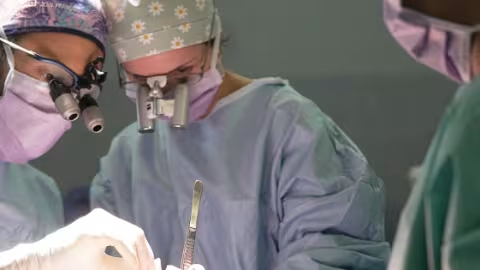
Du 15 au 20 septembre, la campagne « Make-Sense, Prendre le cancer à la gorge » se déploie sur différents canaux pour sensibiliser aux cancers ORL, qui touchent chaque année 15 000 nouveaux patients en France. À cette occasion, la Dr Ingrid Breuskin, chirurgienne et cheffe du comité ORL de Gustave Roussy, et la Dr Caroline Even, oncologue médicale, font le point sur les dernières avancées dans la prise en charge de ces pathologies. Gustave Roussy est un expert reconnu dans la prise en charge de ces cancers, comme en témoignent différents classements.
-
Throat cancer and HPV: better understanding for better protection
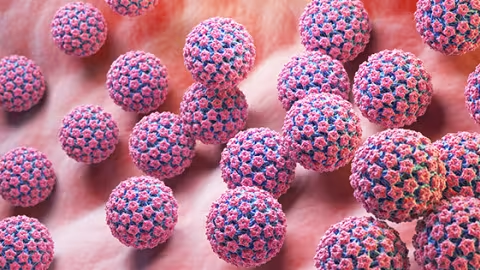
On World Human Papillomavirus (HPV) Awareness Day, Gustave Roussy is drawing attention to oropharyngeal cancers – throat cancers affecting the tonsils, soft palate, base of the tongue, and the back of the throat. In many cases, the cause is the human papillomavirus (HPV), a virus transmitted mainly through sexual contact that affects both men and women.


Frequently Asked Questions
Yes, a large proportion of ENT cancers are linked to tobacco and alcohol. Quitting smoking remains the most effective preventive measure.
Any ENT symptoms that have persisted for more than three weeks (sore throat, difficulty swallowing, hoarseness, swollen glands in the neck, mouth sores) should be evaluated by a doctor.
As a national center of excellence for several rare ENT tumors, Gustave Roussy brings together all the expertise needed for the diagnosis, treatment, reconstruction, and follow-up care of patients. The Institute has also ranked first in Le Point magazine’s “Hospital and Clinic Rankings” for several years in the ENT Cancer specialty.