Welcome to the new Gustave Roussy website
A new website designed to offer you a simpler, clearer, and more intuitive experience. Patients, caregivers, healthcare professionals, and donors: find information, news, and services more easily.
Throat cancer and HPV: better understanding for better protection
On World Human Papillomavirus (HPV) Awareness Day, Gustave Roussy is drawing attention to oropharyngeal cancers – throat cancers affecting the tonsils, soft palate, base of the tongue, and the back of the throat. In many cases, the cause is the human papillomavirus (HPV), a virus transmitted mainly through sexual contact that affects both men and women.
Published on
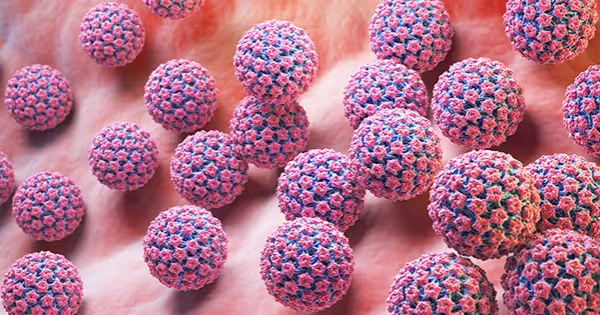
On World Human Papillomavirus (HPV) Awareness Day, Gustave Roussy is drawing attention to oropharyngeal cancers – throat cancers affecting the tonsils, soft palate, base of the tongue, and the back of the throat. In many cases, the cause is the human papillomavirus (HPV), a virus transmitted mainly through sexual contact that affects both men and women.
An extremely common virus
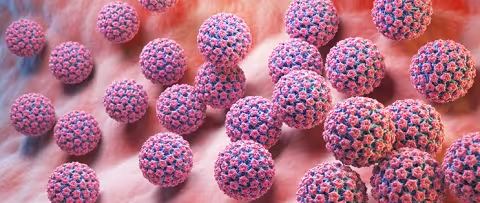
Human papillomaviruses, known as HPV, are extremely common viruses with more than 200 subtypes. They can be transmitted through skin-to-skin contact, infecting the skin, or through sexual contact, infecting the mucous membranes of the anal, genital, and oral regions. It is estimated that around 70% to 80% of sexually active men and women will be exposed to HPV at some point in their lives. Most of these infections are harmless, but some forms are oncogenic. This means that infection may be followed, several years later, by the development of cancer.
Nearly 100% of cervical cancers are attributable to HPV infection. These viruses are also responsible for cancers in the ear, nose, and throat (ENT) region, mainly affecting the throat, as well as cancers of the vagina, vulva, anus, and penis.
Also transmitted orally
Oral HPV infection can be contracted through oral–genital sexual contact. The virus is transmitted from an infected area to uninfected oral mucosa, for example, through microscopic tears invisible to the naked eye. It is a common infection: studies have shown that at a given time, around 10% of men and 4% of women have an oropharyngeal HPV infection.
Most oral or genital infections are transient and are cleared by the immune system. Only a minority persist and may, in some cases, progress to a cancerous lesion – a process that takes several years.
Specific types of cancer
In France, around 1,200 HPV-related oropharyngeal cancers are diagnosed each year. More broadly, HPV infections are responsible for approximately 6,300 cancers annually, across all anatomical sites combined. HPV-associated ENT cancers predominantly affect men, who account for around three out of four cases[1].
HPV-induced ENT cancers differ from those caused by tobacco and alcohol, the two main risk factors for these types of tumours. HPV-related cancers characteristically develop primarily in the oropharynx – that is, the throat – more specifically on the tonsils and the base of the tongue. The affected population is generally younger and has little or no history of smoking.
HPV-induced tumours, however, respond better to treatment, resulting in an improved prognosis for patients.
An effective preventive vaccine
There is a safe and effective vaccine to protect against HPV infections. In France, the vaccine in use protects against nine different types of HPV, including those most frequently responsible for cancer. Vaccination can therefore prevent up to 90% of HPV infections that may lead to cancer.
To optimise its effectiveness, vaccination should take place before the onset of sexual activity in girls and boys, that is, before any possible exposure to papillomaviruses. However, catch-up vaccination is available up to the age of 26.
In France, HPV vaccination is recommended:
- For all girls and boys aged 11 to 14, with two doses administered five months apart. Vaccination is offered free of charge in secondary schools to pupils in Years 8 and 9, subject to parental consent.
- As a catch-up programme for all girls and boys aged 15 to 26 inclusive, in which case three doses are required.
To arrange vaccination, you can seek advice from your GP, pharmacist, midwife, nurse, or a municipal or departmental vaccination service.
An HPV Group at Gustave Roussy
In 2022, Gustave Roussy established an “HPV Group” to promote multidisciplinary care and research into HPV-induced cancers. The group brings together gynaecologists, proctologists, dermatologists, ENT specialists, oncologists, surgeons, virologists, pathologists, public health physicians, and researchers, with the ambition of developing a clinical and translational research programme focused on all HPV-induced cancers.
Its objective is both to improve access to therapeutic innovation and to foster multidisciplinary care and research at the time of diagnosis and treatment, as well as in prevention and screening.
[1] Badoual C. et al. Les cancers des voies aérodigestives supérieures induits par une infection par Papillomavirus humain : spécificités épidémiologiques, diagnostiques, pronostiques et thérapeutiques. Bull Acad Natl Med. 2022. doi:10.1016/j.banm.2022.10.019
Last news
-
Breast Cancer: Gustave Roussy Ranked No. 1 in France for Breast Surgery and Breast Reconstruction
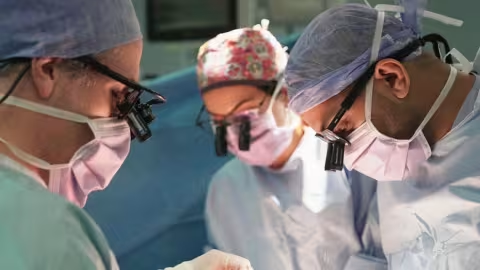
On the occasion of Breast Cancer Awareness Month, the 2025 data from Visuchir, the national surgical activity monitoring tool of the French Health Insurance system, places Gustave Roussy in first position for both breast surgery and breast reconstruction. Beyond this ranking, these figures highlight that reconstruction is now an integral part of breast cancer treatment. It is considered at every stage of care: from tumor removal surgery, whether lumpectomy or mastectomy, through to the post-cancer period, helping to restore the body and support women in regaining their physical integrity and quality of life.
-
Newsweek Ranking: Gustave Roussy Named Europe’s Leading Cancer Centre and Third Best Worldwide
The 2027 edition of Newsweek’s World's Best Specialized Hospitals ranking once again recognises Gustave Roussy as the leading cancer centre in France and Europe, and the third best worldwide. This distinction highlights the excellence of the Institute’s care and research, as well as the daily commitment of all its professionals.

-
Living with and beyond cancer: the promises and challenges of digital health
In a Viewpoint article published in The Lancet Digital Health, Drs Ines Vaz-Luis and Maria Alice Franzoi, together with Emmanuel Mussault, a patient partner at the PRISM University Hospital Institute, examine the role that digital tools can play in supporting people living with and beyond cancer. Their central message is that these technologies can support more personalised and accessible care, but their value depends primarily on how they are integrated into care pathways, the human support provided, their ability to address individual needs and their evaluation in real-world settings.
-
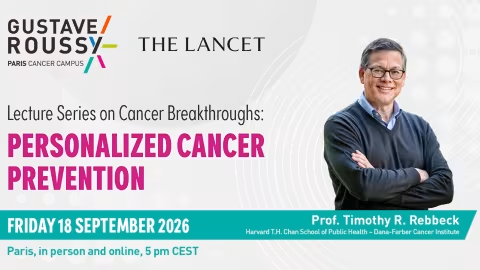
Gustave Roussy and The Lancet launch an international lecture series on innovations transforming cancer care
The inaugural lecture in the “Lecture Series on Cancer Breakthroughs” will take place on Friday 18 September at 5:00 pm. It will be delivered by Professor Timothy R. Rebbeck, a leading cancer prevention specialist at Harvard University and the Dana-Farber Cancer Institute.