Welcome to the new Gustave Roussy website
A new website designed to offer you a simpler, clearer, and more intuitive experience. Patients, caregivers, healthcare professionals, and donors: find information, news, and services more easily.
Mens November: Take care of your jewelry its precious!
November is the month dedicated to raising awareness and promoting prevention of male cancers, which include prostate, testicular, and penile cancers. The goal is to raise public awareness of these diseases—which account for approximately 63,000 new cases in France each year—and to encourage men to perform testicular self-exams, a simple step that can help detect a lump, the nature of which must then be determined through further medical examinations. Gustave Roussy has extensive expertise in the treatment of male cancers, particularly through its Genitourinary Oncology Committee, which is deeply involved in research on these diseases.
Published on

Designed to break down taboos surrounding cancers affecting men, the “Take Care of Your Jewelry. It’s Precious” campaign is back to raise public awareness of this cause throughout the month of November.
This year, the focus is on the available treatments as well as Gustave Roussy’s expertise in managing these diseases.
This campaign also provides an opportunity to share the stories of men affected by these diseases and to highlight their journeys in coping with the illness.
Focus – Cancers in Men: What Are We Talking About?
Male cancers include tumors of the prostate, testicles, and penis. According to figures from the National Cancer Institute (INCa), there are approximately 63,000 new cases each year in France, the vast majority of which (60,000) are prostate cancers.
- Prostate cancers originate in the prostate gland, located below the bladder. In the vast majority of cases, they occur in men over the age of 50. These tumors generally have a favorable prognosis, although aggressive forms of the disease are possible.
- Testicular cancer is the most common cancer among young men (ages 15–35), with just over 2,000 cases diagnosed each year in France. The majority of cases are associated with germ cells, which give rise to sperm.
- Penile cancers are rare. They account for 400 to 500 new cases annually in France. They can develop in various parts of the penis, arising from skin cells or underlying tissues.
A New Rapid Diagnostic Process at Gustave Roussy
The Institute recently launched a rapid diagnostic program for male cancers, which takes place every Tuesday. It is intended for:
- Men with suspected testicular cancer.
- Men diagnosed with localized prostate cancer.
This program consists of three steps:
For testicular cancer, a blood test measuring markers specific to this condition is first performed, followed by an ultrasound and a CT scan. Patients then see a medical oncologist and, if necessary, a urologic surgeon.
For localized prostate cancers, the care pathway also begins with a blood test and marker levels, supplemented by a CT scan of the prostate if necessary. Patients then consult with a radiation oncologist and a urological surgeon.
All cases are then discussed in the afternoon during a multidisciplinary team meeting to determine the most appropriate treatment strategy for each patient.
This video requires a cookie from the website: youtube.com
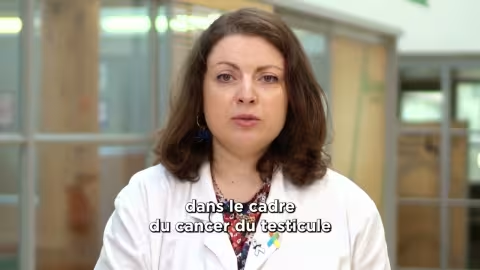
What is hormone therapy?
Hormone therapy is a treatment indicated for prostate cancer. These cancers are hormone-sensitive: testosterone, the primary male hormone, causes the cancer to grow. Hormone therapy aims to lower testosterone levels or block its effect on cancer cells. This treatment can be administered via injection, orally, or by combining these two methods.
Hormone therapy is an extremely effective treatment for prostate cancer. However, it has a variety of side effects, ranging from fatigue to bone weakness or cardiovascular problems.
“It is essential to assess these side effects and manage them throughout the course of treatment. Gustave Roussy has therefore established a dedicated transition day: this allows us to provide comprehensive care for patients, addressing all of their side effects, with a focus on one key aspect: adapted physical activity,” emphasizes Prof. Pierre Blanchard, head of the Genitourinary Oncology Committee at Gustave Roussy.
This video requires a cookie from the website: youtube.com
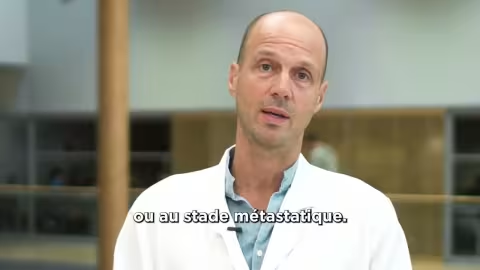
Radiation therapy or surgery?
For localized prostate cancer, two treatment options may be offered to patients.
- Surgery (prostatectomy), which aims to remove the patient’s entire prostate.
- Radiation therapy, which uses high-energy rays to target the prostate and destroy cancer cells.
These two options have the same success rate, but their side effects differ. To make the most informed treatment decision, men for whom both of these treatment options have been recommended can seek a second opinion from the experts at Gustave Roussy.
This video requires a cookie from the website: youtube.com
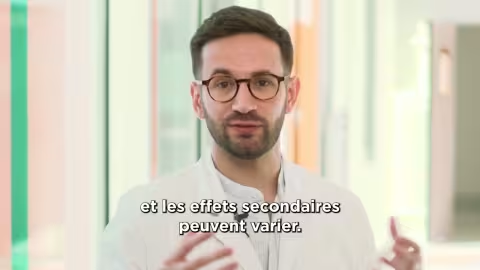
Benoît's Story: His Experience with Testicular Cancer Treatment
“My name is Benoît, and I’m 67 years old. My general practitioner diagnosed me with testicular cancer the month I turned 60. When I arrived at Gustave Roussy, my tumor was the size of a grapefruit. Very quickly, I was told that I needed surgery to remove the affected testicle. (…) I never believed, not for a single second, that this was the end. I always believed I would recover. And Gustave Roussy made that possible for me.”
Watch Benoît’s full story in this video
This video requires a cookie from the website: youtube.com
Last news
-
Nuclear medicine: DART, a pioneering platform for the development of alpha therapy
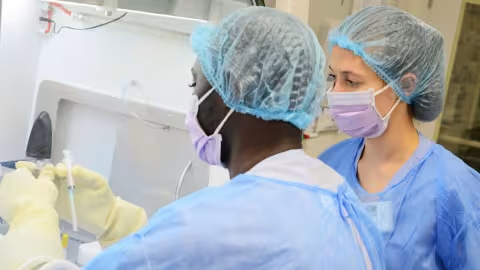
Developed through a partnership between Gustave Roussy and the Paris-Saclay Cancer Cluster, the DART project aims to provide industry partners with a centre of excellence spanning preclinical, clinical and translational research to support the development of alpha therapy. This innovative nuclear medicine approach can destroy cancer cells more powerfully than standard approaches while reducing damage to surrounding healthy cells.
-
Gustave Roussy at the ESMO 2026 Congress
The European Society for Medical Oncology (ESMO) is holding its annual congress from 23 to 27 October in Madrid, Spain. This major international event provides oncologists and researchers from around the world with an opportunity to present the latest findings from clinical studies aimed at improving cancer care and deepening our understanding of the disease. Once again, this year, physicians and researchers from Gustave Roussy have contributed to several dozen studies that will be presented during the five-day congress.
-
5 questions with Dr François-Xavier Danlos about therapeutic cancer vaccines
Therapeutic cancer vaccines are making significant progress in clinical development. The ESMO Congress, which begins on 23 October, will provide an opportunity to learn about new data on a therapeutic vaccine against melanoma. However, there are major differences between vaccines traditionally used to prevent disease and therapeutic cancer vaccines. Dr François-Xavier Danlos, a medical oncologist in Gustave Roussy’s Drug Development Department and a specialist in immunotherapy development, explains.
-
ADCs: Two Landmark Publications in Cancer Cell and Nature Medicine Showcase Gustave Roussy's Expertise
In less than two months, researchers and clinicians from Gustave Roussy have contributed to two major publications on Antibody-Drug Conjugates (ADCs) in Cancer Cell and Nature Medicine. Together, these papers provide both a comprehensive overview of current knowledge and a strategic vision to accelerate the development of the next generation of these innovative therapies.