Welcome to the new Gustave Roussy website
A new website designed to offer you a simpler, clearer, and more intuitive experience. Patients, caregivers, healthcare professionals, and donors: find information, news, and services more easily.
Nuclear medicine: DART, a pioneering platform for the development of alpha therapy
Developed through a partnership between Gustave Roussy and the Paris-Saclay Cancer Cluster, the DART project aims to provide industry partners with a centre of excellence spanning preclinical, clinical and translational research to support the development of alpha therapy. This innovative nuclear medicine approach can destroy cancer cells more powerfully than standard approaches while reducing damage to surrounding healthy cells.
Published on
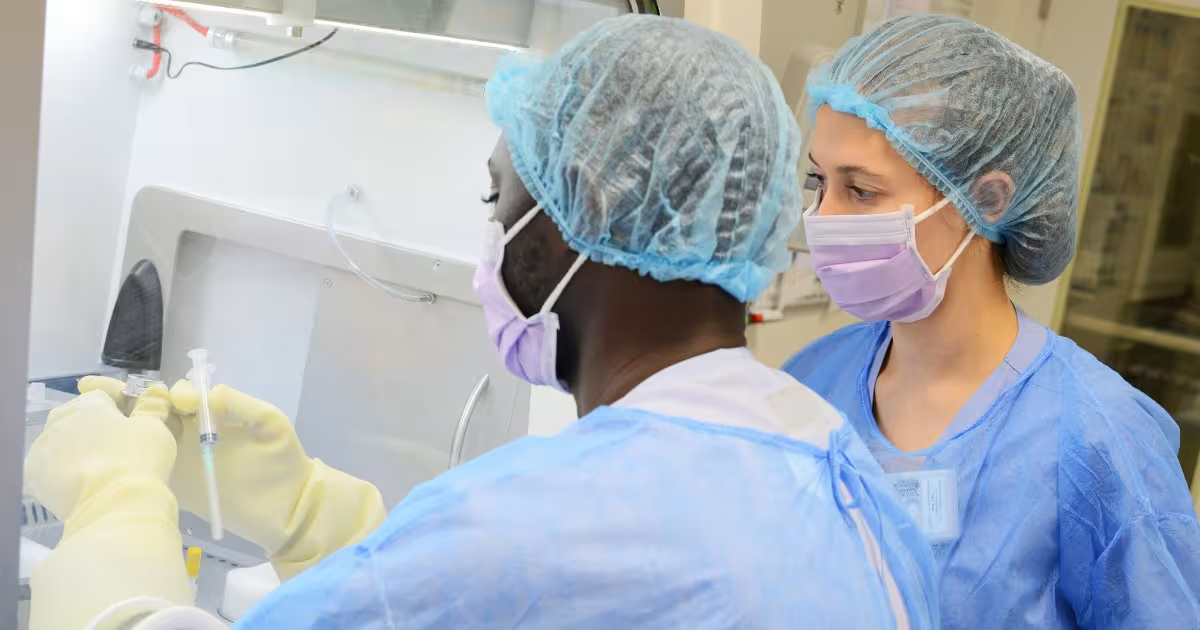
Targeted radionuclide therapy (TRT) is a nuclear medicine treatment. It involves administering radiopharmaceuticals to patients: radioligands.
These radioligands consist of:
- A radioactive isotope, either a beta or alpha emitter, capable of emitting radiation that destroys cancer cells.
- A vector or ligand, a molecule that recognises a target. This is often a receptor overexpressed by cancer cells or one with a specific affinity for the organ being targeted.
Once injected into the patient, the radioligand travels to, binds to and accumulates at its target. The isotope emits radiation that damages the DNA of cancer cells and destroys them. This targeted technique reduces damage to healthy tissue and is generally better tolerated by patients than chemotherapy.
At present, most radioligands with marketing authorisation use beta emitters, such as lutetium-177. However, beta particles travel several millimetres through tissue and deposit relatively little energy, which limits their effectiveness.
Beta-emitting radioligands therefore struggle to eradicate micrometastases and more aggressive tumours, often resulting in partial and short-lived treatment responses, with complete response rates below 15%.
An exceptionally powerful therapeutic approach: alpha therapy
In this context, alpha therapy represents a major therapeutic breakthrough.
Thanks to their very high linear energy transfer and a range of only a few dozen micrometres, alpha-emitting radioligands cause direct, lethal damage to tumour-cell DNA. They therefore offer unique potential for treating resistant tumours, tumours with highly aggressive biology and microscopic disease. Whereas some forms of radiation spread their energy over several millimetres, alpha particles act across a distance equivalent to only a few cells.
Despite the therapeutic promise of this innovative class of medicines, the development of alpha therapy is currently held back by a major structural barrier: the absence in Europe of integrated infrastructure covering the entire preclinical, clinical and translational continuum, while bringing together expertise in radiopharmacy, advanced dosimetry, radiobiology, radiation protection and access to patients.
A centre of excellence
The DART project at Gustave Roussy, led by Professors Désirée Deandreis and Éric Deutsch, is being conducted in collaboration with the Paris-Saclay Cancer Cluster (PSCC). Its aim is to provide industry partners with a preclinical, clinical, and translational centre of excellence designed to fast-track the development of alpha-emitting radioligands. It is built around three pillars:
- A certified preclinical infrastructure for proof-of-concept studies, specifically designed and equipped to conduct preclinical research with alpha-emitting radioisotopes in advanced mouse models, including syngeneic models and patient-derived xenografts (PDX). This infrastructure will combine regulatory compliance with access to Gustave Roussy’s unique expertise in immunology, DNA repair, omics and advanced dosimetry.
- An outstanding clinical facility dedicated to phase 0, I, II and III clinical trials, with substantial patient recruitment capacity at Europe’s leading cancer centre. The facility will include an extension of Gustave Roussy’s pharmacokinetics laboratory and radiopharmacy, together with a small-scale radiolabelling unit enabling radiopharmaceuticals to be labelled on site and clinical trials to begin more rapidly.
- An advanced translational research programme supported by an infrastructure integrating multimodal imaging, advanced dosimetry, artificial intelligence and molecular profiling. Its pioneering ambition is to develop integrated dosimetry at three levels, covering the tumour, healthy organs and the immune system, in order to elucidate the mechanisms of action, resistance and toxicity of alpha therapy alongside immune and molecular profiling of the patient and tumour tissue.
“DART is Europe’s first integrated ‘bench-to-bedside’ platform dedicated to alpha therapy. It has been designed to accelerate the development of this new treatment modality, from the preclinical stage through to clinical trials. It will also develop advanced dosimetry tools using artificial intelligence to personalise and optimise treatment,” explain Professor Désirée Deandreis, nuclear medicine physician and Deputy Head of Gustave Roussy’s Department of Imaging, and Professor Éric Deutsch, radiation oncologist and Medical Director of Gustave Roussy. “With DART, France and Europe will finally have a platform capable of turning alpha therapy into an accessible clinical reality by shortening the time between discovery and therapeutic application. Backed by an industrial ecosystem that is already mobilised, this public-private model positions Gustave Roussy and the PSCC as two key players in the future of oncology, where innovation translates directly into benefits for patients,” they conclude.
Last news
-
Gustave Roussy at the ESMO 2026 Congress
The European Society for Medical Oncology (ESMO) is holding its annual congress from 23 to 27 October in Madrid, Spain. This major international event provides oncologists and researchers from around the world with an opportunity to present the latest findings from clinical studies aimed at improving cancer care and deepening our understanding of the disease. Once again, this year, physicians and researchers from Gustave Roussy have contributed to several dozen studies that will be presented during the five-day congress.
-
5 questions with Dr François-Xavier Danlos about therapeutic cancer vaccines
Therapeutic cancer vaccines are making significant progress in clinical development. The ESMO Congress, which begins on 23 October, will provide an opportunity to learn about new data on a therapeutic vaccine against melanoma. However, there are major differences between vaccines traditionally used to prevent disease and therapeutic cancer vaccines. Dr François-Xavier Danlos, a medical oncologist in Gustave Roussy’s Drug Development Department and a specialist in immunotherapy development, explains.
-
ADCs: Two Landmark Publications in Cancer Cell and Nature Medicine Showcase Gustave Roussy's Expertise
In less than two months, researchers and clinicians from Gustave Roussy have contributed to two major publications on Antibody-Drug Conjugates (ADCs) in Cancer Cell and Nature Medicine. Together, these papers provide both a comprehensive overview of current knowledge and a strategic vision to accelerate the development of the next generation of these innovative therapies.
-
Drug shortages: Gustave Roussy becomes the only Cancer Centre in France authorised to produce Special Hospital Preparations
The Clinical Pharmacy Department at Gustave Roussy has been authorised by the French Ministry of Health to manufacture Special Hospital Preparations (SHPs). Granted for a period of seven years, this accreditation enables the Institute’s hospital pharmacy to produce certain medicines in coordination with the French National Agency for the Safety of Medicines and Health Products (ANSM) and the Ministry of Health. Gustave Roussy is the only French Comprehensive Cancer Centre (CLCC) authorised to manufacture Special Hospital Preparations, alongside ten university hospitals.