Welcome to the new Gustave Roussy website
A new website designed to offer you a simpler, clearer, and more intuitive experience. Patients, caregivers, healthcare professionals, and donors: find information, news, and services more easily.
INTERCEPTION: The national pilot program for personalized cancer prevention among individuals at increased risk of cancer enters its operational phase with the enrollment of the first patients
The Interception program has reached a new milestone with the enrollment of its first patients as part of the national Article 51 pilot program. Rolled out over four years across seven healthcare facilities, this pilot program is designed to evaluate an innovative model for personalized cancer prevention and screening.
On

Developed and launched at the Gustave Roussy Cancer Center (CLCC) Gustave Roussy in 2021—under the operational leadership of Unicancer and the scientific leadership of Gustave Roussy, led by Dr. Suzette Delaloge—the Interception program is now the subject of a national Article 51 pilot study. Its rollout is based on a multi-partner initiative involving the National Federation of French Mutual Insurance Companies (FNMF), the Patients en réseau association, and numerous community stakeholders (CPTS, URPS, DAC, MSP, and health centers).
It aims to identify individuals at increased risk of cancer as early as possible in order to offer them personalized prevention and improve their care, within the framework of enhanced city-hospital collaboration, in a context where nearly 40% of cancers occur in people who could have been identified as having an increased risk during the previous five to ten years.
The pilot program will be implemented over four years in seven healthcare facilities across the country:
- Gustave Roussy, in Villejuif
- Léon Bérard Center, in Lyon
- Eugène Marquis Center, in Rennes
- Sainte-Catherine – Avignon-Provence Cancer Institute
- Polyclinique du Parc (Elsan Group), in Saint-Saulve
- Reunion Island University Hospital, in Saint-Pierre
- Bergonié Institute, in Bordeaux
In total, 6,440 patients are expected to benefit from this new care pathway as part of the pilot program.
According to Sophie Beaupère, Executive Director of Unicancer, “With the inclusion of the first patients, Interception is now scaling up and taking a decisive step forward. Our goal is to demonstrate that it is possible to organize early identification of high-risk individuals across different regions and to develop a personalized prevention pathway that fully integrates community and hospital care. The challenge now is to establish the conditions for its long-term sustainability and broader implementation.”
The first patients are joining the Interception program
The pilot program is now entering its operational phase with the first patient enrollments during the “Interception” event held on Thursday, October 15, at Gustave Roussy, as part of a program focused on pancreatic cancer risk.
“Since Gustave Roussy launched the personalized prevention program in 2021, more than 3,500 people have participated in Interception across all pathways. Today we are taking an important step forward with the enrollment of the first patients under Article 51. This pilot program aims to identify at-risk individuals earlier throughout France by integrating the entire care pathway—from initial consultations with referring physicians to follow-up care and the implementation of community-based prevention initiatives—into the program’s scope. ” explains Dr. Olivier Caron, who has led the Interception program at Gustave Roussy since Dr. Delaloge stepped down as head of INCa.
The care pathway proposed as part of the Interception pilot program includes several steps:
-
Identification of high-risk individuals by a healthcare professional using the Scorisk online questionnaire, followed by referral to an Interception center if there is a high risk of cancer;
-
An “Interception Day,” designed to increase participants’ understanding of their risk, provide personalized prevention and screening measures, as well as individual consultations, assessments, specialized tests, and group workshops;
-
The development of a Personalized Prevention Plan (PPP) outlining screening and risk-reduction measures tailored to each individual;
-
Long-term support, including digital monitoring, assistance with behavioral change, and the option to participate in addiction or nutrition programs;
-
Early intervention in the event of suspected or diagnosed cancer.
Eligible patients may be referred to one of the eight care pathways offered as part of the pilot program:
- Breast cancer (genetic risk FAR G)
- Breast cancer (non-genetic risk: FAR F/FAR A)
- Lung cancer
- Colon cancer (Lynch syndrome)
- Non-genetic colon cancer
- Childhood exposure to chemotherapy or radiation therapy
- Pancreatic cancer
- Prostate cancer
Assess the conditions for large-scale implementation and funding
The implementation of this pilot program will make it possible to evaluate, on a national scale, the benefits of a personalized cancer prevention pathway, as well as the organizational and economic conditions necessary for its long-term sustainability.
The pilot program relies in particular on the implementation of a special funding mechanism, consisting of specific lump-sum payments to encourage healthcare professionals to identify and refer at-risk individuals, as well as to enable the provision of support and follow-up services following the “Interception” day.
Learn more
https://www.unicancer.fr/fr/espace-patients/interception/
https://www.gustaveroussy.fr/cancer-prevention/prevention-diagnostic/interception
-
Islami F, Marlow EC, Thomson B, McCullough ML, Rumgay H, Gapstur SM, Patel AV, Soerjomataram I, Jemal A. Proportion and number of cancer cases and deaths attributable to potentially modifiable risk factors in the United States, 2019. CA Cancer J Clin. 2024 Sep–Oct;74(5):405–432. doi: 10.3322/caac.21858. Epub 2024 Jul 11. PMID: 38990124. Rebbeck TR, Burns-White K, Chan AT, Emmons K, Freedman M, Hunter DJ, Kraft P, Laden F, Mucci L, Parmigiani G, Schrag D, Syngal S, Tamimi RM, Viswanath K, Yurgelun MB, Garber JE. Precision Prevention and Early Detection of Cancer: Fundamental Principles. Cancer Discov. July 2018;8(7):803-811. doi: 10.1158/2159-8290.CD-17-1415. Epub 2018 Jun 15. PMID: 29907587.
Press contact
If you are a journalist and have a question, please contact:
Claire Parisel or Léona Pinto
Tel. +33 1 42 11 50 59
Tel. +33 1 42 11 63 59
Mob. +33 6 17 66 00 26
Email
The Media Team cannot respond to patient inquiries.
Last press releases
-
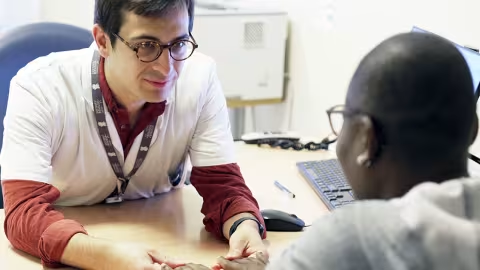
After a breast cancer diagnosis, how can treatment be started more quickly?
Gustave Roussy is launching a new care pathway designed to accelerate the management of women recently diagnosed with breast cancer. It brings together, in a single day, the radiology examinations, blood tests, and oncology consultation required to initiate treatment. This new pathway complements the Institute’s rapid breast care offering. The InstaDiag Breast pathway already consolidates all diagnostic examinations into a single day to establish a diagnosis.
-
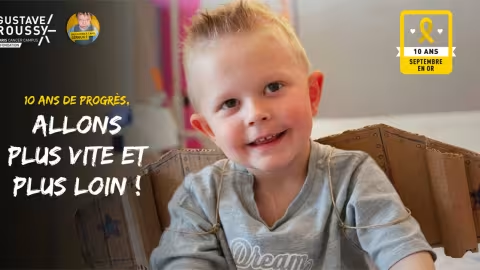
Gold september: two new research programmes launched to tackle childhood cancers
Two of Gustave Roussy’s four new medical and scientific programmes are dedicated to childhood cancers. The first, DECRIPT, aims to improve understanding of the role played by genetics in the development of certain childhood cancers, as well as second cancers that may occur in adulthood. The second, INSPIRE, will draw on the knowledge and techniques already developed at the Institute to create organoids, with the aim of deciphering the mechanisms underlying metastasis and resistance to treatment.
-
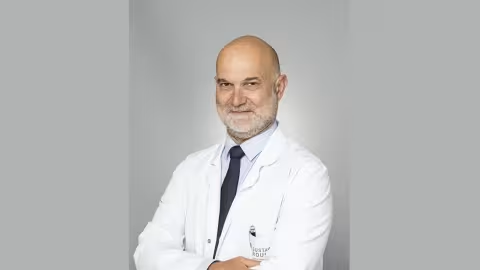
Prof. Fabrice Barlesi reappointed at the head of Gustave Roussy, the leading cancer center in France and Europe
By order of Ms. Stéphanie Rist, Minister of Health, Families, Autonomy and Persons with Disabilities, dated 27 July 2026, Professor Fabrice Barlesi has been reappointed as Director General of Gustave Roussy, effective 1 August 2026. At the helm of the Institute for five more years, Prof. Barlesi will continue the transformations undertaken during his first term. This renewal reflects the confidence placed in the project led by the institution to accelerate progress in the fight against cancer, foster and support the development of innovations set to change the future of oncology, and strengthen the influence of one of the world's leading cancer centers.
-
Route du Rhum 2026 Jean Le Cam and Christophe Rateau to sail for Gustave Roussy
For the Route du Rhum - Destination Guadeloupe 2026, Jean Le Cam and Christophe Rateau will sail under the colors of Gustave Roussy, the leading cancer center in France and Europe. Competing respectively in the Vintage and Class40 categories, the two skippers will carry the Institute's mission to the general public, supporting cancer research and raising awareness of prevention, innovation and patient care.