Welcome to the new Gustave Roussy website
A new website designed to offer you a simpler, clearer, and more intuitive experience. Patients, caregivers, healthcare professionals, and donors: find information, news, and services more easily.
Symptoms of Lung Cancer
Lung cancer can remain asymptomatic for a long time. When symptoms do appear, they are nonspecific and may have other causes. However, a persistent or unusual cough, unusual shortness of breath, coughing up blood, or an unexplained change in overall health should prompt you to seek medical attention.

Key Takeaways
The appearance of a symptom does not necessarily mean that it is cancer. However, any unusual, persistent, or worsening symptom should be evaluated by a doctor, regardless of whether you smoke or not.
Respiratory symptoms that should raise concern
Respiratory symptoms can occur in people who smoke, have smoked, or have never smoked. In someone who already has a cough or a chronic respiratory condition, it is especially important to pay attention to any change in or worsening of their usual symptoms.
The onset of a cough, a persistent cough, or a change in a chronic cough may warrant a doctor’s visit, especially if it does not improve or is accompanied by other symptoms.
The presence of blood in sputum, known as hemoptysis, requires prompt medical attention. If the bleeding is severe or accompanied by difficulty breathing, emergency care is necessary.
The onset or worsening of shortness of breath, as well as recurrent bronchitis or pneumonia, may require further testing.
New or persistent pain in the chest or shoulder, as well as a hoarse or persistently altered voice, are among the symptoms that may prompt a visit to the doctor.
General symptoms that are sometimes associated with it
Lung cancer can also cause an unexplained decline in overall health. Several symptoms may be associated with it:
- unusual and persistent fatigue;
- loss of appetite or unintentional weight loss;
- difficulty swallowing;
- a persistent fever or symptoms that do not go away despite appropriate treatment;
- more rarely, swelling of the face, neck, or eyelids.
Smoker or nonsmoker: the same signs deserve attention
Smoking is the leading risk factor for lung cancer, but the disease can also occur in people who have never smoked. Persistent symptoms should therefore be evaluated in all cases.
When should you see a doctor?
It is recommended that you see a doctor if you experience an unusual symptom that persists, recurs, or worsens. The healthcare professional will assess the situation and determine whether tests—including chest imaging—are necessary.
In the event of heavy coughing up of blood or sudden difficulty breathing
Contact emergency services immediately. These symptoms can have several causes and require prompt medical evaluation.
Coordinated Care at the CICT
Gustave Roussy, Marie-Lannelongue Hospital, and Paris Saint-Joseph Hospital are pooling their expertise within the International Center for Thoracic Cancers. The InstaDiag pathway makes it possible to quickly arrange the necessary tests when lung cancer or another thoracic tumor is suspected.
Lung Cancer: What Are the Warning Signs?
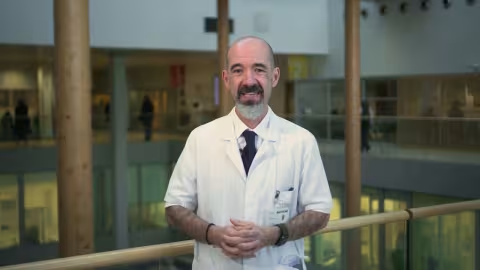
Professor David Planchard, a thoracic oncologist and head of the Thoracic Pathology Committee at Gustave Roussy, explains in a video the symptoms that should not be ignored.