Welcome to the new Gustave Roussy website
A new website designed to offer you a simpler, clearer, and more intuitive experience. Patients, caregivers, healthcare professionals, and donors: find information, news, and services more easily.
Treatments for Skin Cancer
The treatment of skin cancer depends on its type, stage, location, and the patient’s overall health. Melanoma, squamous cell carcinoma, basal cell carcinoma, and Merkel cell carcinoma require different treatment strategies. Each case is discussed in a multidisciplinary team meeting.
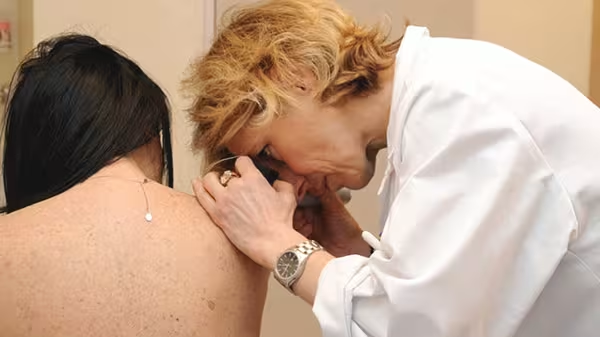
Different treatments depending on the type of cancer
Surgery remains the primary treatment for many localized skin tumors. When the disease carries a high risk of recurrence, cannot be surgically removed, or has spread, radiation therapy or drug therapy may be recommended.
Melanoma Treatment
The first step is to remove the suspicious lesion for analysis. If the diagnosis of melanoma is confirmed, a second procedure, called a wide excision, removes a margin of healthy skin around the scar. The width of this margin depends primarily on the thickness of the melanoma as measured during the histopathological analysis.
A sentinel lymph node biopsy may be recommended for certain melanomas, particularly those 0.8 mm or thicker or those that are ulcerated. This test checks for any microscopic involvement of the first lymph node along the tumor’s lymphatic pathway. A positive sentinel lymph node no longer automatically leads to a complete lymph node dissection. Close monitoring and additional treatment may be discussed depending on the stage and the risk of recurrence.
After surgery, adjuvant therapy may be recommended to reduce the risk of recurrence in certain high-risk cases. This may involve anti-PD-1 immunotherapy or, when the tumor carries a BRAF V600 mutation, a combination of anti-BRAF and anti-MEK targeted therapies.
An isolated, resectable metastasis can, in certain situations, be surgically removed. When the disease is inoperable or involves multiple metastases, treatment relies primarily on medications. Testing for a BRAF gene mutation helps guide treatment decisions.
- Immunotherapy can be administered alone or in combination with other treatments. It helps the immune system recognize and fight cancer cells.
- If the tumor has a BRAF V600 mutation, a combination of an anti-BRAF and an anti-MEK agent may be recommended. These treatments are taken orally.
- Radiation therapy may be used to treat certain metastases, particularly those in the brain or bones. Stereotactic radiation therapy may be indicated for certain brain locations.
Cutaneous Squamous Cell Carcinoma
The standard treatment is surgery, which aims to completely remove the tumor along with a margin of healthy tissue. Reconstruction may be necessary depending on the size and location of the lesion. For certain tumors, radiation therapy may be recommended after surgery or when surgery is not an option.
If lymph nodes are involved, the treatment strategy may combine surgery and radiation therapy. In locally advanced or metastatic cases that cannot be treated with curative surgery or radiation therapy, anti-PD-1 immunotherapy may be recommended. Chemotherapy is currently reserved for certain specific situations.
Basal Cell Carcinoma
Surgery is the treatment of choice in most cases. For certain superficial carcinomas, local treatments may be considered, including a cream containing imiquimod or 5-fluorouracil, or dynamic phototherapy. The choice depends on the location, size, and subtype of the lesion.
When surgery and radiation therapy are not appropriate for a locally advanced form of the disease, a treatment targeting the Hedgehog pathway, such as vismodegib, may be offered. In the event of disease progression or intolerance to this treatment, anti-PD-1 immunotherapy may be considered based on the indication. Metastatic forms, which are very rare, require specialized care.
Merkel cell carcinoma
For localized disease, treatment generally involves surgical removal of the tumor. Radiation therapy to the surgical site and, depending on the situation, to lymph node regions may be used in conjunction with surgery to reduce the risk of recurrence.
In advanced or metastatic cases, immunotherapy targeting the PD-1 or PD-L1 pathway may be recommended. Chemotherapy may still be used in certain situations, but responses to it are often less durable. Given the rarity of this tumor, the treatment strategy should be determined at a specialized center.
Join a clinical trial
Many clinical trials are open to patients with cancer. Participating in a clinical trial provides access to innovative treatments while contributing to the development of new therapies.

A decision made as a team
At Gustave Roussy, dermatologists, surgeons, pathologists, medical oncologists, radiation oncologists, and radiologists pool their expertise to provide the most appropriate treatment for each patient.