Welcome to the new Gustave Roussy website
A new website designed to offer you a simpler, clearer, and more intuitive experience. Patients, caregivers, healthcare professionals, and donors: find information, news, and services more easily.
ENT Cancers: Warning Signs to Watch For
From March 30 to April 5, 2026, France will host the “Rouge-Gorge” campaign, dedicated to raising awareness about throat cancers. To mark the occasion, Gustave Roussy is taking action and reminding the public of the warning signs that should prompt them to consult a healthcare professional. In France, between 15,000 and 16,000 new cases of ENT cancers are diagnosed each year, according to data from the INCA. On Thursday, April 2, experts from the Gustave Roussy ENT committee will be on the plaza at La Défense to raise public awareness about these conditions.
Published on
Head and neck cancers, or ENT cancers, are malignant tumors that develop in the organs that make up the upper aerodigestive tract (UADT):
- The mouth (lips, tongue, gums, palate)
- The nasopharynx (the part of the pharynx located behind the nose)
- The oropharynx (the part of the pharynx located behind the mouth, including the tonsils and the base of the tongue)
- The hypopharynx (the lower part of the pharynx, just above the esophagus)
- The larynx (the voice box, which includes the “Adam’s apple”)
Early detection of these diseases is crucial: depending on the tumor’s location, the chances of a cure can reach 80 to 90 percent when treated at an early stage—a rate that drops significantly once the disease has progressed.
It is therefore important to watch for unusual symptoms that may appear in the ENT area. Cancers of the upper aerodigestive tract can manifest through several signs that may seem trivial at first glance but should not be ignored if they persist. The rule to follow is “any symptom lasting three weeks or longer.”
Thus, if you notice at least one of the following symptoms:
- A lump or swollen lymph nodes in the neck;
- Sore throat;
- A sore tongue, mouth ulcers that won’t heal, and/or white or red patches in the mouth;
- Difficulty and/or pain when swallowing;
- Unexplained pain inside the ear;
- A change in voice or persistent hoarseness;
- A stuffy nose on one side and/or nosebleeds;
If these symptoms last for more than 3 weeks, you should see your primary care physician, who will refer you to an ENT specialist for further testing if necessary.
Three risk factors, most of which are preventable
In the vast majority of cases, ENT cancers are linked to specific behaviors, making them partially preventable diseases.
- Tobacco remains the leading cause: it is implicated in approximately 85% of cancers of the upper aerodigestive tract.
- Alcohol is the second major risk factor. When combined, tobacco and alcohol do not simply add their effects—they multiply them.
- The HPV virus, a sexually transmitted infection that is now widespread, is reshaping the epidemiological landscape of these cancers. In France, approximately 1,200 HPV-related oropharyngeal cancers (tonsils and base of the tongue) are diagnosed each year, with a sharp and concerning rise in incidence across Western countries.
Prevention: Addressing Risk Factors at Any Age
The most effective prevention remains that which addresses the causes: quitting smoking and drinking in moderation, regardless of the patient’s age or health status at the time of the decision.
Regarding HPV, there is a safe and effective vaccine to protect against these viruses. In France, the vaccine used protects against nine different types of HPV, including those most commonly associated with cancer. Getting vaccinated can thus prevent up to 90% of HPV infections that can lead to cancer.
In France, HPV vaccination is recommended for all children aged 11 to 14, and as a catch-up vaccination for all girls and boys aged 15 to 26.
- For more information: vaccination.
Gustave Roussy, a center of excellence for ENT cancers
As the national reference center for rare head and neck tumors—including tumors of the skull base and salivary glands—Gustave Roussy has ranked first for several years in Le Point magazine’s ranking of hospitals and clinics for the treatment of ENT cancers.
The Institute’s ENT committee brings together a high-level multidisciplinary team: ENT and thyroid surgeons, plastic surgeons, radiation oncologists, medical oncologists, specialized dentists, pathologists, radiologists, prosthodontists, and speech-language pathologists. This convergence of expertise allows the Institute to offer each patient personalized care tailored to every stage of the disease.
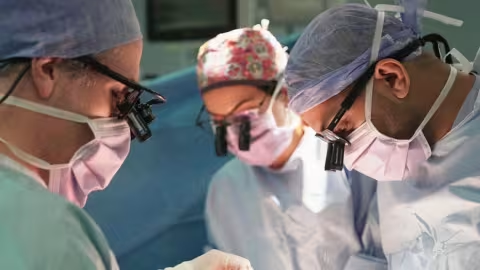
True to its commitment to excellence and innovation, Gustave Roussy develops cutting-edge minimally invasive surgical approaches, notably robot-assisted surgery, aimed at preserving patients’ organs and quality of life as much as possible. When complex reconstructive surgery is necessary, the team’s expertise helps minimize the resulting complications as much as possible. In radiation therapy, IMRT—intensity-modulated radiation therapy—is among the techniques offered. In medical oncology, targeted therapies, immunotherapies, and therapeutic vaccines are opening up new possibilities for patients with advanced-stage disease.
A week filled with numerous events
As part of the Rouge-Gorge campaign, taking place from March 30 to April 5, Gustave Roussy is organizing several events to raise public awareness of ENT cancers.
- March 31: A “Repas Tocqués” workshop featuring blended foods, for patients under the care of the ENT committee.
- April 1: A screening day will be held in the main lobby of Gustave Roussy.
- April 2: An awareness day will be held on the plaza in the La Défense district, featuring experts from the Gustave Roussy ENT committee.
Last news
-
ADCs: Two Landmark Publications in Cancer Cell and Nature Medicine Showcase Gustave Roussy's Expertise
In less than two months, researchers and clinicians from Gustave Roussy have contributed to two major publications on Antibody-Drug Conjugates (ADCs) in Cancer Cell and Nature Medicine. Together, these papers provide both a comprehensive overview of current knowledge and a strategic vision to accelerate the development of the next generation of these innovative therapies.
-
Drug shortages: Gustave Roussy becomes the only Cancer Centre in France authorised to produce Special Hospital Preparations
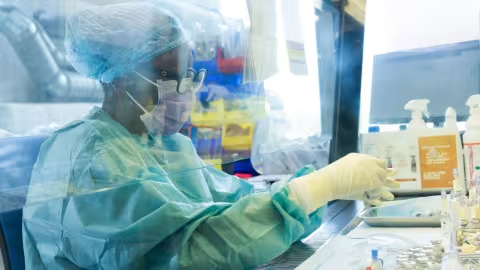
The Clinical Pharmacy Department at Gustave Roussy has been authorised by the French Ministry of Health to manufacture Special Hospital Preparations (SHPs). Granted for a period of seven years, this accreditation enables the Institute’s hospital pharmacy to produce certain medicines in coordination with the French National Agency for the Safety of Medicines and Health Products (ANSM) and the Ministry of Health. Gustave Roussy is the only French Comprehensive Cancer Centre (CLCC) authorised to manufacture Special Hospital Preparations, alongside ten university hospitals.
-
Personalising Breast Cancer Treatments: 5 Questions with Dr Barbara Pistilli
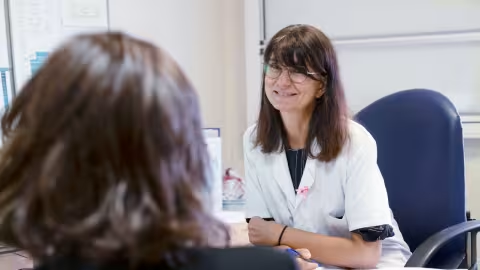
Advances in treatment and patient care mean that five-year net survival for breast cancer now reaches 88%1 in France. However, with around 60,000 new cases diagnosed each year in France alone, breast cancer remains a major public health challenge. One reason is the side effects associated with treatment. In response to this issue, Dr Barbara Pistilli, Head of the Breast Cancer Committee at Gustave Roussy, advocates an approach centred on personalised care, ensuring that each woman receives a treatment intensity tailored to her tumour and individual journey, without compromising her chances of recovery.
-
Breast Cancer: Gustave Roussy Ranked No. 1 in France for Breast Surgery and Breast Reconstruction
On the occasion of Breast Cancer Awareness Month, the 2025 data from Visuchir, the national surgical activity monitoring tool of the French Health Insurance system, places Gustave Roussy in first position for both breast surgery and breast reconstruction. Beyond this ranking, these figures highlight that reconstruction is now an integral part of breast cancer treatment. It is considered at every stage of care: from tumor removal surgery, whether lumpectomy or mastectomy, through to the post-cancer period, helping to restore the body and support women in regaining their physical integrity and quality of life.