Welcome to the new Gustave Roussy website
A new website designed to offer you a simpler, clearer, and more intuitive experience. Patients, caregivers, healthcare professionals, and donors: find information, news, and services more easily.
Personalising Breast Cancer Treatments: 5 Questions with Dr Barbara Pistilli
Advances in treatment and patient care mean that five-year net survival for breast cancer now reaches 88%1 in France. However, with around 60,000 new cases diagnosed each year in France alone, breast cancer remains a major public health challenge. One reason is the side effects associated with treatment. In response to this issue, Dr Barbara Pistilli, Head of the Breast Cancer Committee at Gustave Roussy, advocates an approach centred on personalised care, ensuring that each woman receives a treatment intensity tailored to her tumour and individual journey, without compromising her chances of recovery.
Published on

Side effects
Among women with breast cancer, treatment-related side effects are common and may persist for several years after the end of care, as shown by the VICAN52
Dr Barbara Pistilli: The side effects of breast cancer treatments should not be underestimated. They can affect patients' quality of life and their ability to return to normal life. For example, in triple-negative breast cancer, immunotherapy stimulates the immune system to help it fight the cancer more effectively. However, in a minority of patients, this treatment can also disrupt the immune system, causing it to attack healthy tissues or organs such as the thyroid gland. Similarly, one of the most common treatment-related side effects is cancer-related fatigue. Patients may experience significant physical, emotional and cognitive fatigue, which can persist long after treatment has ended. Data from the CANTO cohort show that more than one third of women treated for breast cancer still experience severe fatigue several years after diagnosis3.
What is treatment personalisation?
Dr Barbara Pistilli: Over the past several years, oncology has undergone a profound transformation. Thanks to advances in research, we now know far more about cancer biology. As a result, two patients with the same breast cancer may follow completely different treatment pathways. For one patient, surgery alone may be sufficient to treat the tumour. Another may require several courses of chemotherapy after surgery to fully treat the cancer and reduce the risk of recurrence. Treatment personalisation therefore aims to provide the right treatment intensity to the right patient. To determine patients' needs, we develop biomarkers. These are molecular signatures expressed by the tumour that help us identify which patient is likely to respond to which type of treatment.
Can you give us an example of a biomarker?
Dr Barbara Pistilli: In triple-negative breast cancer, recent studies have shown that a high density of T lymphocytes in the vicinity of the tumour is a favourable prognostic biomarker. These tumour-infiltrating lymphocytes (TILs) make the tumour "hot", meaning that the patient's immune system actively recognises and attacks the cancer. A study4 published in April 2024 showed that women who underwent surgery for localised triple-negative breast cancer had a lower risk of recurrence and higher survival rates, even without chemotherapy after surgery, when their tumours were heavily infiltrated by lymphocytes.
Focus on TILs.
This term refers to cells that are part of our immune system: T lymphocytes. In people with cancer, these lymphocytes can infiltrate a tumour and destroy cancer cells, hence the name tumour-infiltrating lymphocytes (TILs).
How can treatment personalisation be advanced further?
Dr Barbara Pistilli: To deepen our knowledge and prescribe the most appropriate treatment for each woman without compromising her chances of recovery, it is essential to conduct robust clinical trials evaluating innovative approaches. Gustave Roussy is heavily involved in this effort. For example, in the OPT-PEMBRO trial, we are investigating whether patients with triple-negative breast cancer can stop immunotherapy after surgery without reducing their chances of cure when surgery reveals no remaining viable cancer cells. Also in triple-negative breast cancer, the ETNA study seeks to determine whether chemotherapy after surgery is truly necessary for patients treated for small tumours measuring between 5 mm and 2 cm. Finally, the OPTIMA-YOUNG study aims to further personalise care for premenopausal women with hormone receptor-positive breast cancer by using a genomic test to identify which patients may safely avoid chemotherapy before surgery.
What benefits are expected?
Dr Barbara Pistilli: By advancing treatment personalisation in breast cancer and other tumour types, several benefits are anticipated. The first objective is to improve cure rates by reducing treatment in patients for whom current standards of care are not appropriate, while intensifying treatment for those at greater risk of recurrence. Personalising treatment also means shortening treatment timelines, reducing exposure to certain toxicities, and improving the quality of survivorship.
[1] Institut national du cancer (INCa). Les cancers du sein : épidémiologie et survie. Update of the 22 July 2026.
[2] Institut national du cancer (INCa), La vie cinq ans après un diagnostic de cancer, enquête VICAN5, June 2018.
[3] Vaz-Luis I, Di Meglio A, Havas J, et al. Long-Term Longitudinal Patterns of Patient-Reported Fatigue After Breast Cancer: A Group-Based Trajectory Analysis. J Clin Oncol. 2022;40(19):2148-2162.
[4] A. Leon-Fere et al., Tumor-Infiltrating Lymphocytes in Triple-Negative Breast Cancer, JAMA, 2024 ; 331 ; (13):1135-1144. doi:10.1001/jama.2024.3056
Last news
-
Breast Cancer: Gustave Roussy Ranked No. 1 in France for Breast Surgery and Breast Reconstruction
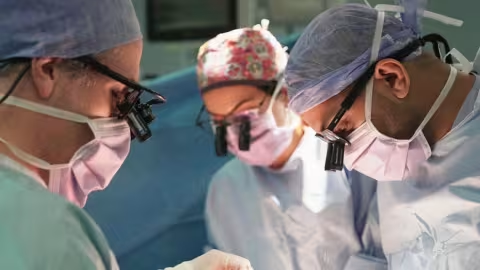
On the occasion of Breast Cancer Awareness Month, the 2025 data from Visuchir, the national surgical activity monitoring tool of the French Health Insurance system, places Gustave Roussy in first position for both breast surgery and breast reconstruction. Beyond this ranking, these figures highlight that reconstruction is now an integral part of breast cancer treatment. It is considered at every stage of care: from tumor removal surgery, whether lumpectomy or mastectomy, through to the post-cancer period, helping to restore the body and support women in regaining their physical integrity and quality of life.
-
Newsweek Ranking: Gustave Roussy Named Europe’s Leading Cancer Centre and Third Best Worldwide
The 2027 edition of Newsweek’s World's Best Specialized Hospitals ranking once again recognises Gustave Roussy as the leading cancer centre in France and Europe, and the third best worldwide. This distinction highlights the excellence of the Institute’s care and research, as well as the daily commitment of all its professionals.

-
Living with and beyond cancer: the promises and challenges of digital health
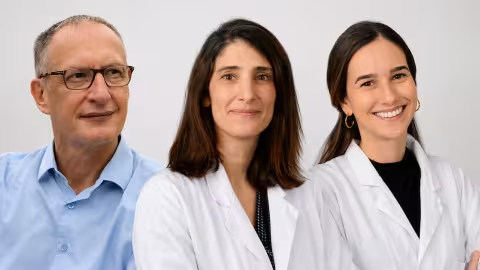
In a Viewpoint article published in The Lancet Digital Health, Drs Ines Vaz-Luis and Maria Alice Franzoi, together with Emmanuel Mussault, a patient partner at the PRISM University Hospital Institute, examine the role that digital tools can play in supporting people living with and beyond cancer. Their central message is that these technologies can support more personalised and accessible care, but their value depends primarily on how they are integrated into care pathways, the human support provided, their ability to address individual needs and their evaluation in real-world settings.
-
Gustave Roussy and The Lancet launch an international lecture series on innovations transforming cancer care
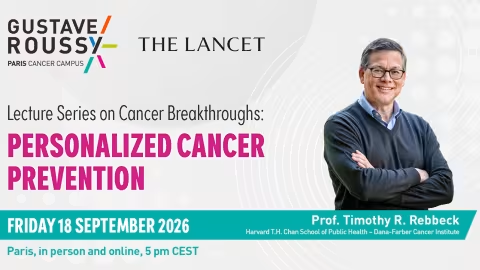
The inaugural lecture in the “Lecture Series on Cancer Breakthroughs” will take place on Friday 18 September at 5:00 pm. It will be delivered by Professor Timothy R. Rebbeck, a leading cancer prevention specialist at Harvard University and the Dana-Farber Cancer Institute.