Welcome to the new Gustave Roussy website
A new website designed to offer you a simpler, clearer, and more intuitive experience. Patients, caregivers, healthcare professionals, and donors: find information, news, and services more easily.
Living with and beyond cancer: the promises and challenges of digital health
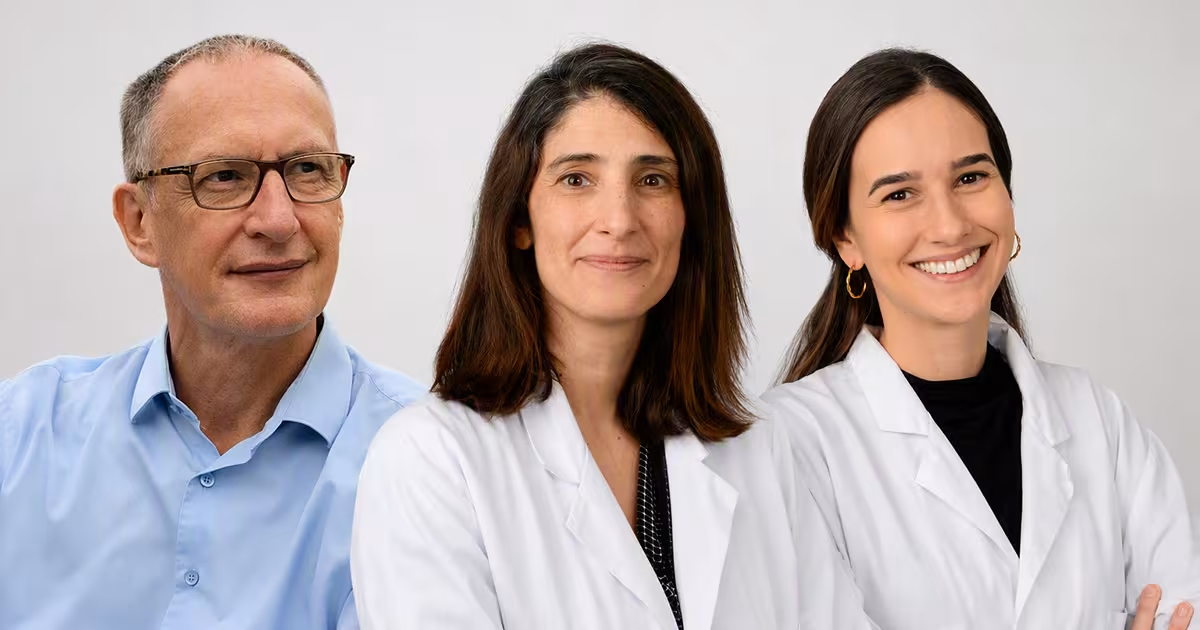
In a Viewpoint article published in The Lancet Digital Health, Drs Ines Vaz-Luis and Maria Alice Franzoi, together with Emmanuel Mussault, a patient partner at the PRISM University Hospital Institute, examine the role that digital tools can play in supporting people living with and beyond cancer. Their central message is that these technologies can support more personalised and accessible care, but their value depends primarily on how they are integrated into care pathways, the human support provided, their ability to address individual needs and their evaluation in real-world settings.
Published on
Advances in early detection and treatment have considerably improved survival among people with cancer. Nearly 50 million people worldwide are now living with or beyond cancer.
Support for this population does not, however, begin only when treatment ends. It starts at diagnosis and may cover very different situations, including active treatment, the transition period following treatment, long-term follow-up and living with advanced cancer.
Needs change over time and may relate to symptoms, quality of life, psychological health, access to information, social and professional life, or the coordination of care.
Needs that extend beyond monitoring the disease
-
In practice, follow-up care often remains focused on the hospital and on monitoring for a possible recurrence, even though a substantial proportion of the difficulties people experience arise in everyday life, outside the hospital.
-
Persistent or fluctuating symptoms, fatigue, emotional distress, difficulties returning to work, questions relating to long-term treatments and the need for referral to supportive care services may continue over time.
-
High-quality care must therefore be personalised, organised over the long term and involve, according to individual needs, oncologists, primary care doctors, nurses and supportive care professionals.
-
The aim is to help manage symptoms, the late effects of treatment, comorbidities, health behaviours and the coordination of the care pathway.
What digital technologies can offer
Digital technologies can help improve the collection and sharing of information, support the self-management of certain symptoms, facilitate access to supportive care programmes, strengthen coordination between professionals and provide resources tailored to each person’s needs.
Some digital interventions, including those addressing fatigue, insomnia, emotional distress or fear of recurrence, have produced encouraging results in clinical trials. By contrast, findings for remote monitoring or self-management tools used on their own have been more mixed during the period following the end of active treatment. Several trials have found no significant improvement in symptoms, quality of life or treatment adherence.
63,5 %.
This is the proportion of people who still experience long-term effects five years after a cancer diagnosis, according to the findings of the VICAN5 study.
The article published in The Lancet Digital Health therefore stresses that a digital tool does not automatically become effective simply because it is technically available. Its impact depends on how it is targeted, when it is offered, user engagement, its integration into healthcare teams’ working practices and the availability of resources to act when needs are identified.
Moving from standalone tools to integrated care pathways
According to the authors, the challenge is to move beyond standalone applications and develop hybrid models in which digital technologies complement care without replacing human relationships. Remote symptom monitoring, support and supportive care programmes, and referral tools can be useful when they are connected to professionals and services able to intervene when necessary.
Co-development with patients, their families, healthcare professionals and those working in real-world care settings is also essential. Tools must take account of the diversity of cancer, treatments, follow-up phases and healthcare systems, as well as different levels of health and digital literacy, to avoid increasing inequalities.
The potential of AI
Artificial intelligence could notably help to structure information from medical records, prepare personalised follow-up plans and respond to certain requests for information. However, these applications still require rigorous validation of their accuracy, safety and clinical impact, together with clear rules defining the situations in which human oversight is required.
Similarly, algorithms combining clinical, biological and patient-reported data could help identify people at risk of persistent difficulties at an earlier stage and enable supportive care to be adapted accordingly. However, their ability to improve care in routine clinical practice has yet to be demonstrated.
Finally, large-scale implementation will require several highly practical issues to be addressed, including interoperability with medical records, professional training, the organisation of healthcare teams, funding, the long-term sustainability of digital solutions, data protection and the evaluation of their impact across diverse populations.
A change in perspective
The Viewpoint presented in The Lancet Digital Health does not suggest that digital technology alone can meet the needs of people living with and beyond cancer. Instead, it calls for a shift from a technology-centred approach to one centred on care pathways: starting with people’s needs, designing tools with their users, integrating them into existing care and assessing not only their effectiveness, but also how they are implemented in real-world settings.
Source : Maria Alice Franzoi, Emmanuel Mussault, Ines Vaz-Luis. « Digitally enabled patient-centred survivorship care: from hype to implementation-aware impact ». The Lancet Digital Health, 2026. doi:10.1016/j.landig.2026.101071. Read the publication
Last news
-
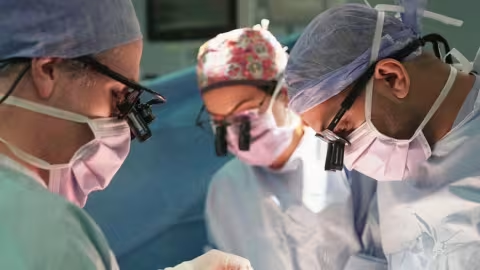
Breast Cancer: Gustave Roussy Ranked No. 1 in France for Breast Surgery and Breast Reconstruction
On the occasion of Breast Cancer Awareness Month, the 2025 data from Visuchir, the national surgical activity monitoring tool of the French Health Insurance system, places Gustave Roussy in first position for both breast surgery and breast reconstruction. Beyond this ranking, these figures highlight that reconstruction is now an integral part of breast cancer treatment. It is considered at every stage of care: from tumor removal surgery, whether lumpectomy or mastectomy, through to the post-cancer period, helping to restore the body and support women in regaining their physical integrity and quality of life.
-
Newsweek Ranking: Gustave Roussy Named Europe’s Leading Cancer Centre and Third Best Worldwide
The 2027 edition of Newsweek’s World's Best Specialized Hospitals ranking once again recognises Gustave Roussy as the leading cancer centre in France and Europe, and the third best worldwide. This distinction highlights the excellence of the Institute’s care and research, as well as the daily commitment of all its professionals.

-
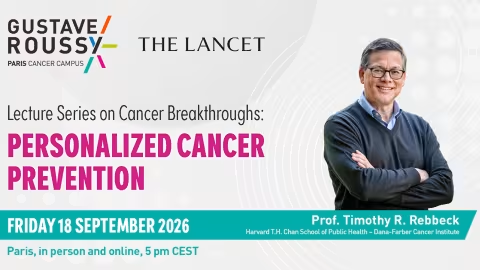
Gustave Roussy and The Lancet launch an international lecture series on innovations transforming cancer care
The inaugural lecture in the “Lecture Series on Cancer Breakthroughs” will take place on Friday 18 September at 5:00 pm. It will be delivered by Professor Timothy R. Rebbeck, a leading cancer prevention specialist at Harvard University and the Dana-Farber Cancer Institute.
-
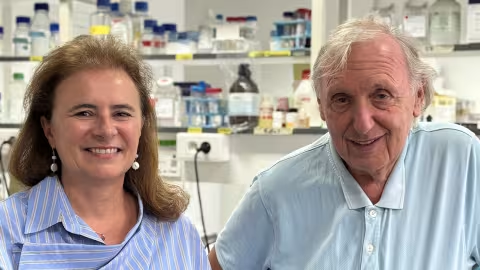
A landmark review on myeloproliferative neoplasms published in the New England Journal of Medicine
Researcher Isabelle Plo and Dr William Vainchenker, a haematologist and researcher at Gustave Roussy, have co-authored a landmark review on myeloproliferative neoplasms (MPNs), published in the New England Journal of Medicine on 19 August. The article summarises major advances in understanding these blood cancers and highlights therapeutic prospects that could transform their management in the years ahead.