Welcome to the new Gustave Roussy website
A new website designed to offer you a simpler, clearer, and more intuitive experience. Patients, caregivers, healthcare professionals, and donors: find information, news, and services more easily.
The Latest Advances in the Treatment of ENT Cancers
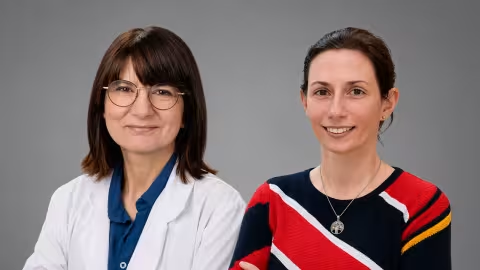
From September 15 to 20, the “Make-Sense: Tackling Cancer Head-On” campaign is being rolled out across various channels to raise awareness about ENT cancers, which affect 15,000 new patients in France each year. To mark the occasion, Dr. Ingrid Breuskin, a surgeon and head of the ENT committee at Gustave Roussy, and Dr. Caroline Even, a medical oncologist, provide an update on the latest advances in the treatment of these diseases. Gustave Roussy is a recognized expert in the treatment of these cancers, as evidenced by various rankings.
Published on
Changed on
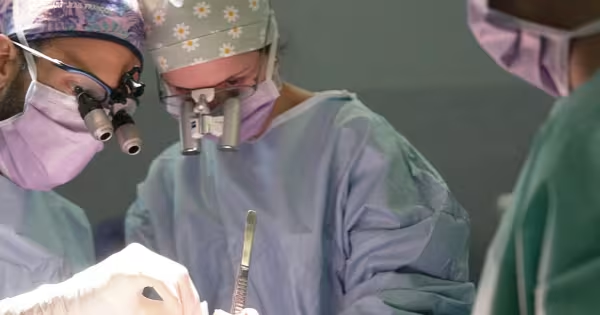
Research in ENT oncology is accelerating significantly. From new approaches to immunotherapy, robotic surgery, proton therapy, and therapeutic vaccines, numerous innovations are opening up concrete prospects for patients.
Immunotherapy: A Revolution in Surgery
Immunotherapy, which activates the immune system to more effectively destroy tumor cells, has shown significant efficacy in ENT cancers, particularly when used in conjunction with surgery. Two large-scale international studies, to which Gustave Roussy contributed, have recently confirmed its benefits and established new global standards of care:
- NIVOPOSTOP: Coordinated in France by Dr. Yungan Tao, this study demonstrates that administering immunotherapy (nivolumab) after surgery, in addition to standard treatments, reduces the risk of recurrence in patients with high-risk ENT squamous cell carcinoma.
- KEYNOTE-689: Published in the New England Journal of Medicine, this study shows that adding immunotherapy (pembrolizumab) before and after surgery significantly improves relapse-free survival in patients with locally advanced head and neck cancers. This approach has already been approved by the U.S. FDA.
Surgery: Robotics, Precision, and Reconstruction
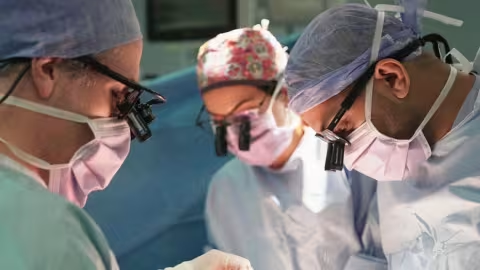
Gustave Roussy is the leading center in France for ENT oncological surgery and reconstruction, according to data from the Visuchir ranking by the French National Health Insurance and Le Point magazine. Between 150 and 200 complex head and neck surgeries are performed each year at the Institute, with a high level of expertise recognized both nationally and internationally.
- Robotics: Thanks to the Da Vinci SP surgical robot, now in use at Gustave Roussy, surgeons can remove certain tumors located deep within the throat (oropharynx, larynx) by accessing them directly through the mouth. This approach, which is less invasive than traditional surgery, is already yielding encouraging results in preserving voice and swallowing function.
- Dental Reconstruction and Rehabilitation: Using digital tools for customized planning and fabrication (surgical guides, prostheses, implants), the teams now aim to restore the patient’s teeth immediately after surgery.
- In the operating room, the injection of fluorescent dyes allows surgeons to better visualize blood flow in the tissues. This improves the precision of surgical maneuvers and enhances the safety of reconstructive procedures, such as free flap grafts.
Radiation Therapy: The Rise of Proton Therapy and Future Technologies
- Unlike conventional radiation therapy, which uses X-rays (photons), proton therapy allows the dose to be concentrated on the tumor, with a sharp drop in radiation intensity beyond the targeted area. This better spares surrounding healthy tissue (brain, salivary glands, spinal cord). Commonly used in the United States, this technique is expected to gradually find its place in the treatment of certain complex ENT cancers (sinuses, nasopharynx, skull base) and in oropharyngeal cancers associated with the human papillomavirus if access to it is made easier.
- Another area of experimental research is FLASH radiation therapy, which delivers very high doses of radiation in a very short time. Gustave Roussy was the first hospital in France to acquire the FLASHKNiFE device and plans to evaluate FLASHDEEP for treating deep-seated tumors starting in 2026. Clinical trials will determine whether this approach is beneficial for certain ENT tumors.
Monitoring and Diagnosis: Toward Precision Medicine
- InstaDiag ENT: This new rapid diagnostic pathway will soon be available at Gustave Roussy. It will allow all the tests necessary for a diagnosis (specialist consultation, imaging, biopsy) and preliminary treatment recommendations to be completed within a few days. This is a way to reduce wait times and limit the medical odyssey faced by patients who have already been diagnosed with an ENT abnormality in their local community.
- Circulating DNA: Certain blood tests can detect circulating DNA from the human papillomavirus (HPV), which is implicated in some ENT tumors, potentially allowing for the early detection of a possible relapse before symptoms appear. A clinical trial is currently underway at Gustave Roussy to confirm the effectiveness of this personalized monitoring.
Therapeutic vaccines and bispecific antibodies
Two very promising approaches are currently in clinical development:
- Personalized vaccines: By targeting markers specific to each tumor, experimental vaccines (Transgene, BioNTech, ISA Pharma) aim to “re-train” the patient’s immune system. They offer hope but still require large-scale trials.
- Bispecific antibodies: These target two proteins at once, such as EGFR and other tumor markers, and appear to enhance the effectiveness of immunotherapy. One of them (petosemtamab) has been granted accelerated status by the FDA, and a Phase III trial has just begun, with active participation from Gustave Roussy.
Last news
-
ADCs: Two Landmark Publications in Cancer Cell and Nature Medicine Showcase Gustave Roussy's Expertise
In less than two months, researchers and clinicians from Gustave Roussy have contributed to two major publications on Antibody-Drug Conjugates (ADCs) in Cancer Cell and Nature Medicine. Together, these papers provide both a comprehensive overview of current knowledge and a strategic vision to accelerate the development of the next generation of these innovative therapies.
-
Drug shortages: Gustave Roussy becomes the only Cancer Centre in France authorised to produce Special Hospital Preparations
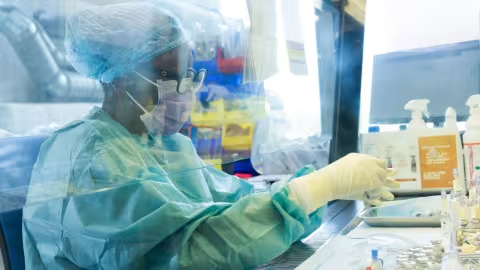
The Clinical Pharmacy Department at Gustave Roussy has been authorised by the French Ministry of Health to manufacture Special Hospital Preparations (SHPs). Granted for a period of seven years, this accreditation enables the Institute’s hospital pharmacy to produce certain medicines in coordination with the French National Agency for the Safety of Medicines and Health Products (ANSM) and the Ministry of Health. Gustave Roussy is the only French Comprehensive Cancer Centre (CLCC) authorised to manufacture Special Hospital Preparations, alongside ten university hospitals.
-
Personalising Breast Cancer Treatments: 5 Questions with Dr Barbara Pistilli
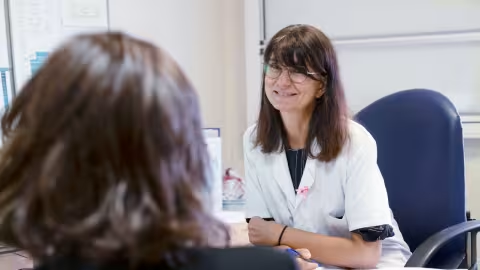
Advances in treatment and patient care mean that five-year net survival for breast cancer now reaches 88%1 in France. However, with around 60,000 new cases diagnosed each year in France alone, breast cancer remains a major public health challenge. One reason is the side effects associated with treatment. In response to this issue, Dr Barbara Pistilli, Head of the Breast Cancer Committee at Gustave Roussy, advocates an approach centred on personalised care, ensuring that each woman receives a treatment intensity tailored to her tumour and individual journey, without compromising her chances of recovery.
-
Breast Cancer: Gustave Roussy Ranked No. 1 in France for Breast Surgery and Breast Reconstruction
On the occasion of Breast Cancer Awareness Month, the 2025 data from Visuchir, the national surgical activity monitoring tool of the French Health Insurance system, places Gustave Roussy in first position for both breast surgery and breast reconstruction. Beyond this ranking, these figures highlight that reconstruction is now an integral part of breast cancer treatment. It is considered at every stage of care: from tumor removal surgery, whether lumpectomy or mastectomy, through to the post-cancer period, helping to restore the body and support women in regaining their physical integrity and quality of life.