
Welcome to the new Gustave Roussy website
A new website designed to offer you a simpler, clearer, and more intuitive experience. Patients, caregivers, healthcare professionals, and donors: find information, news, and services more easily.
Brachytherapy
Brachytherapy is a form of internal radiation therapy that involves temporarily placing a radioactive source in contact with or inside the tumor. This approach allows a high dose of radiation to be delivered precisely to the area to be treated while minimizing radiation exposure to surrounding tissues and organs.
Director
: Dr. Elaine Limkin
Contact
: Tel.: +33 (0)1 42 11 33 65 or 45 66
Key Figures
-
Nearly 500
adult patients treated each year at Gustave Roussy
-
10 to 15
children served each year
-
Center of Expertise
One of the few centers in the world specializing in pediatric brachytherapy
What is brachytherapy?
Brachytherapy is a radiation therapy technique that involves placing a radioactive source directly inside the tumor or in contact with it. Unlike external beam radiation therapy, the radiation is delivered from inside the body, as close as possible to the area to be treated.
Brachytherapy
Brachytherapy is a form of radiation therapy in which the radioactive source is placed directly inside the body to treat the tumor with a high degree of precision.
In what cases might brachytherapy be recommended?
Uterovaginal brachytherapy is a form of internal radiation therapy that delivers a high dose of radiation directly to the tumor while sparing neighboring organs as much as possible.
It is primarily used to treat cancers of the cervix, vagina, and endometrium. It may be recommended to reduce tumor size before surgery, or as an adjunct to chemoradiation therapy to optimize disease control.
For inoperable cervical cancers, it is an essential step in treatment and allows for the delivery of a dose that external beam radiation therapy alone could not provide.
Two techniques are currently offered at Gustave Roussy:
- Permanent brachytherapy, which involves placing small radioactive seeds directly into the prostate under general anesthesia.
- High-dose-rate brachytherapy, which involves temporarily inserting catheters into the prostate to deliver high-intensity radiation using an iridium-192 source. This technique is generally combined with external beam radiation therapy.
Brachytherapy can be used to treat certain localized cancers of the lip, tongue, nose, or skin. Thanks to its high precision, it allows treatment to be focused on the affected area while minimizing radiation exposure to surrounding healthy tissue.
→ More information on ENT/head and neck
cancers → More information on skin
cancers
Brachytherapy is also used to treat certain rare childhood tumors, including:
- genitourinary rhabdomyosarcomas;
- certain ENT cancers;
- certain limb sarcomas.
Gustave Roussy is one of the few specialized centers in the world to offer this technique in pediatrics. It often makes it possible to avoid major surgery and limit the long-term effects of external radiation therapy in very young children.
Key Takeaways
Depending on the type of cancer and the patient's condition, brachytherapy may be used alone or in combination with other treatments, including surgery, external beam radiation therapy, or chemotherapy.
What are the benefits of this technique?
Brachytherapy is a treatment aimed at preserving organs and functions. Its goal is to effectively treat cancer while preserving the organs and their functions as much as possible. Thanks to its high precision, it helps minimize treatment-related side effects and, in certain situations, can serve as an alternative to more invasive surgery.
It may therefore be offered as an alternative to certain surgeries when those procedures are likely to have significant functional consequences.
Why is brachytherapy so precise?
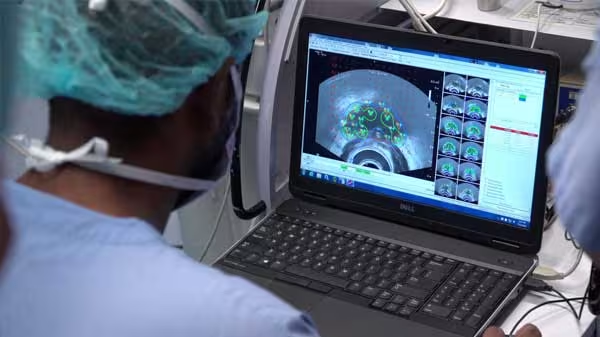
Advances in medical imaging—particularly CT scans and 3D MRI—now make it possible to precisely identify the areas to be treated. These images help medical teams position the applicators or catheters as close as possible to the tumor and tailor the dose delivered to each patient. This precision helps preserve nearby tissues and organs as much as possible.
The Various Techniques of Brachytherapy
The sources are placed in direct contact with the tumor to be irradiated, taking advantage of natural cavities that serve as receptacles for the radioactive material and its delivery systems. The most common form of intracavitary brachytherapy is uterovaginal brachytherapy for cervical cancer. There are also indications for endoesophageal brachytherapy.
The sources are implanted inside the tumor, such as in a tumor of the tongue, lip, or prostate. Large cervical cancers also usually require interstitial brachytherapy to deliver sufficient doses to the residual tumor after external beam radiation therapy.
The radiation is administered in repeated sessions lasting a few minutes each (between 2 and 10 times), at a rate of one to two sessions per day. This type of treatment can be administered on an outpatient basis or may require hospitalization, depending on the clinical situation and whether or not general anesthesia is needed to implant the non-radioactive delivery device.
A technique that delivers the total dose in hourly pulses lasting 5 to 45 minutes, 24 hours a day. This technique is used particularly in pediatrics.
In the treatment of prostate tumors using ultra-low-dose-rate therapy, iodine-125 seeds are implanted under anesthesia and left in the body permanently.
Please note
When hospitalization is necessary (ranging from a few days to a week), it takes place in the Indre-et-Loire ward on the 3rd floor in a private, isolated room.
What side effects might occur?
Like any treatment, brachytherapy can cause side effects. These vary depending on the tumor’s location, the volume treated, the dose administered, and any accompanying treatments. The medical team will keep you informed and support you throughout your care.
Urinary, rectal, or sexual problems may sometimes occur as a result of treatment.
In the field of otolaryngology, mucosal reactions sometimes persist for a few weeks after treatment ends.
Brachytherapy administered at the skin surface may cause redness and local or inflammatory reactions during or after treatment.
Treatment for gynecologic cancer may lead to pelvic complications, particularly vaginal ones. These complications are monitored by specialists.
Rare expertise in pediatric brachytherapy
Gustave Roussy is one of the few specialized centers in the world to offer brachytherapy for certain rare pediatric tumors, including genitourinary rhabdomyosarcomas and certain ENT cancers. This approach often makes it possible to avoid major surgery and limit the long-term effects of external beam radiation therapy in children.