Welcome to the new Gustave Roussy website
A new website designed to offer you a simpler, clearer, and more intuitive experience. Patients, caregivers, healthcare professionals, and donors: find information, news, and services more easily.
OncoLum
The OncoLum Center at Gustave Roussy offers an innovative approach to supportive care based on photobiomodulation (PBM), a noninvasive technique that uses red and near-infrared light to prevent or alleviate certain side effects associated with cancer treatments. This care aims to improve patients’ comfort, quality of life, and ability to continue their treatments under the best possible conditions.
Director
Dr. Camelia Billard-Sandu
Contact
+33 (0)1 42 11 54 51 / +33 (0)1 42 11 45 45
Innovative Technology for Patients
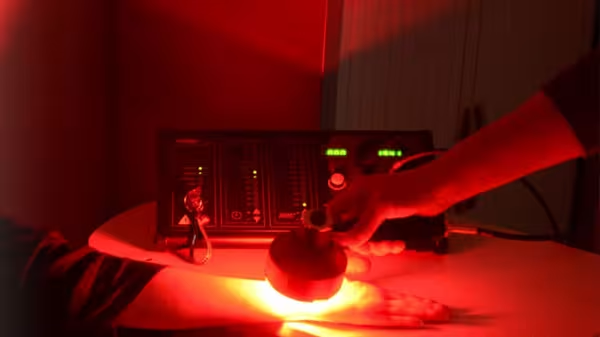
Photobiomodulation uses LED or laser light sources that emit red or near-infrared light. Without generating heat or damaging tissue, this light acts at the cellular level to promote natural repair mechanisms and reduce certain complications associated with cancer treatments.
At Gustave Roussy, photobiomodulation is offered as a complementary supportive therapy that may be provided at various stages of the treatment journey, upon a doctor’s prescription and within the framework of validated protocols.
Key Takeaways
Photobiomodulation does not treat cancer itself. It aims to prevent or alleviate certain side effects of cancer treatments in order to improve patients' comfort and quality of life.
In what situations might photobiomodulation be recommended?
Photobiomodulation is particularly recognized for the prevention of mucositis, a painful inflammation of the mouth that can occur during ENT radiation therapy or certain intensive chemotherapy regimens. This indication is among the recommendations recognized by the ESMO.
It can be used to prevent or reduce skin reactions associated with radiation therapy, particularly in patients being treated for breast cancer.
Some patients may experience xerostomia (dry mouth) or dysphagia (difficulty swallowing) after their treatments. Photobiomodulation is one of the approaches being evaluated to alleviate these symptoms.
The technique is also used or studied for chronic pain, post-radial fibrosis, trismus, peripheral neuropathies, lymphedema, and certain treatment-related bone complications.
What happens during a session?
Treatment is provided based on a doctor’s prescription and following a clinical evaluation. The team tailors the type of device, treatment parameters, and protocol to the specific condition being treated and the desired outcomes.
Before each session, the professionals assess the symptoms and the progression of the clinical condition to evaluate the treatment’s effectiveness. Depending on the indications, medical photographs or follow-up questionnaires may be used.
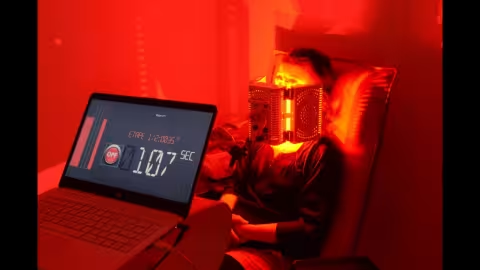
Sessions generally last between 5 and 20 minutes. A minimum schedule of two sessions per week may be recommended for several weeks. Protective eyewear must be worn at all times during treatment.
Supervised and Safe Care
Photobiomodulation is part of a rigorous medical approach based on validated protocols and the expertise of specially trained teams.
The OncoLum certification guarantees:
- Optimal quality of photobiomodulation care.
- Membership in a network of expert centers in France.
Certified centers meet the following criteria, among others:
- A CE-certified medical photobiomodulation facility.
- A dedicated practice with specific treatment time slots.
- Medical and paramedical professionals trained through the University Diploma or the Photobiomodulation Seminar.
- A structured approach to working with health authorities to ensure a safe practice environment.
Trained and specialized teams
The professionals conducting the sessions ensure that only validated protocols are followed to guarantee patient safety and the use of photobiomodulation based on available scientific data.
For any additional information: oncolum@gustaveroussy.fr