

Welcome to the new Gustave Roussy website
A new website designed to offer you a simpler, clearer, and more intuitive experience. Patients, caregivers, healthcare professionals, and donors: find information, news, and services more easily.
PRISM: Second-Generation Precision Medicine for Cancer
PRISM: Second-Generation Precision Medicine for Cancer
This video requires a cookie from the website: youtube.com
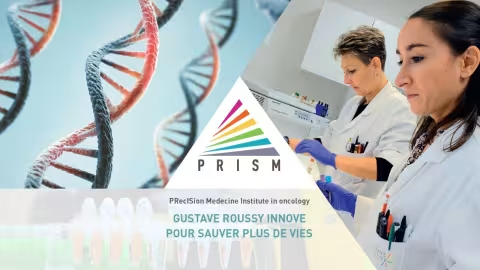
Today, 60% of adults and 80% of children are cured of cancer, but these cure rates drop significantly when the disease is detected at an advanced stage.
The challenge of the new precision medicine is to identify cancer earlier and predict the risk of developing highly aggressive forms—without waiting for relapses—in order to offer the most effective treatment from the moment of diagnosis.
Launched in 2019 and coordinated by Professor Fabrice André, Director of Research at Gustave Roussy, PRISM aims to model the molecular, biological, and immunological mechanisms involved in the onset and development of cancer using artificial intelligence.
Using a wide range of patient data (clinical, genomic, microbiological, imaging, etc.), machine learning algorithms will enable the development of more precise diagnostic and prognostic tools, thereby allowing for personalized therapies tailored to the characteristics of each patient’s tumor.
PRISM: 4 Innovations
| Multidimensional molecular and biological analyses (DNA, RNA, proteins, individual cells, and microenvironment) |
The use of artificial intelligence to organize and interpret data |
|
Discoveries validated in large-scale clinical trials |
Precision treatments offered from the moment of diagnosis |
Through your donation, you directly contribute to research advances aimed at innovating and curing cancer in the 21st century
Help our researchers roll out the PRISM program to prevent cancer
One-Time Donation
Recurring Donation
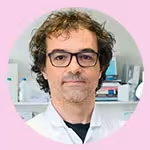
Prof. Fabrice André, Director of Research at Gustave Roussy
Accessing innovations while a cure is still possible.
“After proving the effectiveness of precision medicine through pioneering clinical trials, we couldn’t stop there and limit targeted treatments to patients who have relapsed after conventional therapies. That is the very goal of the PRISM project: to direct patients who need it toward targeted therapies and early-stage trials as soon as they are diagnosed. This will give them access to innovations while a cure for the disease is still possible.”