Welcome to the new Gustave Roussy website
A new website designed to offer you a simpler, clearer, and more intuitive experience. Patients, caregivers, healthcare professionals, and donors: find information, news, and services more easily.
LIO - Oncology Immunomonitoring Laboratory
Joint Service Unit
US23 – AMMICa
Platform Type
Translational Platform
Principal Investigator
Prof. Lydie CASSARD
Research Areas
Cytometry, Proteomics
Guardianships


Abstract
The LIO is a translational research platform specializing in the real-time analysis of immune responses in cancer patients treated with immunotherapy. Its missions include: discovering biomarkers predictive of response or resistance, monitoring immune-mediated adverse effects, elucidating the mechanisms of action of immunotherapies, and identifying new therapeutic targets through academic and industrial collaborations.
The LIO’s key contribution focuses on circulating senescent T cells (T8sen). The platform has demonstrated that high levels of T8sen in the blood predict resistance to anti-PD(L)1 therapies in advanced lung cancer and that chronic cytomegalovirus infection is the primary driver of their accumulation. These findings formed the basis for the SENTINEL project (BMS Foundation), which explores the molecular mechanisms of T-cell senescence with the goal of developing biotherapies targeting T8sen. In addition, the LIO is involved in approximately twenty concurrent programs, clinical trials, and research projects, funded by academic, institutional, and industrial sources. Among the key programs in which the LIO participates, the REVEAL RHU (ANR) aims to develop predictive blood tests for NSCLC, specifically by studying T8sen and tumor-associated neutrophils; TARMAC evaluates circulating biomarkers of tarlatamab in medullary thyroid carcinoma; and APOC/AMGEN, which aims to perform CDH3/MSLN protein profiling in dissociated tumors as part of the development of a trispecific antibody.
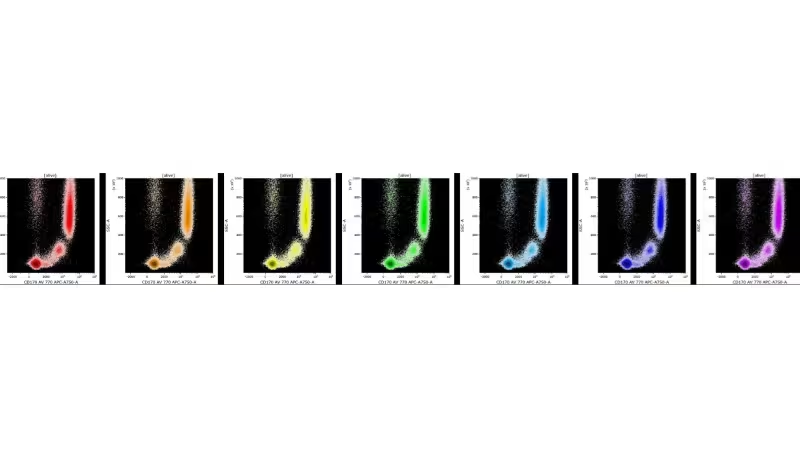
The laboratory relies on multiparametric cytometry on fresh samples, OLINK®/Luminex® protein multiplexing, tumor dissociation, and preclinical mouse models. Thanks to these tools, the LIO ensures a continuum between basic research, clinical validation, and therapeutic development.
Services Offered
Technologies used: real-time multiparametric cytometry on fresh samples (DX-Flex, Beckman), protein multiplexing (OLINK®/Luminex®/ELLA), impedance testing (xCELLigence), tumor dissociation, and preclinical mouse models.
Type of support: For teams wishing to benefit from the LIO’s analytical capabilities, access via a service agreement can be arranged. This includes sample preparation, data acquisition, and analysis of results by LIO experts. Access through scientific collaboration as part of a funded research project: LIO researchers are responsible for defining and validating the experiments to be conducted, while the LIO technician, under the supervision of the engineer, is responsible for carrying out the experiments. The researchers and the engineer participate in the analysis of data that requires specialized expertise.
Contact Us
If you are considering entrusting us with an analysis, please contact us to learn more about the available options, define the service, and obtain a quote: GD-LIO@gustaveroussy.fr

Team
Nathalie CHAPUT GRAS - Platform Scientific Director
University Associate Professor and Hospital Practitioner
Employer: Gustave Roussy
CASSARD Lydie - Platform Operations Manager
Research Engineer or equivalent
Employer: Gustave Roussy
NAIGEON, Marie
Associate Professor
Employer: Gustave Roussy
GIRARD Lou
Ph.D.
Employer: Gustave Roussy
SUN Kevin
Research Technician or equivalent
Employer: Gustave Roussy
JOUNIAUX Jean
Research Engineer or equivalent
Employer: Gustave Roussy
FLOR Guillaume
Postdoctoral Fellow
Employer: Gustave Roussy
CARMO Fillipe
Postdoctoral Fellow
Employer: Gustave Roussy
Key Publications
Contact
- Address
-
IGH+12
114 Edouard-Vaillant
Street, 94 805 Villejuif Cedex, France