PCCR: Rare Circulating Cells Platform
Joint Service Unit
US23 – AMMICa
Platform Type:
Translational Platform
Scientific Director:
Prof. Marianne Oulhen
Research Areas:
Cytometry, Genomics, Cell Imaging, Microscopy, Models, Proteomics, Single-cell, Transcriptomics
Abstract
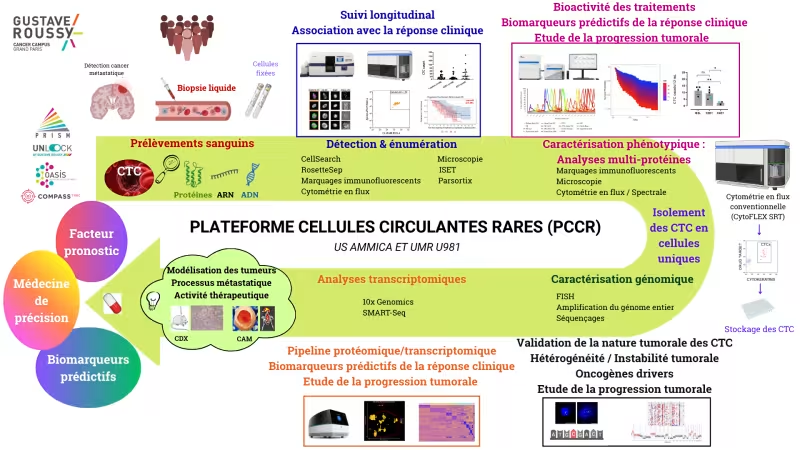
The CCR platform is dedicated to the phenotypic and molecular analysis of extremely rare cells found in the blood, such as circulating tumor cells (CTCs). Our laboratory has gained globally recognized expertise in this field through the publication of numerous articles on the detection and characterization of these cells.
As part of clinical trials, the laboratory evaluates various non-invasive biomarkers (therapeutic targets, tyrosine kinase receptors, signaling pathways, DNA repair) to assess treatment response in CTCs.
The objectives are (I) to count and characterize CTCs detected at different points in the patients’ clinical course, (II) to assess the early bioactivity of treatments, (III) to predict sensitivity or resistance to therapies, and (IV) to better understand tumor progression.
The platform relies on cutting-edge technologies: microscopy (immunofluorescent staining and FISH analyses), flow cytometry (single-cell detection and isolation, multi-protein analyses), and single-cell sequencing (targeted, whole-exome, whole-genome, transcriptome). It develops innovative projects such as xenografts derived from CTCs (CDX) or culture on the chorioallantoic membrane (CAM) of chicken embryos to model tumors and test therapeutic activity. Mouse models are used to validate data from liquid biopsies.
Research Programs and Initiatives
Our laboratory is affiliated with the IHU PRISM as part of the UNLOCK program.
As a partner in European consortia, the platform contributes to the development of liquid biopsy analysis technologies, affirming its central role in personalized medicine and translational research in oncology.
Services Offered
Pour un suivi longitudinal ou une corrélation avec les résultats cliniques, la détection et la numération des CTC peut être réalisée :
- directement dans le sang total : EF-FACS (Enrichment-Free FACS) incluant différents panels de marqueurs immunofluorescents et une analyse par cytométrie en flux
- ou après méthodes d'enrichissement : CellSearch, ISET, Parsortix, RosetteSep, marquages immunofluorescents, microscopie, cytométrie en flux
- En vue d'analyses moléculaires ultérieures (ADN, ARN)
Analyses fonctionnelles
Pour l'estimation de la bio-activité des médicaments, la prédiction précoce de la sensibilité/résistance et l'étude de la progression tumorale :
- marquages immunofluorescents
- analyse en microscopie
- analyse en cytométrie en flux conventionnelle
- analyse en cytométrie spectrale (en développement)
En développement : 10X Genomics, SMART-Seq ou autres technologies, pipelines bio-informatiques robustes
Altérations du nombre de copies et mutations de gènes :
- amplification du génome entier
- séquençage « LowPass whole genome »
- séquençage ciblé NGS panel cancer 60 gènes
Pour la modélisation des tumeurs, la compréhension du processus métastatique et le test de l'activité d’agents thérapeutiques :
Développement de Xénogreffes à partir de CTC (CDX) chez la souris et culture sur membrane chorioallantoïque (CAM) de l'embryon de poulet.
Contact Us
If you are considering entrusting us with an analysis, please contact us to learn more about the available options, define the service, and obtain a quote: GD-BCC@gustaveroussy.fr

Team
OULHEN Marianne - Platform Operations Manager
Research Engineer or Equivalent
Employer: Gustave Roussy
Noémie BEUSCART
Research Technician or equivalent
Employer: Gustave Roussy
PAWLIKOWSKA, Patrycja
Research Engineer or equivalent
Employer: Gustave Roussy
CAMARA, Kousso
Other status, including apprentice
Employer: Gustave Roussy
SANCHEZ-BECERRA Maria Virginia
Doctoral Student
Employer: Gustave Roussy
COURTOIS Arthur
Research Technician or equivalent
Employer: Gustave Roussy
Key Publications
Contact