Welcome to the new Gustave Roussy website
A new website designed to offer you a simpler, clearer, and more intuitive experience. Patients, caregivers, healthcare professionals, and donors: find information, news, and services more easily.
Repair of double-strand breaks, replicative stress, and genome integrity
- Thematic(s)
- Molecular Biology and Biochemistry, Genetics / Genomics
- Attachment unit
- UMR9019 - Genome Integrity and Cancer
- Manager(s)
- Pauline Dupaigne, Gerard Mazón
- Institutional connection
-
Gustave Roussy, CNRS, Paris-Saclay University
Summary
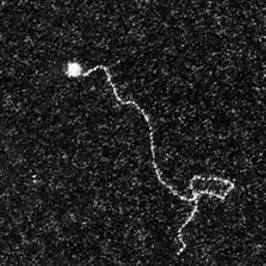
The team studies, at the mechanistic level, the main repair pathways for double-strand breaks and replication-blocking lesions, particularly homologous recombination and non-homologous end joining (NHEJ). We combine molecular biology and genetics approaches to study the regulation of these pathways in cells. At the same time, we employ innovative methodological strategies, including electron microscopy (EM) and atomic force microscopy (AFM), to analyze DNA repair factors during reconstituted biochemical reactions, as well as to visualize DNA intermediates enriched from cells. We have also developed cryo-EM techniques to determine the structures of nucleoprotein complexes essential for DNA repair, in order to better understand the molecular mechanisms that maintain genomic stability.
-
Cryo-EM of replication forks with RAD52 and RAD51: We are characterizing the interactions of RAD51 and RAD52 on purified replication forks to understand their binding modes, the formation of mixed strands, and their role in protecting forks under replicative stress.
-
NHEJ machinery: Cryo-EM has enabled us to determine the helical structure of XRCC4 filaments, revealing their function as a scaffold for the NHEJ pathway and as an anchor for other cellular partners.
-
Structural Studies of BRCA2, RAD51, FIGNL1, and RAD54: We are resolving cryo-EM structures of peptides derived from FIGNL1 or RAD54 bound to RAD51 or DMC1 to define essential interactions and assess the impact of mutations.
-
Regulation of HR factors by degradation signals: In ovarian cancer, we are identifying degradation signals modulated by replicative stress and analyzing their impact on HR protein levels to explore their potential as therapeutic targets.
Team members
-
Gerard MAZON - Associate Unit Director
Research Director and Equivalents, Inserm
ADAIMY Tia
Ph.D. Student, Paris-Saclay University
Josiane Ammar
Ph.D. Student, Paris-Saclay University
BACONNAIS Sonia
Research Engineer or equivalent, CNRS
Pauline Dupaigne
Research Associate and equivalent, Inserm
Raphael FEIRERA VELOSO
Design Engineer or equivalent, CNRS
Léa GUIRAUD
Ph.D. Candidate, Paris-Saclay University
LE CAM Eric
Research Director or equivalent, CNRS, Emeritus
Amina Serrar
Ph.D. Candidate, Paris-Saclay University
Key publications
Contacts
- Phone
- 01.42.11.57.70