Welcome to the new Gustave Roussy website
A new website designed to offer you a simpler, clearer, and more intuitive experience. Patients, caregivers, healthcare professionals, and donors: find information, news, and services more easily.
Translational Cancer Genomics
- Thematic(s)
- Data & AI, Genetics / Genomics, Precision Medicine
- Attachment unit
- U1361 - Cancer Data Science
- Manager(s)
- Sergey Nikolaev
- Institutional connection
-
Gustave Roussy, CentraleSupélec, Inserm, Paris-Saclay University
Summary
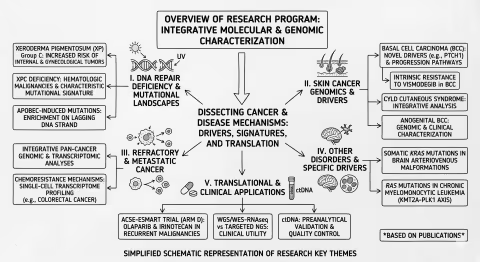
Our translational cancer genomics team, which is part of IHU-PRISM, is deciphering the genetic architecture of malignant tumors, focusing on lesion-induced mutagenesis and mechanisms of treatment resistance. We study how normal cells transform into cancer cells and how they evolve in response to anticancer treatments in order to improve clinical outcomes. Our research on mutagenesis explores how stress factors shape the mutational landscape; in particular, we model UV-exposed skin cancers and conduct research on xeroderma pigmentosum in collaboration with the “Les Enfants de la Lune” association to study DNA repair defects. We analyze advanced cancers treated with genotoxic therapies to determine how DNA-damaging agents influence mutational trajectories and to predict treatment efficacy. At the same time, we study treatment resistance by comparing the genetic, epigenetic, and transcriptional profiles of primary tumors with those of refractory tumors. Our META-PRISM cohort analysis, conducted at Gustave Roussy, uses whole-exome sequencing and RNA (RNA-seq) at all stages of disease progression to improve survival prediction and optimize patient selection for Phase I trials in advanced breast cancer. In collaboration with Sanofi, we are studying lung cancer resistance to tyrosine kinase inhibitors, using scRNA-seq, ATAC-seq, and scDNA-seq to characterize the persistent phase of cancer progression. As part of the MyProbe consortium, we are identifying, from large cohorts, epigenetic and subclonal markers of resistance to hormonal therapy in HR+ breast cancer. This work relies on our bioinformatics infrastructure, which develops pipelines for identifying somatic and germline variants from whole-genome, exome, or targeted panel sequencing data. This enables us to determine tumor purity, microsatellite instability, and mutation burden, while our RNA-specific pipelines facilitate the identification of gene fusions and the deconvolution of the microenvironment. Variants are annotated using the OncoKB and CiViC databases, ensuring that our laboratory validations of DNA repair defects are based on accurate genomic data.
Team members
-
NIKOLAEV Sergey - Unit Director
Research Director and Equivalents, Inserm
Hanae BENAMIRA-CARRI
Postdoctoral Fellow, SANOFI
CHALVIN, Siann
Research Engineer or equivalent, Inserm
FANDREI David
Postdoctoral Fellow, Gustave Roussy
GROISMAN Irina
Research Associate or equivalent, Inserm
MFONDU Naomi
Other status, including apprentices, Gustave Roussy
NADEZHDIN Evgeny
Research Engineer or equivalent, Inserm
Fatemeh Rajabi
Postdoctoral researcher, Inserm
RAJABI Fatemeh
Postdoctoral researcher, Gustave Roussy
WANG Weitao
Other status, including apprentice, Gustave Roussy
YURCHENKO Andrei
Research Fellow and Equivalents, Inserm
ZHANG Yuxuan
Other status, including apprentices, Gustave Roussy
Key publications
Contacts
- Phone
- 01.42.11.57.75