

Welcome to the new Gustave Roussy website
A new website designed to offer you a simpler, clearer, and more intuitive experience. Patients, caregivers, healthcare professionals, and donors: find information, news, and services more easily.
RHU REVEAL: The Value of Liquid Biopsy in Lung Cancer
It is one of four innovative, large-scale projects coordinated by Gustave Roussy that have been selected for funding under the fifth call for proposals for the University Hospital Health Research (RHU) initiative within the Investments for the Future program. Its goal: to predict relapse and facilitate follow-up care through liquid biopsy in patients with non-small-cell lung cancer.
University Hospital Research

Led by the team of Professor Benjamin Besse, a medical oncologist specializing in the treatment of thoracic cancers and Director of Clinical Research at Gustave Roussy, the REVEAL project is being conducted in collaboration with several partners, including another cancer center—the Montpellier Cancer Institute —Unicancer, Paris Saclay University, Inserm, CentraleSupélec, as well as two biotechnology companies, Stilla® Technologies and Cell Environment, each contributing its expertise in its respective field.
A Program Based on Liquid Biopsy
With 46,300 new cases diagnosed each year in France, a very low 5-year survival rate, and 33,100 deaths, lung cancer is the leading cause of cancer-related mortality.
Non-small cell lung cancer accounts for 85% of cases. When diagnosed at an early stage, treatment relies on surgery and radiation therapy, sometimes combined with chemotherapy.
The newly developed liquid biopsy technique, which uses circulating tumor DNA, now makes it possible to screen for genetic abnormalities in cancer through a simple blood draw to determine whether targeted therapy can be administered.
Unlike CT scans, liquid biopsy is a non-irradiating procedure that is easily accessible throughout the country.
A three-pronged approach to patient diagnosis and monitoring
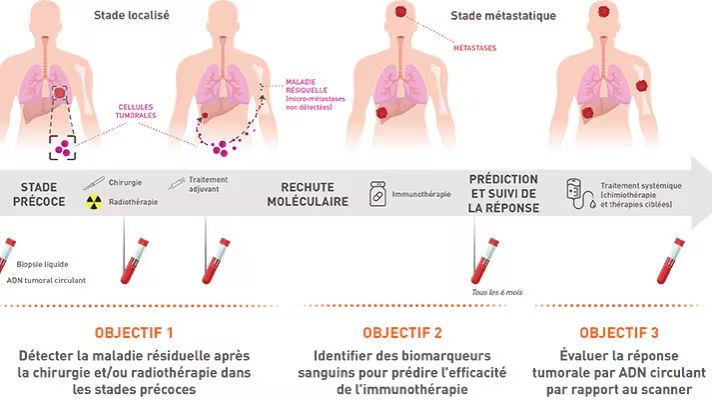
REVEAL consists of three programs.
The first area of focus aims to evaluate and define the next generation of circulating DNA (or liquid biopsy) tests to accurately measure residual disease after surgery and/or radiation therapy. Residual disease refers to the probability that, following treatment for localized cancer, undetected micrometastases will persist in a patient at the time of the initial evaluation. The next step is to demonstrate the effectiveness of monitored follow-up to detect the occurrence of early relapse, particularly among smokers, for whom current tests provide no indication.
To develop and validate an effective, highly sensitive predictive tool, a prospective trial called “CANTO Lung” will be conducted by Unicancer. The study will involve collecting blood samples and following 550 patients with early-stage non-small-cell lung cancer—whose tumors were completely removed—for four years. The use of artificial intelligence and a machine learning approach will enable the development of an algorithm to predict relapses and the presence of residual disease.
The second program aims to predict sensitivity or resistance to immunotherapy using blood-based biomarkers when a liquid biopsy reveals molecular relapse. The search for these potential biomarkers (immunosenescence, inflammation, neutrophil phenotypes) is being conducted using blood samples collected during previous clinical trials (REVEAL, PREMIS, PULSE, PERSEE). The goal is to identify a set of blood biomarkers that can be patented and subsequently commercialized.
The third pillar of REVEAL involves the development and validation of a circulating DNA test for monitoring patients with metastatic disease. The goal is to compare monitoring via liquid biopsy with the current method using CT scans, with tumor response assessed according to RECIST criteria. The research will utilize blood samples, CT scan images, and clinical records from previous studies.