Welcome to the new Gustave Roussy website
A new website designed to offer you a simpler, clearer, and more intuitive experience. Patients, caregivers, healthcare professionals, and donors: find information, news, and services more easily.
Gold september: two new research programmes launched to tackle childhood cancers
Two of Gustave Roussy’s four new medical and scientific programmes are dedicated to childhood cancers. The first, DECRIPT, aims to improve understanding of the role played by genetics in the development of certain childhood cancers, as well as second cancers that may occur in adulthood. The second, INSPIRE, will draw on the knowledge and techniques already developed at the Institute to create organoids, with the aim of deciphering the mechanisms underlying metastasis and resistance to treatment.
On
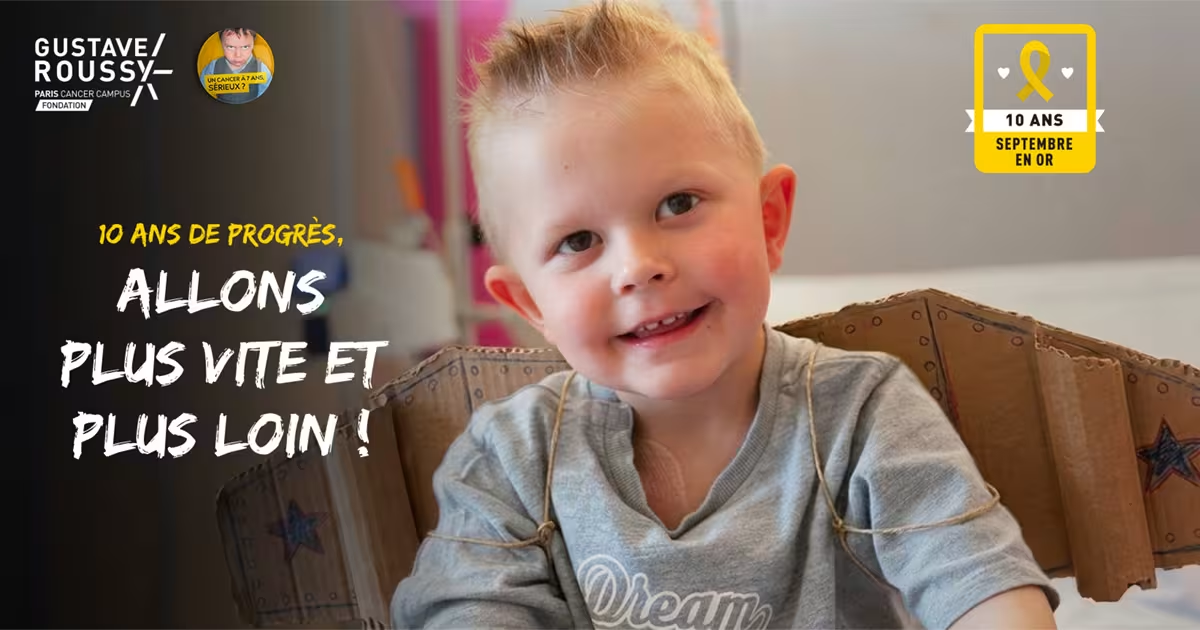
Gustave Roussy is a leading centre in the treatment and study of childhood cancers. In 1952, Dr Odile Schweisguth established Europe’s first paediatric oncology department at the Institute. Nearly 80 years later, the vision and commitment of this pioneer in paediatric oncology continue to shape the Department of Child and Adolescent Oncology that she founded, as well as its affiliated research teams.
Since the Gold September campaign was launched in France in 2016, collective mobilisation and the funds raised have accelerated the development of new research projects. The objective is to cure the 20% of young patients for whom current treatments remain insufficient by improving our understanding of certain diseases and developing new therapeutic approaches. As the campaign marks its tenth anniversary, childhood cancers, which account for 2,300 new cases in France every year, are once again at the heart of major initiatives at Gustave Roussy.
In January 2026, Gustave Roussy brought together more than 71 researchers from four teams dedicated to childhood cancers within a single joint research unit, headed by Dr Thomas Mercher, a specialist in childhood leukaemia. Its objective is to encourage medical and scientific exchanges and collaborations to discover new molecular mechanisms that can support the development of new therapies. At the same time, two of Gustave Roussy’s four new medical and scientific programmes, known as PMS programmes, are dedicated to childhood cancers. These research programmes form part of the Institute’s strategic plan. Their purpose is to deliver tangible improvements in the care, cure and follow-up of patients with cancer by creating a direct bridge between fundamental and exploratory laboratory research and clinical treatments delivered in hospital.
DECRIPT: improving understanding of the role played by genetics
Led by Dr Brice Fresneau and Dr Léa Guérrini-Rousseau, both paediatric oncologists, DECRIPT focuses on understanding the genetic factors involved in cancers affecting children and adolescents, as well as the risk of developing a second cancer in adulthood. It combines clinical and fundamental research, with a focus on epidemiological and genetic data. Its central objective is to improve prevention and follow-up and, ultimately, to deliver more personalised care for patients at greatest risk.
“The increase in childhood cancer cure rates is excellent news. However, this new reality also means that a growing number of former patients are at risk of developing late complications, including a second cancer in adulthood. This risk may be influenced by the treatments received during childhood, but also by several genetic factors,” says Dr Brice Fresneau.
DECRIPT therefore aims to gain a better understanding of why some children develop cancer and why some former patients face a higher risk of developing a second cancer. Its main objective is to identify new genetic predisposition factors, whether associated with a single gene or with a combination of several genetic variations. The programme will focus on rare or still poorly understood variants, as well as interactions between genetic predispositions and cancer treatments.
The programme is based on a large-scale approach made possible by the resources developed at Gustave Roussy over several decades of clinical and fundamental research. Pooling these genetic and clinical data is essential to detecting rare abnormalities, analysing combinations of variants and improving our understanding of their links with the development of a first or second cancer.
“DECRIPT follows a translational approach, with the ambition of transforming research findings into useful tools for patients and healthcare professionals. The data generated by the programme should enable us to develop risk models that incorporate genetic factors, demographic data, treatments received and clinical characteristics,” explains Dr Léa Guérrini-Rousseau.
Ultimately, these tools could help adapt treatments, personalise follow-up arrangements and offer targeted prevention strategies to patients facing the greatest risks. The programme will also include health economics studies to assess the value of these approaches within the organisation of care.
INSPIRE: deciphering metastasis and treatment resistance
The INSPIRE programme, jointly led by paediatric oncologist Dr Claudia Pasqualini and research director Professor Florent Ginhoux, aims to improve understanding of why certain childhood cancers continue to resist treatment and lead to the development of metastases. Despite rising cure rates, some forms of childhood cancer remain difficult to treat. In these situations, relapses and metastases account for most deaths, reflecting mechanisms of treatment resistance that are still poorly understood.
“Recent research has highlighted the central role played in these processes by the tumour microenvironment, meaning all the cells surrounding the tumour. In childhood cancers, this environment can hinder the immune system and reduce the effectiveness of treatments. Macrophages are among the cells that play a key role in these mechanisms. Normally involved in the body’s defence, they can be hijacked by the tumour and contribute to blocking the immune response, promoting treatment resistance and facilitating the spread of cancer cells, which ultimately leads to the formation of metastases,” explains Professor Florent Ginhoux.
INSPIRE aims to characterise interactions between tumour cells and their immune environment extremely precisely, particularly interactions involving macrophages. The objective is to determine how these interactions change over time and according to the organs concerned, and to understand their role in the mechanisms through which tumours spread.
To achieve these objectives, the programme will draw on the development of new-generation experimental models known as organoids, which act as personalised avatars of each patient’s tumour. Their development builds on expertise already established at Gustave Roussy, particularly within Professor Florent Ginhoux’s team, which has shown that immune cells can be incorporated into these models to reproduce the tumour microenvironment as closely as possible. INSPIRE will therefore not examine the tumour in isolation. The organoids will be enriched with immune system cells, particularly macrophages, to reproduce interactions that occur within the human body.
Finally, the programme will develop multi-organ systems in which several organoids representing different organs to which the disease can spread will be brought into interaction. These systems will make it possible to model the processes through which tumours spread throughout the body by reproducing exchanges between organs and the conditions that enable metastases to become established. The objective is to identify the mechanisms involved.
“Beyond its ambition to improve understanding of fundamental mechanisms, INSPIRE follows a translational approach aimed at turning this knowledge into clinical advances. The models developed as part of the programme will provide a particularly suitable framework for testing new therapeutic approaches under conditions that closely reflect patients’ actual disease. They will make it possible to assess the impact of strategies designed to modulate the tumour microenvironment or specifically target the tumour-promoting functions of macrophages,” concludes Dr Claudia Pasqualini.
Last press releases
-
INTERCEPTION: The national pilot program for personalized cancer prevention among individuals at increased risk of cancer enters its operational phase with the enrollment of the first patients
The Interception program has reached a new milestone with the enrollment of its first patients as part of the national Article 51 pilot program. Rolled out over four years across seven healthcare facilities, this pilot program is designed to evaluate an innovative model for personalized cancer prevention and screening.
-
After a breast cancer diagnosis, how can treatment be started more quickly?
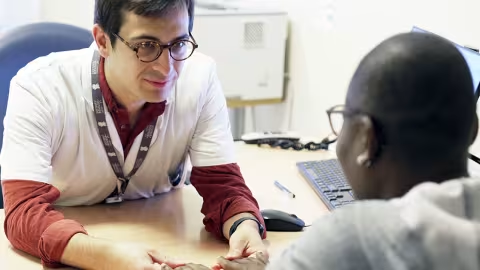
Gustave Roussy is launching a new care pathway designed to accelerate the management of women recently diagnosed with breast cancer. It brings together, in a single day, the radiology examinations, blood tests, and oncology consultation required to initiate treatment. This new pathway complements the Institute’s rapid breast care offering. The InstaDiag Breast pathway already consolidates all diagnostic examinations into a single day to establish a diagnosis.
-
Prof. Fabrice Barlesi reappointed at the head of Gustave Roussy, the leading cancer center in France and Europe
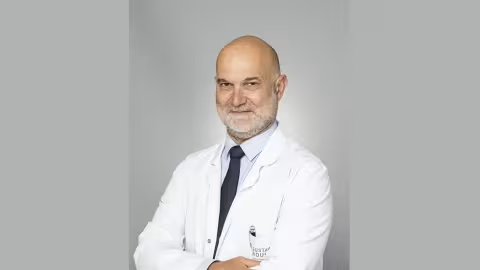
By order of Ms. Stéphanie Rist, Minister of Health, Families, Autonomy and Persons with Disabilities, dated 27 July 2026, Professor Fabrice Barlesi has been reappointed as Director General of Gustave Roussy, effective 1 August 2026. At the helm of the Institute for five more years, Prof. Barlesi will continue the transformations undertaken during his first term. This renewal reflects the confidence placed in the project led by the institution to accelerate progress in the fight against cancer, foster and support the development of innovations set to change the future of oncology, and strengthen the influence of one of the world's leading cancer centers.
-
Route du Rhum 2026 Jean Le Cam and Christophe Rateau to sail for Gustave Roussy
For the Route du Rhum - Destination Guadeloupe 2026, Jean Le Cam and Christophe Rateau will sail under the colors of Gustave Roussy, the leading cancer center in France and Europe. Competing respectively in the Vintage and Class40 categories, the two skippers will carry the Institute's mission to the general public, supporting cancer research and raising awareness of prevention, innovation and patient care.