Welcome to the new Gustave Roussy website
A new website designed to offer you a simpler, clearer, and more intuitive experience. Patients, caregivers, healthcare professionals, and donors: find information, news, and services more easily.
The inaugural edition of the Gustave Roussy Prize awarded to Professor Charles Swanton
On
Villejuif, February 4, 2025
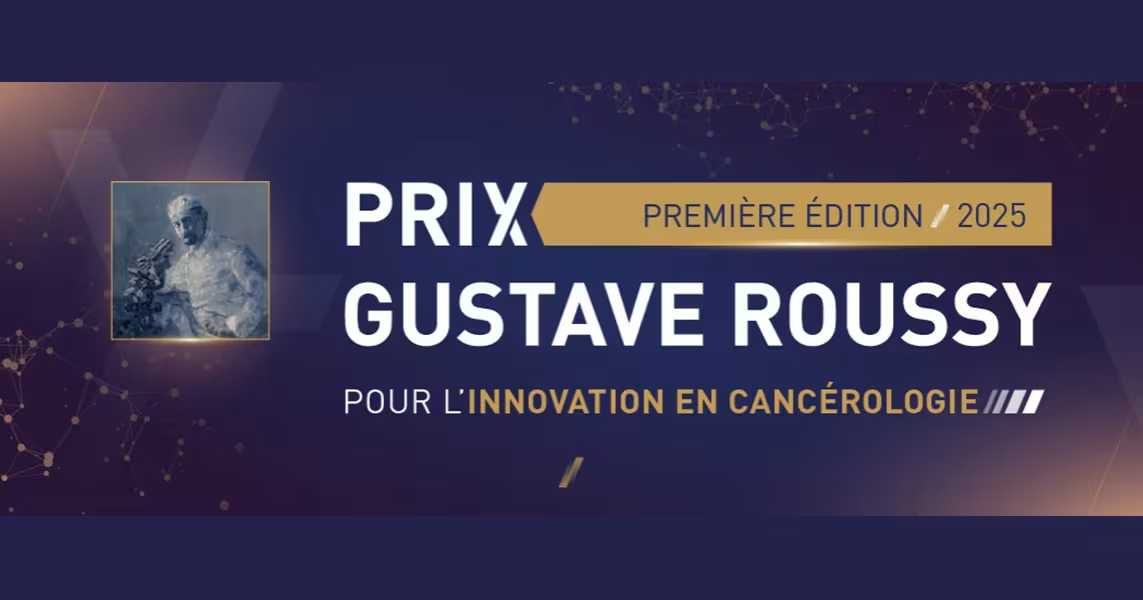
The inaugural edition of the Gustave Roussy Prize awarded to Professor Charles Swanton
For its first edition, the Gustave Roussy Prize, endowed with €200,000, has been awarded to Professor Charles Swanton. A British researcher and clinician, ranked among the world’s most cited scientists, Professor Swanton is Deputy Clinical Director of the Francis Crick Institute in London, where he leads a laboratory dedicated to cancer evolution and genome instability. The jury of the Gustave Roussy Prize highlighted the “exceptionalism” of his scientific contributions and unanimously recognised his major influence in cancer research.
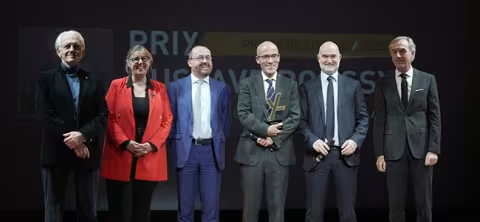
From left to right : Gérard Mourou, Nobel Prize in Physics 2018 ; Sylvie Retailleau, former minister of Higher Education and Research ; Yannick Neuder, minister of Health and Access to Care ; Charles Swanton, winner of the 2025 edition of the Gustave Roussy Prize ; Fabrice Barlesi, General Director of Gustave Roussy ; Éric Ducournau, General Director of Pierre Fabre Laboratories
On Tuesday, 4 February, on the occasion of World Cancer Day, Professor Fabrice Barlesi, Gustave Roussy’s General Director, presented the Gustave Roussy Prize to Professor Charles Swanton during a ceremony held at the Théâtre du Lido in Paris, in the presence of Madame Sylvie Retailleau, former Minister of Higher Education and Research, and Monsieur Gérard Mourou, 2018 Nobel Laureate in Physics. The jury members unanimously recognised his remarkable and innovative scientific contributions among a highly competitive pool of candidates, as well as his vision and leadership in large-scale collaborative projects.
"Through his ground-breaking work, Charles Swanton has transformed precision medicine and cancer care, impacting millions of lives worldwide. His discoveries continue to guide diagnostic and treatment strategies in the fight against this complex disease," stated Professor Fabrice Barlesi.
Launched in 2024 and supported by Pierre Fabre Laboratories as a founding sponsor along with the Gustave Roussy Foundation, this prize, endowed with €200,000, aims to reward, each year, a researcher whose scientific discoveries have had a major impact on the care of cancer patients.
"It is a tremendous honour for the Gustave Roussy Foundation to award this first prize to a renowned researcher whose advances are shaping the future of cancer research. This commitment fully aligns with our mission: to create the conditions for world-class research to turn hope into cure and to take on the challenge of curing cancer by the end of the century," added Sébastien Bazin, President of the Gustave Roussy Foundation.
"We are immensely proud to be the main partner of the new Gustave Roussy Prize. We extend our congratulations to its first laureate and express our admiration for his major breakthroughs in cancer research. Professor Swanton’s work has transformed our understanding of tumour mechanisms and paved the way for immense therapeutic advances in oncology. Thanks to Professor Swanton, his teams, and his peers, targeted therapies are revolutionising the treatment of many patients, and we are proud to be part of this therapeutic revolution," said Eric Ducournau, Chief Executive Officer of Pierre Fabre Laboratories.
From Discoveries to Concrete Applications
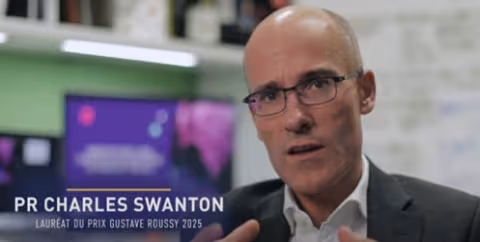
Professor Charles Swanton has revolutionised the scientific and medical understanding of cancer at all stages of disease development, from initiation to progression, metastasis, and immune evasion. He has helped lay the foundations of precision medicine and opened new perspectives in cancer diagnosis, treatment, and prevention, with tangible applications for all patients.
His research has established that tumours consist of genetically distinct subpopulations of cells, evolving according to predictable mechanisms. This discovery led to the identification of truncal mutations – common to all tumour cells – as priority therapeutic targets. Furthermore, Professor Swanton has contributed to a better understanding of cancer immune surveillance. By identifying the key role of clonal neoantigens – proteins specific to tumour cells – in the immune response, his research paves the way for vaccines and cell therapies capable of precisely targeting these neoantigens.
Professor Swanton has also highlighted the central role of chromosomal instability in cancer evolution, referring to the propensity of tumour cells to accumulate abnormalities in chromosome number or structure. He demonstrated that this genetic instability generates diversity, enabling tumours to resist treatments, metastasise, and evade the immune system. In parallel, his research has revealed how the enzyme APOBEC, a protein that modifies DNA by causing mutations, contributes to tumour progression and resistance to targeted therapies.
Finally, Charles Swanton's scientific contributions have helped elucidate how environmental factors such as fine particle pollution and inflammatory processes linked to ageing promote the onset and progression of lung cancer. These discoveries reinforce the urgency of reducing urban pollution and developing molecular prevention strategies.
About Professor Charles Swanton
After earning an MB PhD from University College London (UCL) in 1999, Professor Charles Swanton pursued an outstanding career, notably as a clinician-scientist at Cancer Research UK. In 2011, he was appointed Chair in Personalised Cancer Medicine at UCL, and two years later, he took the helm of the "Cancer Evolution and Genome Instability" laboratory at the Francis Crick Institute, where he became Deputy Clinical Director in 2023. He is also the principal investigator of TRACERx, a major programme aimed at deciphering lung cancer evolution.
Professor Charles Swanton has co-authored nearly 400 scientific publications, including several as lead or senior author in top-tier journals. He also serves on the editorial board of prestigious journals such as Cell, Annals of Oncology, and Cancer Discovery, and is a member of major international scientific societies, including the European Society for Medical Oncology (ESMO) and the American Association for Cancer Research (AACR).
Press contact
If you are a journalist and have a question, please contact:
Claire Parisel or Léona Pinto
Tel. +33 1 42 11 50 59
Tel. +33 1 42 11 63 59
Mob. +33 6 17 66 00 26
Email
The Media Team cannot respond to patient inquiries.
Last press releases
-
ESMO 2026 - Exploring the potential of immunotherapy in early-stage triple-negative breast cancer
Dr Joana Ribeiro, medical oncologist in the Drug Development Department at Gustave Roussy, will present the results of the POP-DURVA clinical trial at the ESMO Congress. Conducted within UNLOCK, a flagship programme of the PRISM Institute, the study evaluated the addition of two immunotherapy injections before surgery in women with localised triple-negative breast cancer. With a strong translational research component, the study also investigated immunotherapy's early effects on the tumour and its immune microenvironment, to better understand the mechanisms underlying treatment response.
-
INTERCEPTION: The national pilot program for personalized cancer prevention among individuals at increased risk of cancer enters its operational phase with the enrollment of the first patients
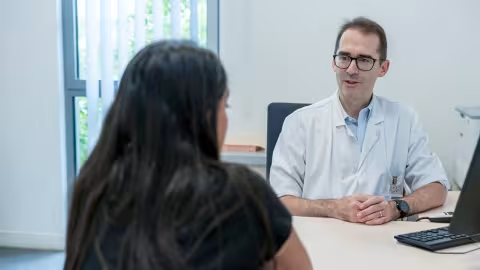
The Interception program has reached a new milestone with the enrollment of its first patients as part of the national Article 51 pilot program. Rolled out over four years across seven healthcare facilities, this pilot program is designed to evaluate an innovative model for personalized cancer prevention and screening.
-
After a breast cancer diagnosis, how can treatment be started more quickly?
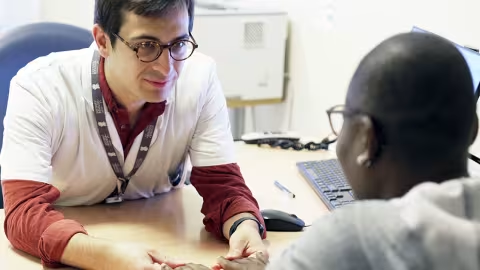
Gustave Roussy is launching a new care pathway designed to accelerate the management of women recently diagnosed with breast cancer. It brings together, in a single day, the radiology examinations, blood tests, and oncology consultation required to initiate treatment. This new pathway complements the Institute’s rapid breast care offering. The InstaDiag Breast pathway already consolidates all diagnostic examinations into a single day to establish a diagnosis.
-
Gold september: two new research programmes launched to tackle childhood cancers
Two of Gustave Roussy’s four new medical and scientific programmes are dedicated to childhood cancers. The first, DECRIPT, aims to improve understanding of the role played by genetics in the development of certain childhood cancers, as well as second cancers that may occur in adulthood. The second, INSPIRE, will draw on the knowledge and techniques already developed at the Institute to create organoids, with the aim of deciphering the mechanisms underlying metastasis and resistance to treatment.