
Welcome to the new Gustave Roussy website
A new website designed to offer you a simpler, clearer, and more intuitive experience. Patients, caregivers, healthcare professionals, and donors: find information, news, and services more easily.
Medical Biology and Pathology: Essential Tests for the Care Pathway
Routine laboratory tests, specialized tests to identify tumor markers or potential genetic predispositions, identification and characterization of tumor lesions from tissue samples… The Department of Medical Biology and Pathology manages the biological and pathological anatomy tests ordered by Gustave Roussy physicians for the Institute’s patients or requested by outside practitioners. Learn how this department—which is essential to both diagnosis and treatment decisions—organizes its daily operations.
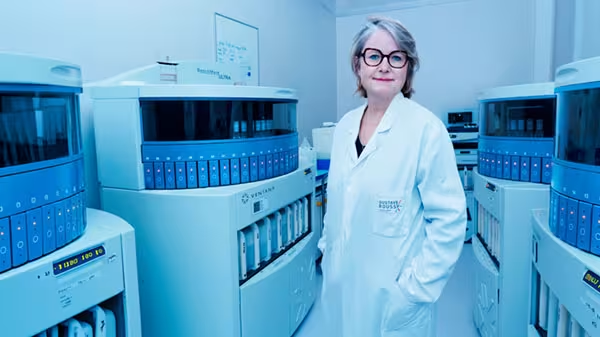
Overview of the Department
Here, it all begins with the centralized receipt of specimens: a dedicated service, shared by the entire department, receives all patient samples intended for analysis at the Gustave Roussy Laboratory of Clinical Biochemistry and Anatomical Cytopathology. Known as Corebiopath, this service handles the intake, receipt, sorting, and registration of each sample.
Six specialized departments, organized into two main divisions, operate under Corebiopath.
The Biology Division brings together all medical biology specialties and performs routine biological analyses, as well as specialized tests designed to identify tumor markers or potential genetic predispositions. The Pathology Division, meanwhile, focuses primarily on identifying and characterizing tumor lesions based on cell and tissue samples. These tests are ordered by Gustave Roussy physicians for the Institute’s patients, but may also be requested by external practitioners seeking to benefit from our expertise.
Discover the various services of the Department of Medical Biology and Pathology at Gustave Roussy.
The Biochemistry Service performs general biochemistry, specialized biochemistry, and hemostasis tests. It measures biological markers useful for the detection and monitoring of certain cancers and tracks biological changes induced by cancer treatments. A high degree of automation in this area enables the department to meet Gustave Roussy’s needs, both in terms of patient diagnosis and follow-up and in supporting certain clinical trials.
The Hematology-Immunology Department performs cellular hematology and cellular immunology analyses. It conducts cytological, phenotypic, and molecular diagnostics of lymphoid and myeloid hematologic disorders. It monitors residual disease during treatment and in the long term. It participates in the care of patients treated with bone marrow transplants and in the follow-up of patients receiving innovative cell therapies.
The Microbiology Department is responsible for diagnosing bacterial, fungal, and viral infections, as well as monitoring viral reactivation in patients who have undergone allogeneic bone marrow transplantation. It provides advice to clinicians on antibiotic therapy. It also performs microbiological monitoring of protected inpatient areas and therapeutic product manufacturing facilities. Its team works closely with the operational hygiene team to monitor and prevent healthcare-associated infections.
The Pharmacology Department performs drug concentration measurements for anticancer medications as part of therapeutic monitoring (oral targeted therapies, hormone therapies, monoclonal antibodies) or monitoring using pharmacokinetic modeling (busulfan, fludarabine, melphalan, platinum salts). These analyses help adjust treatment dosages to optimize efficacy and minimize toxicity. The department also performs assays for innovative metabolic biomarkers (2HGA, succinate) as well as screening for DPD deficiencies through phenotyping. The range of onco-pharmacology services evolves regularly, in line with therapeutic advances, to best meet new clinical needs.
The Tumor Genetics Department performs molecular analyses in three main areas: cytogenetics, somatic tumor genetics, constitutional genetics (oncogenetics), and genomic profiling of liquid biopsies. The tests performed contribute to diagnosis, prognostic assessment, and the selection of therapeutic strategies for solid tumors. They also help identify predispositions to cancer, which is essential information for the care of patients and their families. The rapid evolution of technologies and indications for molecular analyses requires the department to be highly responsive in order to meet the needs of patients and external institutions with which we have agreements.
The main focus of the Pathology Department is the diagnosis and characterization of tumor growths. To learn more, click here
Did you know?
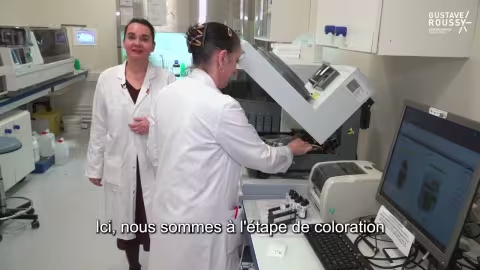
Anatomical cytopathology (or “anapath”) is a medical specialty that involves examining samples taken from patients with the naked eye or under a microscope to identify and analyze abnormalities associated with disease. Want to learn more? Take a tour of the anapath lab at Gustave Roussy with Dr. Magali Lacroix-Triki.

Teaching, Research, and Publications: A Very Active Department
The Department of Medical Biology and Pathology offers numerous in-house and external training programs aimed at a wide audience: physicians, biologists, and pathologists; DES residents; medical and pharmacy students; technicians; and paramedical staff… Members of the Department regularly participate in training programs organized by other departments. Several members of the Department hold academic positions in the School of Medicine or the School of Pharmacy.
In addition, clinicians, biologists, and pathologists actively contribute to research activities conducted at Gustave Roussy within their respective fields of specialization. Some serve as heads of research units or platforms. Many of them are active in professional societies related to their specialties and help organize national and international conferences.
A Reference Clinical Laboratory at Gustave Roussy
The department’s Biology Division brings together the specialties of clinical biology and performs routine laboratory tests and specialized tests ordered by physicians at Gustave Roussy as well as by external practitioners. Designated as a Reference Laboratory for Medical Biology (LBMR) pursuant to the decree of January 18, 2022, amending the decree of July 15, 2021, it is thus a nationally recognized medical biology reference laboratory for specific medical biology tests or for specific pathologies across 4 specialties, covering 14 medical biology tests or specific pathologies.
The Gustave Roussy LBMR thus makes its facilities and specific expertise in oncology available to external partners, guaranteeing operational know-how that supports specialized care and enables the laboratory to advise on, perform, and interpret specific tests necessary for cancer management.
View the list of relevant tests and conditions:
Everything You Need to Know About the Sampling Manual
All information regarding clinical laboratory tests and specimen collection guidelines at Gustave Roussy is available in the specimen collection manual
Dr. Magali Lacroix-Triki welcomes you to the Pathology Department, which she heads
“Our department consists of several areas, ranging from the specimen processing workflow to the slides that enable us to make our diagnosis. At the heart of the laboratory is the area where we receive specimens, which come to us from clinical departments, radiology, or operating rooms. The first step takes place at the macroscopic examination station: specimens critical for diagnosis are selected before being embedded in paraffin blocks, from which we make very thin sections that are smeared onto glass slides to be stained and examined under a microscope. These blocks are then archived and can be stored for years. These archives are invaluable for artificial intelligence projects: pathologists select the slides to be digitized using a slide scanner—a type of microscope equipped with a camera, housed inside a machine.”
FRESH: Monitoring Tumors and Tailoring Treatments with a Simple Blood Test
The FRESH liquid biopsy program, led by Gustave Roussy in partnership with Roche and Foundation Medicine, is open to all patients in France. It aims to develop and promote liquid biopsy, which involves collecting and analyzing patients’ blood samples to detect tumor biomarkers, thereby enabling less invasive and more accurate monitoring. By facilitating access to liquid biopsy and providing expertise in analyzing results and guiding treatment decisions, FRESH helps accelerate its adoption in clinical practice.
“We offer liquid biopsies to all patients with advanced cancer in whom we might detect circulating tumor DNA, regardless of the type of cancer. The results of the liquid biopsy can provide us with a list of genes, some of which, when mutated, can be targeted with existing drugs or with new drugs being evaluated in clinical trials, particularly at Gustave Roussy,” explains Dr. Kaissa Ouali, a medical oncologist.
Dr. Marie Morfouace, the program’s scientific director, adds: “FRESH is a unique program in Europe. Any French hospital wishing to participate can simply submit their request through our referral portal and send a blood sample to Gustave Roussy. Building a network of federated national centers is essential, and that is, of course, the goal of the program.”
Two key strengths of Gustave Roussy at the heart of the FRESH program
- The genomic profiling laboratory in the Department of Medical Biology and Pathology uses a test (FoundationOne Liquid CDx) that is available exclusively at Gustave Roussy nationwide. This test can analyze a panel of more than 300 genes to identify genomic alterations that cause the onset or progression of cancers.
- The interpretation of the results is based on extensive expertise in both mutation analysis and treatment guidance.