Welcome to the new Gustave Roussy website
A new website designed to offer you a simpler, clearer, and more intuitive experience. Patients, caregivers, healthcare professionals, and donors: find information, news, and services more easily.
Our Environmental Approach
Providing care without compromising the future. At Gustave Roussy, the fight against cancer goes hand in hand with a commitment to taking action to limit our impact on the environment. Energy consumption, waste, procurement, food, transportation, digital technology… these are all areas where the Institute is taking action to build a more sustainable model. Through the Green program, which is integrated into its transformation strategy, Gustave Roussy is implementing concrete measures to reduce its environmental footprint while ensuring excellence in care, research, and education.

Taking Action for Health Without Compromising the Future
Reduce the use of plastic bottles by 50 percent. Recycle 41 metric tons of organic waste. Reduce the use of a climate-impacting anesthetic gas by a factor of 50... At Gustave Roussy, the ecological transition is measured in concrete actions and tangible results.
Faced with climate and environmental challenges, the Institute is taking steps to transform its practices without ever compromising its primary mission: to offer patients the best possible chance of recovery. This approach brings together healthcare providers, researchers, hospital staff, and partners around a shared goal: to develop a model of cancer care that is more sustainable, more responsible, and firmly focused on the future.
Caring for patients means caring for the environment in which they live. This conviction guides Gustave Roussy’s environmental approach, which is committed to a multidimensional sustainable development policy driven by the Green program. Its ambition is clear: to integrate environmental issues into the heart of hospital, research, and teaching activities.
This approach is fully aligned with the vision of the 2026–2030 institutional plan, which calls for balancing innovation, responsibility, and the long-term sustainability of resources.
The healthcare system consumes resources, generates waste, and relies on a wide range of equipment. Addressing these impacts is no longer an option but a collective responsibility.
Provide better care. Consume less. Preserve the future.
At Gustave Roussy, the environmental transition has become a driver of transformation on par with medical innovation and research. Because patient health and the health of the planet are inextricably linked, the Institute continues to build a hospital model that is more resource-efficient, more responsible, and more sustainable.
To organize its efforts, Gustave Roussy has identified eight priority areas: water management, sustainable food systems, energy efficiency, waste reduction, greening, sustainable transportation, responsible procurement, and digital moderation.
-
20 metric tons
made from recycled paper and cardboard
-
355,000
plastic bottles avoided thanks to the installation of new water dispensers
-
57
metric tons of CO₂ equivalent in emissions avoided by reducing the use of plastic bottles.
-
41
metric tons of food waste collected starting in the first full year of the restaurant waste sorting program’s rollout.
-
222
metric tons of CO₂ equivalent per year thanks to the connection to the district heating network. This infrastructure will become operational in October 2024 following an investment of 1.2 million euros.
-
More than 1,000
Employees who participated in the 2024 Mobility Survey helped establish a new collective agreement promoting sustainable mobility.
-
From 700 to 14
Desflurane vials used in the operating room: a major shift in medical practices to reduce the environmental impact of healthcare.
Reducing the hospital's environmental footprint
Gustave Roussy’s environmental transformation is based primarily on operational measures implemented on a daily basis.
The Institute is working to reduce waste by expanding waste sorting, recovering biowaste, recycling packaging, and collecting cigarette butts. In the operating room, a “Green Zone” facilitates the recycling of metals and plastics generated by medical procedures.
Water is also a major challenge. Several measures have been implemented to reduce consumption, including the optimization of certain technical equipment and the improvement of resource management practices. For example, shutting down the pumps that maintain the vacuum in the research wings overnight saves up to 10 m³ of water per day.
On the energy front, Gustave Roussy is working to optimize building energy consumption and is gradually incorporating bio-based and recycled materials into its new construction projects.
These initiatives share a common goal: to reduce environmental impacts without ever compromising the quality and safety of patient care.
Consume Wisely for Better Healthcare
The environmental transition requires a comprehensive rethinking of consumption patterns.
At Gustave Roussy, sustainable food is one of the key pillars of the Green program. Reducing food waste, developing responsible supply chains, complying with the objectives of the Egalim Act, and diversifying the food offering are all part of an approach that combines health, nutrition, and the environment.
The Institute is also taking action regarding its procurement. Its framework for promoting socially and environmentally responsible procurement aims to incorporate more environmental criteria into public procurement, prioritize products with a low environmental impact, and encourage circular economy practices.
This approach aligns with a fundamental principle of modern oncology: seeking the best balance between performance, relevance, and the prudent use of resources.
Results Already Visible
-
1.7 metric tons
plastic waste avoided by phasing out single-use bottles
-
Nearly 1 metric ton
recycled metal from the Green Zone of the operating room
-
300 kg
recycled plastic in operational activities
-
3 beehives
installed on campus to promote biodiversity
-
1 community garden
developed with employees
-
Charging stations
implemented to support more sustainable mobility
Building a More Sustainable Campus
Today, the environmental initiative extends beyond the hospital’s boundaries to become part of the campus’s overall transformation.
New buildings currently under development are progressively incorporating goals related to environmental performance, space optimization, and energy consumption management. This vision supports the construction of the Grand Parc Campus, designed as an ecosystem that combines research, innovation, education, and quality of life.
Through its 2026–2030 institutional plan, Gustave Roussy reaffirms its commitment to securing its resources for the long term and building a model capable of reconciling scientific excellence, environmental responsibility, and economic sustainability.
The ecological transition is therefore not a separate initiative. It plays a central role in the Institute’s transformation and its ability to meet the challenges of the future.
Reducing Emissions at the Source
Energy is one of the key areas of focus for the Green program. The Institute has launched several major projects aimed at improving the energy efficiency of its infrastructure.
Since October 2024, domestic hot water has been supplied via the district heating network. This investment of 1.2 million euros prevents 222 metric tons of CO₂ equivalent from being emitted each year. At the same time, a facade renovation program has been launched to improve the thermal performance of the buildings.
Mobility: Changing Travel Habits
Mobility is a key challenge in reducing the Institute’s carbon footprint.
To accelerate the transition, Gustave Roussy has signed a new collective agreement promoting sustainable mobility: increased reimbursement for public transportation passes, the introduction of a sustainable mobility allowance of up to €300 per year, and the development of on-site bicycle repair workshops. The goal is ambitious: to reduce car use to less than 30% by 2026 and cut emissions associated with commutes by 25%.
Further Reading
-
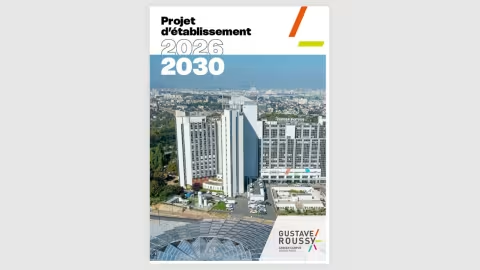
Avec son nouveau Projet d’Etablissement, Gustave Roussy réaffirme son ambition de guérir 80 % des patients d’ici 2040
Gustave Roussy, premier centre français et européen de lutte contre le cancer, dévoile son Projet d’Établissement 2026-2030. Ce projet ambitieux, fruit d’une démarche participative, actualise la trajectoire 2020-2030 de son plan stratégique institutionnel en se concentrant sur des leviers déterminants : l’individualisation des soins, l’impact de la recherche, la transformation numérique et la sécurisation des ressources. Il définit une trajectoire claire pour transformer durablement la prise en charge oncologique et accélérer l’innovation.
-
Video: Corporate Video
Watch the Institute's promotional video on YouTube