Welcome to the new Gustave Roussy website
A new website designed to offer you a simpler, clearer, and more intuitive experience. Patients, caregivers, healthcare professionals, and donors: find information, news, and services more easily.
What is a clinical trial?
Clinical trials are used to evaluate new diagnostic and treatment approaches in order to improve patient care. They are an essential step before new therapies can be made available in routine clinical practice.

A crucial step in medical innovation
Every therapeutic advance is the result of many years of research.
Before a drug, surgical technique, radiation therapy protocol, or new treatment strategy can be made available to all patients, its effectiveness and safety must be evaluated through rigorous clinical trials.
These studies may involve:
- new drugs;
- new drug combinations;
- new methods of administration;
- innovations in surgery;
- new radiation therapy techniques;
- innovative diagnostic strategies;
- treatment strategies
Clinical trials may be conducted by the pharmaceutical industry, academic research groups, or directly by Gustave Roussy.
A strict and secure environment
All clinical trials undergo regulatory and ethical review before they begin. They follow a specific scientific protocol designed to ensure the safety of participants, the quality of the data collected, respect for patients' rights, and the scientific validity of the results.
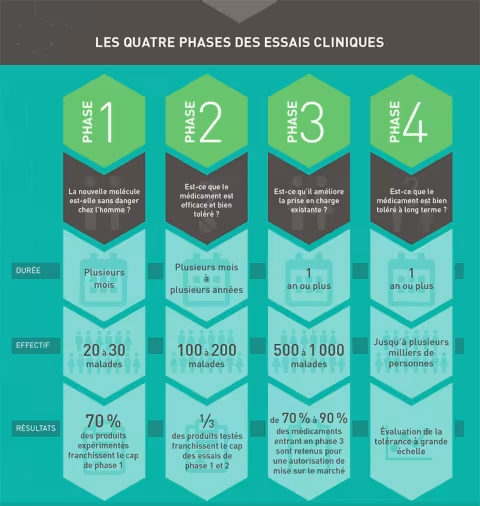
The Four Phases of a Clinical Trial
This first step helps determine the appropriate dose and identify any potential side effects of the treatment being studied.
Primary objective: to ensure that the treatment can be administered safely.
Once the dose has been determined, the treatment is tested in a larger group of patients with the same type of cancer.
Primary objective: to determine whether the treatment produces the expected effects.
The new treatment is compared to standard care in large-scale studies. These trials are generally based on randomization, that is, the random assignment of participants to different treatment groups.
Primary objective: to confirm the clinical benefit of the treatment and support a potential marketing authorization.
Even after marketing authorization, treatments continue to be monitored.
The main objective is to identify any rare or delayed adverse effects and to better understand their long-term use.
Explanatory Diagram