Welcome to the new Gustave Roussy website
A new website designed to offer you a simpler, clearer, and more intuitive experience. Patients, caregivers, healthcare professionals, and donors: find information, news, and services more easily.
ASCO 2019: Artificial intelligence can predict the chances of post-treatment fatigue in breast cancer
On
Changed on
Chicago, 1st june 2019
ASCO 2019
Artificial intelligence can predict the chances of post-treatment fatigue in breast cancer
Research results presented at the 2019 ASCO Conference show for the first time that artificial intelligence can help predict the chances of development of severe fatigue in women due to undergo treatment for breast cancer. This is before they commence treatment and even before they show clinical symptoms associated with such asthenia. This work, conducted on patients in the CANTO (CANcer TOxicities) cohort, demonstrates the value of exploring the possibilities that artificial intelligence may offer for curing breast cancer while restricting the possible sequelae to a minimum.
More than a quarter of patients experience severe fatigue in the months following completion of breast cancer treatment. This is not the simple fatigue that everyone may feel at the end of a long day at work or after heavy physical exertion. Patients are exhausted by this fatigue with its physical, cognitive and emotional components, and feel worn out. The least activity becomes a real ordeal. “Some patients can no longer manage to leave the house; their lives are turned upside down,” pointed out medical researcher and head of the fatigue outpatient facility at Gustave Roussy, Dr. Inès Vaz-Luis. A part of the latter’s research focuses on fatigue following breast cancer and is supported by Susan Komen for the Cure.
Gustave Roussy medical researchers in collaboration with colleagues at the Memorial Sloan-Kettering Cancer Center tried to develop a test which can recognise at the time of diagnosis of breast cancer, before institution of treatment, which women are likely to be affected by fatigue. The aim is to recommend, within the bounds of the possible, alternative, better-tolerated therapies.
The researchers used patients from the CANTO cohort, sponsored by Unicancer and coordinated by Professor Fabrice André, Inserm Research Director and Gustave Roussy oncologist with a special interest in breast cancer. This is mainly financed by the Agence Nationale de la Recherche (National Research Agency) through the “Investments in the Future” programme. It is a very large cohort study initiated in 2012 which recruited 12,000 patients from more than 20 centres in France. Having selected those patients who were not fatigued before being treated, their genome was sequenced looking for various genetic polymorphisms (variations in gene sequences, performed using Genmed). Then, employing an artificial intelligence technique, combinations of genetic polymorphisms which might cause post-treatment fatigue were identified. “We noted that the presence of a number of genetic disruptions related to signal transmission between synapses resulted in an increased probability of developing cognitive fatigue following breast cancer treatment,” reported Professor André. This might explain why these women mainly manifest cognitive fatigue following treatment.
“Thanks to this technique, we managed to predict cognitive fatigue in patients before they had experienced other clinical symptoms,” stated Dr. Vaz-Luis.
A study conducted by Dr. Vaz-Luis and presented in October 2018 at the European Society for Medical Oncology (ESMO 2018) Congress, had previously identified clinical factors associated with the risk of having chronic fatigue at one year after breast cancer treatment: young patients, smokers and those with one or more other conditions in addition to their breast cancer.
Oral session
Saturday 1st June from 8:36 to 8:48 am (Chicago time) - Room S102
▶ Read the abstract N° 11515
▶
cp_asco_2019_artificial-intelligence-01-06-2019.pdf
▶ See all the ASCO 2019 videos
Press contact
If you are a journalist and have a question, please contact:
Claire Parisel or Léona Pinto
Tel. +33 1 42 11 50 59
Tel. +33 1 42 11 63 59
Mob. +33 6 17 66 00 26
Email
The Media Team cannot respond to patient inquiries.
Last press releases
-
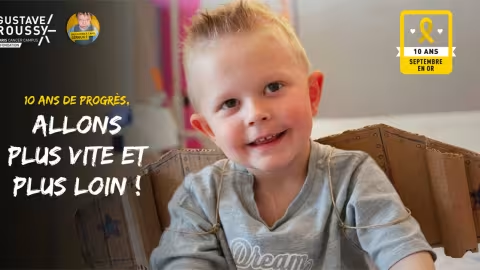
Gold september: two new research programmes launched to tackle childhood cancers
Two of Gustave Roussy’s four new medical and scientific programmes are dedicated to childhood cancers. The first, DECRIPT, aims to improve understanding of the role played by genetics in the development of certain childhood cancers, as well as second cancers that may occur in adulthood. The second, INSPIRE, will draw on the knowledge and techniques already developed at the Institute to create organoids, with the aim of deciphering the mechanisms underlying metastasis and resistance to treatment.
-
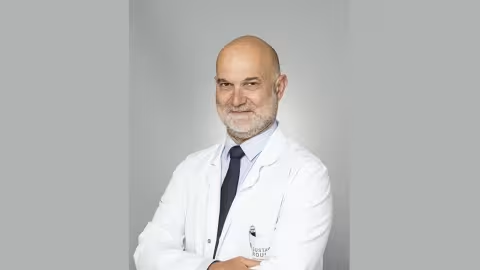
Prof. Fabrice Barlesi reappointed at the head of Gustave Roussy, the leading cancer center in France and Europe
By order of Ms. Stéphanie Rist, Minister of Health, Families, Autonomy and Persons with Disabilities, dated 27 July 2026, Professor Fabrice Barlesi has been reappointed as Director General of Gustave Roussy, effective 1 August 2026. At the helm of the Institute for five more years, Prof. Barlesi will continue the transformations undertaken during his first term. This renewal reflects the confidence placed in the project led by the institution to accelerate progress in the fight against cancer, foster and support the development of innovations set to change the future of oncology, and strengthen the influence of one of the world's leading cancer centers.
-
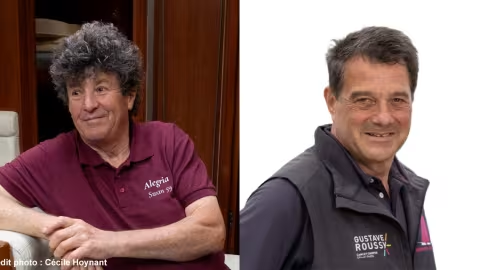
Route du Rhum 2026 Jean Le Cam and Christophe Rateau to sail for Gustave Roussy
For the Route du Rhum - Destination Guadeloupe 2026, Jean Le Cam and Christophe Rateau will sail under the colors of Gustave Roussy, the leading cancer center in France and Europe. Competing respectively in the Vintage and Class40 categories, the two skippers will carry the Institute's mission to the general public, supporting cancer research and raising awareness of prevention, innovation and patient care.
-
Owkin and Gustave Roussy partner to bring K Pro into real-world clinical practice
Owkin and Gustave Roussy, Europe's leading cancer center, today announced a partnership to test K Pro directly within the hospital's real-world clinical and research workflows.