
Welcome to the new Gustave Roussy website
A new website designed to offer you a simpler, clearer, and more intuitive experience. Patients, caregivers, healthcare professionals, and donors: find information, news, and services more easily.
ASCO 2021 - Prostate cancer with metastases at the time of diagnosis A combination of two hormone therapies and a single chemotherapy doubles progression-free survival
On
Changed on
ASCO 2021
Prostate cancer with metastases at the time of diagnosis:
A combination of two hormone therapies and a single chemotherapy doubles progression-free survival
8th june 2021

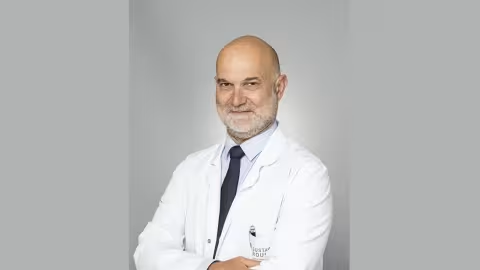
The European PEACE 1 study might shed a new light and change standard treatment in metastatic prostate cancer. The initial results from this phase III clinical trial (sponsored by Unicancer and presented at the 2021 ASCO Conference by Professor Karim Fizazi, Gustave Roussy oncologist) show that combining abiraterone, a new generation hormone therapy, with conventional hormone therapy and a chemotherapeutic agent at the outset, reduces by half the risk of tumour progression and gains two and a half years of progression-free survival.
With some 50,000 new cases diagnosed annually, prostate cancer is one of the commonest cancers and the leading one in males. In addition, it is ranked as the 3rd cause of death in men: in 2018 it resulted in 8,100 deaths in France. About 10% of prostate cancers diagnosed each year are metastatic at the time of diagnosis: for these 5,000 patients the chances of long-term survival are not high. The treatment of these tumours, which are also more aggressive, has been restricted for a long time just to inhibition of the production of testosterone, which nourishes these hormone-sensitive tumours, explained Professor Karim Fizazi, oncologist at Gustave Roussy, who specialises in the treatment of prostate cancer. He is the principal investigator in the PEACE 1 study and the good results of this are presented this year at the ASCO Conference.
“From testicular ablation, practised in the 1940s, there have been major developments in terms of suppression of testosterone production. Conventional hormone therapy medication (LHRH agonists and antagonists) has thus become standard treatment of hormone-sensitive metastatic cancer.” For a number of decades from 1980, they constituted the only therapeutic option but, in general, only allowed for one additional year of progression-free survival. A significant revolution commenced in 2015, with the development of new options which have widened the therapeutic arsenal and facilitated intensification of treatment. Several studies and meta-analyses have demonstrated that combining from the outset a taxane-based chemotherapeutic drug (docetaxel) with conventional androgen-suppressive medication increases by about 2 years the median progression-free survival. Recent data on new generation hormone therapies (abiraterone, apalumide or enzalutamide) have also shown that these improve results in comparison with those obtained by traditional hormone therapy alone. The two options have become the recommended standard treatment, the choice between them being in the hands of the oncologist. “Without any data evaluating the benefits of simultaneous administration of the various agents from the start of treatment, the question of combining them, when to do so and for how long a period remained unanswered,” explained Professor Fizazi.
The objective of the PEACE 1 European study was to resolve these uncertainties by studying the benefits of a combination of three drugs instead of only two, using two principal criteria of comparison: progression-free disease survival and overall survival rate. The preliminary results for the first assessment criterion are the subject of an oral presentation at the ASCO meeting. They now constitute a clear argument in favour of simultaneous use from the outset of three therapeutic agents: abiraterone + conventional hormone therapy + chemotherapy. The clinical trial, sponsored by Unicancer and carried out in France by the Group for Study of Urogenital Tumors (GETUG) was conducted between 2013 and 2018 on a cohort of 1,173 patients, median age 67, recruited in 80 hospitals in seven European countries (France, Spain, Italy, Switzerland, Ireland, Belgium and Romania). All patients had recently diagnosed metastatic prostate cancer but were allowed at inclusion to have already started a conventional hormone therapy less than three months previously. They were assigned randomly to one of two groups. In the first they received three drugs: conventional hormone therapy together with 6 cycles of docetaxel (75 mg/m2), administered at three-weekly intervals, and abiraterone 1,000 mg/day. The control group received a combination of two drugs: conventional hormone therapy + chemotherapy. Follow-up at 42 months “showed a marked improvement in radiological progression-free survival in the group treated with the addition of abiraterone, independently of the number of metastases present at diagnosis,” concluded Professor Fizazi. In fact, a difference of two and a half years was observed between the two groups of patients thanks to the addition of abiraterone, while the control group results confirmed those already obtained in previous studies (e.g. STAMPEDE) with median progression-free survival of 2 years obtained by combining chemotherapy and conventional hormone therapy. “Gaining two and a half additional symptom-free years with no elevation of laboratory disease markers and thus achieving an overall progression-free survival of four and a half years is unheard of! An additional piece of good news is that the three-drug regimen did not induce any particular increase in toxicity over a 6-month period. We did not see any adverse effects other than those for which abiraterone is well-known to be responsible - hypertension, hypokalaemia and elevation of hepatic transaminases, the majority being benign.” rejoiced Karim Fizazi.
Might adding abiraterone at the initiation of treatment to the combination of hormone therapy + chemotherapy become the new standard treatment of prostate cancer when metastases are present at the time of diagnosis? “Classically, in oncology, one may not decide until the benefits of treatment on overall survival have been assessed.” The PEACE 1 results for this second principal criterion will not be known until after the summer, “but the question deserves to be asked now,” judged Professor Fizazi, “Gaining two and a half additional years of progression-free survival in comparison with the current standard represents a great benefit for these patients and the results are, to my mind, sufficiently reliable for us to change practice”.
Oral presentation by Prof. Karim FIZAZI
8th june 2021 at 14:00
Abstract #5000
► Read the abstract
pr-asco21-peace1-prostate-en.pdf
Press contact
If you are a journalist and have a question, please contact:
Claire Parisel or Léona Pinto
Tel. +33 1 42 11 50 59
Tel. +33 1 42 11 63 59
Mob. +33 6 17 66 00 26
Email
The Media Team cannot respond to patient inquiries.
Last press releases
-
Gold september: two new research programmes launched to tackle childhood cancers
Two of Gustave Roussy’s four new medical and scientific programmes are dedicated to childhood cancers. The first, DECRIPT, aims to improve understanding of the role played by genetics in the development of certain childhood cancers, as well as second cancers that may occur in adulthood. The second, INSPIRE, will draw on the knowledge and techniques already developed at the Institute to create organoids, with the aim of deciphering the mechanisms underlying metastasis and resistance to treatment.

-
Prof. Fabrice Barlesi reappointed at the head of Gustave Roussy, the leading cancer center in France and Europe
By order of Ms. Stéphanie Rist, Minister of Health, Families, Autonomy and Persons with Disabilities, dated 27 July 2026, Professor Fabrice Barlesi has been reappointed as Director General of Gustave Roussy, effective 1 August 2026. At the helm of the Institute for five more years, Prof. Barlesi will continue the transformations undertaken during his first term. This renewal reflects the confidence placed in the project led by the institution to accelerate progress in the fight against cancer, foster and support the development of innovations set to change the future of oncology, and strengthen the influence of one of the world's leading cancer centers.
-
Route du Rhum 2026 Jean Le Cam and Christophe Rateau to sail for Gustave Roussy
For the Route du Rhum - Destination Guadeloupe 2026, Jean Le Cam and Christophe Rateau will sail under the colors of Gustave Roussy, the leading cancer center in France and Europe. Competing respectively in the Vintage and Class40 categories, the two skippers will carry the Institute's mission to the general public, supporting cancer research and raising awareness of prevention, innovation and patient care.

-
Owkin and Gustave Roussy partner to bring K Pro into real-world clinical practice
Owkin and Gustave Roussy, Europe's leading cancer center, today announced a partnership to test K Pro directly within the hospital's real-world clinical and research workflows.