Welcome to the new Gustave Roussy website
A new website designed to offer you a simpler, clearer, and more intuitive experience. Patients, caregivers, healthcare professionals, and donors: find information, news, and services more easily.
ASCO 2022 -A promising targeted therapy for treatment of relapses of acute myeloid leukaemia
On
ASCO 2022
A promising targeted therapy for treatment of relapses of acute myeloid leukaemia
Villejuif, 7th June 2022
The results of the Phase III IDHENTIFY study convey new hope for patients with relapsed acute myeloid leukaemia who bear certain mutations of the IDH-2 protein. Enasidenib, a novel highly-targeted therapy, improves survival rates, complete remissions and quality of life. These results were presented at an oral session of the American Society of Clinical Oncology (ASCO) by Dr Stéphane de Botton, Head of the Haematology Team at the Gustave Roussy Institute and lead investigator for this study.
Abstract No. 7005 presented by Dr Stéphane de Botton in oral session Tuesday 7th June at 6.33 pm
Acute myeloid leukaemia (AML) is rare and difficult to treat. It is characterised by uncontrolled proliferation of undifferentiated cells within the bone marrow. Its incidence (around 3,500 cases per year) increases with age, the mean age at diagnosis being 68 years. An IDH2 gene mutation is found in 8 to 20% of individuals with AML. “In the majority of such cases, one of two IDH2 mutations is present: the first, R140Q, is found in 3/4 of patients and the second, R172K, is detected in the remaining quarter,” explained Dr de Botton, Head of the Haematology Team at the Gustave Roussy Institute and lead investigator in the phase III IDHENTIFY study.
A new agent, enasidenib, which specifically targets these IDH2 mutations in acute myeloid leukaemia, is currently available in the United States but not in France.
A well-tolerated treatment which improves patient survival
The phase III open-label, randomised IDHENTIFY trial is the first to compare the efficacy and safety of enasidenib in comparison with standard salvage therapy (chemotherapy or palliative support).
To evaluate this selective IDH2 inhibitor, 319 patients over the age of 60, who were in relapse and all of whom had also received at least two treatment lines, participated in this international study. In view of their age and/or state of health, it was not possible for them to receive intensive chemotherapy. The patients were divided into two groups according to their mutation: R140Q or R172 K. “This criterion is relevant as it had previously been shown that patients with the R172K mutation could be expected to respond better to medication,” pointed out Dr Stéphane de Botton.
In each cohort, the sub-group to receive enasidenib and that to have conventional salvage therapy (azacitidine at intermediate dose levels or low-dose Aracytine [cytarabine], or supportive therapy) was selected randomly. The study assessment criteria were: overall survival, the level of response to treatment and the duration of the relapse-free period.
The results showed that 36.5% of the patients carrying mutation R140Q and receiving enasidenib responded to the treatment with18.5% achieving complete remission, compared with 11.4% and 3.5% respectively in those in the standard therapy sub-group.
The results were even more impressive in the group of patients with the R172K mutation: here 51.2% of the patients responded to enasidenib compared with 6.7% in the control group and the remission rate was 37.2 % versus 4.4%. Survival without an adverse event and the duration of the relapse-free period were also higher in the sub-groups who received enasidenib.
“On assessing these excellent findings, this perfectly safe, highly-targeted treatment ought to become the reference treatment for acute myeloid leukaemia patients with the R172K mutation who have relapsed or are refractory to treatment,” concluded Dr de Botton.
This study follows previous ones conducted by Dr Stéphane de Botton, presented at ASCO 2021 and published in high-quality journals, which have demonstrated the efficacy of highly-targeted agents in refractory or relapsed acute myeloid leukaemia.
Abstract No. 7005
Overall survival by IDH2 mutant allele (R140 or R172) in patients with late-stage mutant-IDH2 relapsed or refractory acute myeloid leukemia treated with enasidenib or conventional care regimens in the phase 3 IDHENTIFY trial.
Oral abstract session
Tuesday 7th June 2022 | 18:33 – 18:45 UTC+2
Press contact
If you are a journalist and have a question, please contact:
Claire Parisel or Léona Pinto
Tel. +33 1 42 11 50 59
Tel. +33 1 42 11 63 59
Mob. +33 6 17 66 00 26
Email
The Media Team cannot respond to patient inquiries.
Last press releases
-
Gold september: two new research programmes launched to tackle childhood cancers
Two of Gustave Roussy’s four new medical and scientific programmes are dedicated to childhood cancers. The first, DECRIPT, aims to improve understanding of the role played by genetics in the development of certain childhood cancers, as well as second cancers that may occur in adulthood. The second, INSPIRE, will draw on the knowledge and techniques already developed at the Institute to create organoids, with the aim of deciphering the mechanisms underlying metastasis and resistance to treatment.

-
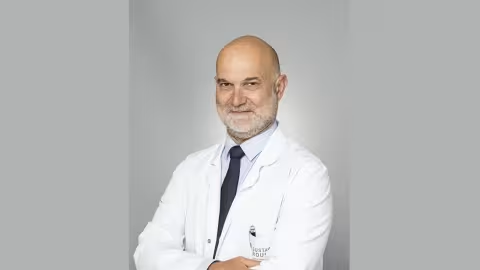
Prof. Fabrice Barlesi reappointed at the head of Gustave Roussy, the leading cancer center in France and Europe
By order of Ms. Stéphanie Rist, Minister of Health, Families, Autonomy and Persons with Disabilities, dated 27 July 2026, Professor Fabrice Barlesi has been reappointed as Director General of Gustave Roussy, effective 1 August 2026. At the helm of the Institute for five more years, Prof. Barlesi will continue the transformations undertaken during his first term. This renewal reflects the confidence placed in the project led by the institution to accelerate progress in the fight against cancer, foster and support the development of innovations set to change the future of oncology, and strengthen the influence of one of the world's leading cancer centers.
-
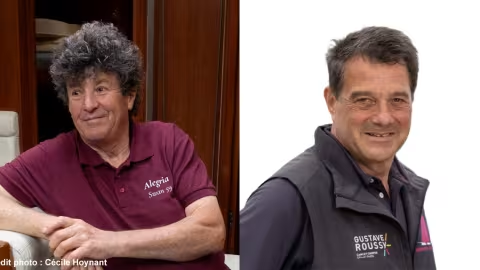
Route du Rhum 2026 Jean Le Cam and Christophe Rateau to sail for Gustave Roussy
For the Route du Rhum - Destination Guadeloupe 2026, Jean Le Cam and Christophe Rateau will sail under the colors of Gustave Roussy, the leading cancer center in France and Europe. Competing respectively in the Vintage and Class40 categories, the two skippers will carry the Institute's mission to the general public, supporting cancer research and raising awareness of prevention, innovation and patient care.
-
Owkin and Gustave Roussy partner to bring K Pro into real-world clinical practice
Owkin and Gustave Roussy, Europe's leading cancer center, today announced a partnership to test K Pro directly within the hospital's real-world clinical and research workflows.