
Welcome to the new Gustave Roussy website
A new website designed to offer you a simpler, clearer, and more intuitive experience. Patients, caregivers, healthcare professionals, and donors: find information, news, and services more easily.
ASCO 2024 - Early screening for depressive symptoms in breast cancer
On

Villejuif, 3 June 2024
ASCO 2024 – Clinical science symposium
Early screening for depressive symptoms in breast cancer
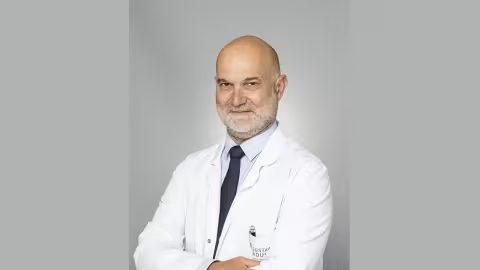
Depressive symptoms are common among women with breast cancer. They lead to impaired quality of life, are associated with poorer treatment adherence and an increased risk of death. A survey presented to ASCO on 3 June 2024 by Dr. Antonio Di Meglio, medical oncologist at Gustave Roussy, breast cancer specialist and researcher in the “Après Cancer” (after cancer) team, looked at the determinants of depression in the course of breast cancer. His work identified a number of risk factors.
This oral presentation is one of the 135 presentations on the agenda for this 2024 edition of ASCO, in which Gustave Roussy’s research physicians took part, including 29 oral presentations. Gustave Roussy is present in many fields of expertise, attesting to the quality of the research carried out there and its international recognition.
The aim of this work was to profile patients at risk of depression as soon as breast cancer was diagnosed in order to implement targeted strategies to prevent this risk.
To carry out this work, Gustave Roussy’s team of researchers relied on the CANTO cohort, sponsored by Unicancer, launched in 2012 at 26 centres in France and comprised of 14,000 women with localised breast cancer. This cohort collects multiple data on patients’ clinical characteristics, socio-economic information, medical history, type of cancer, treatments, toxicity, and cancer-related disorders.
The study conducted by Dr. di Meglio looked at the possible depressive disorders of 9,087 patients in this cohort. All were followed for six years after diagnosis. All of these women underwent surgery, approximately 90% received radiotherapy, 82% hormone therapy and 53% chemotherapy.
"This work enabled us to identify several groups of women based on their depressive symptoms, says Dr. Antonio di Meglio. In total, 70% had little or no depressive symptoms, at diagnosis and treatment, and during 6 years of follow-up. Nearly 7% of the patients in this study already had depressive disorders at the time of diagnosis, which resolved very quickly after active treatment (surgery, chemotherapy, radiation therapy). By contrast, 20% of these women developed depression during the treatment phase or six-year follow-up period, although they did not necessarily have depressive disorder before diagnosis." It also appeared that the active treatment phase presented the greatest risk for the onset and worsening of depressive symptoms. However, the type of treatment received did not appear to be a risk factor for depression.
Research into determinants associated with depression in this cohort of women precisely identified several risk factors. Thus, while this cohort covers women aged 20 to 85, it appears that older women have an increased risk of depression, as do those with a high body mass index (overweight or obese) and those with a lower socio-economic level. Women with a history of psychiatric disorders, those already complaining of increased fatigue, anxiety problems, cognitive disorders, or poor self-image at the time of diagnosis were also more likely to have depressive symptoms.
These patients, who had presented with depressive disorders during breast cancer, also mentioned a greater impact of cancer in their lives: positive impact with more altruism, empathy for others, greater awareness of health; but also negative impact with more concern in general, in particular concerning employment and relationships with the partner. During the treatment phase, most often associated with the onset of depressive disorder, a change in lifestyle, with weight gain, reduced physical activity, increased alcohol consumption, was associated with more severe depressive symptoms.
This work will enable us to better identify, from the moment of diagnosis, those women with breast cancer who are most at risk of depression, so that we can implement prevention and treatment strategies. "Screening and monitoring for depressive symptoms is essential to intercept the psychological vulnerability of women diagnosed with breast cancer," concludes Dr Di Meglio. "Appropriate psychological support, along with interventions aimed at mitigating health-risking behaviours such as weight gain, sedentary behaviour and alcohol consumption, particularly during the treatment phase, could help reduce long-term depressive symptoms after breast cancer treatment".
Abstract no. 12009 - Patterns of depressive symptoms among survivors of early-stage breast cancer (BC) - Clinical science symposium – Monday, 3 June 2024 | 4:42 p.m. UTC-5.
cp-asco24-dimeglio-en-030624.pdf
Press contact
If you are a journalist and have a question, please contact:
Claire Parisel or Léona Pinto
Tel. +33 1 42 11 50 59
Tel. +33 1 42 11 63 59
Mob. +33 6 17 66 00 26
Email
The Media Team cannot respond to patient inquiries.
Last press releases
-
Gold september: two new research programmes launched to tackle childhood cancers
Two of Gustave Roussy’s four new medical and scientific programmes are dedicated to childhood cancers. The first, DECRIPT, aims to improve understanding of the role played by genetics in the development of certain childhood cancers, as well as second cancers that may occur in adulthood. The second, INSPIRE, will draw on the knowledge and techniques already developed at the Institute to create organoids, with the aim of deciphering the mechanisms underlying metastasis and resistance to treatment.

-
Prof. Fabrice Barlesi reappointed at the head of Gustave Roussy, the leading cancer center in France and Europe
By order of Ms. Stéphanie Rist, Minister of Health, Families, Autonomy and Persons with Disabilities, dated 27 July 2026, Professor Fabrice Barlesi has been reappointed as Director General of Gustave Roussy, effective 1 August 2026. At the helm of the Institute for five more years, Prof. Barlesi will continue the transformations undertaken during his first term. This renewal reflects the confidence placed in the project led by the institution to accelerate progress in the fight against cancer, foster and support the development of innovations set to change the future of oncology, and strengthen the influence of one of the world's leading cancer centers.
-
Route du Rhum 2026 Jean Le Cam and Christophe Rateau to sail for Gustave Roussy
For the Route du Rhum - Destination Guadeloupe 2026, Jean Le Cam and Christophe Rateau will sail under the colors of Gustave Roussy, the leading cancer center in France and Europe. Competing respectively in the Vintage and Class40 categories, the two skippers will carry the Institute's mission to the general public, supporting cancer research and raising awareness of prevention, innovation and patient care.

-
Owkin and Gustave Roussy partner to bring K Pro into real-world clinical practice
Owkin and Gustave Roussy, Europe's leading cancer center, today announced a partnership to test K Pro directly within the hospital's real-world clinical and research workflows.