Welcome to the new Gustave Roussy website
A new website designed to offer you a simpler, clearer, and more intuitive experience. Patients, caregivers, healthcare professionals, and donors: find information, news, and services more easily.
ASCO 2025 - For the first time in 20 years, a new treatment shows benefit in high-risk head and neck cancers
On
Changed on
ASCO 2025 – Plenary session
Villejuif, 1 June 2025
For the first time in 20 years, a new treatment shows benefit in high-risk head and neck cancers
Patients with high-risk resected head and neck squamous cell carcinoma have seen no major therapeutic advances since 2004, when the current standard of care was established. The results of the European phase III trial NIVOPOSTOP (GORTEC 2018-01), presented in the plenary session at the ASCO congress, mark a turning point for these patients with an otherwise poor prognosis. Sponsored by GORTEC, the French cooperative research group dedicated to head and neck cancers, the study demonstrates the benefit of adding immunotherapy after surgery in this setting. In the long term, it paves the way for a new global standard of care. Dr Yungan Tao, radiation oncologist at Gustave Roussy, head and neck cancer specialist and President-elect of GORTEC, coordinated the international NIVOPOSTOP trial in France.
Abstract No. LBA2 presented orally by Pr Jean Bourhis, international study coordinator, on Sunday, 1 June at 13:37 UTC – 5.
This oral presentation is one of the 109 presentations featured in the 2025 ASCO programme with contributions from Gustave Roussy’s physician-scientists. Gustave Roussy is active across numerous areas of expertise, reflecting both the high quality of the research carried out at the Institute and its international standing.
Head and neck squamous cell carcinomas (HNSCC) – cancers linked to tobacco, alcohol, or human papillomavirus (HPV) – account for around 90% of all head and neck cancers. These malignancies arise in the mucous membranes of the mouth, pharynx or larynx. Even when operable, some of these tumours carry a high risk of recurrence after surgery. Two key high-risk factors have been identified: (1) when the tumour has spread beyond the membrane of the cervical lymph nodes; and (2) when complete microscopic resection could not be achieved.
The last major advance in the management of this disease – the addition of cisplatin-based chemotherapy to postoperative radiotherapy – dates back over 20 years. Yet relapse remains common, with nearly half of high-risk patients experiencing a recurrence. At this stage, therapeutic options are limited, underscoring the need for more effective treatments. Numerous trials have been conducted in recent years, including those involving EGFR inhibitors, but none have yielded sufficient evidence to change clinical practice or significantly improve outcomes.
It is in this context that the international phase III trial NIVOPOSTOP (GORTEC 2018-01) was launched to assess the addition of immunotherapy to the current standard treatment. GORTEC, the cooperative group behind the study, is dedicated to head and neck oncology and has extensive experience in conducting large-scale, innovative international phase III trials. Its work is based on robust, high-quality trial management and a strong multidisciplinary network of investigators and experts in head and neck cancers. GORTEC is currently chaired by Dr Yoann Pointreau, with Dr Yungan Tao serving as President-elect.
Improved Disease-Free Survival
The NIVOPOSTOP trial was conducted between 2018 and 2024 across six countries and enrolled 680 patients under the age of 75 who had undergone surgery for a locally advanced squamous cell carcinoma of the oral cavity, oropharynx, hypopharynx or larynx, and presented with at least one high-risk feature for recurrence.
Following surgery, patients were randomised into two groups: one received the standard treatment (radiotherapy plus three cycles of cisplatin), while the other also received immunotherapy with nivolumab. The immunotherapy was administered in 10 doses over eight months, starting two weeks before chemoradiotherapy, continuing during it, and then as a six-month maintenance phase.
The results, presented at the ASCO Congress, demonstrate that the addition of nivolumab significantly improves disease-free survival, reducing the risk of recurrence and/or death by 24%.
“After a median follow-up of over 30 months, the three-year disease-free survival rate increased from 52.5% with standard treatment to 63.1% with the addition of immunotherapy. This is the first major advance in this clinical setting in more than two decades,” says Dr Yungan Tao, last author of the NIVOPOSTOP study. The benefit was observed regardless of PD-L1 expression, a biomarker often used to predict immunotherapy response.
These findings mark a major step forward in the management of high-risk head and neck cancers. “Although overall survival data are not yet available, the addition of immunotherapy to the current standard of care is expected to become the new therapeutic standard for these patients,” Dr Tao concludes.
Abstract no. LBA2
NIVOPOSTOP (GORTEC 2018-01): A phase III randomized trial of adjuvant nivolumab added to radio-chemotherapy in patients with resected head and neck squamous cell carcinoma at high risk of relapse.
Plenary session presented by Pr Jean Bourhis.
Sunday, 1 June 2025 | 13:37 UTC-5.
cp-asco25-headneck-cancers-nivopostop-en.pdf
Press contact
If you are a journalist and have a question, please contact:
Claire Parisel or Léona Pinto
Tel. +33 1 42 11 50 59
Tel. +33 1 42 11 63 59
Mob. +33 6 17 66 00 26
Email
The Media Team cannot respond to patient inquiries.
Last press releases
-
Gold september: two new research programmes launched to tackle childhood cancers
Two of Gustave Roussy’s four new medical and scientific programmes are dedicated to childhood cancers. The first, DECRIPT, aims to improve understanding of the role played by genetics in the development of certain childhood cancers, as well as second cancers that may occur in adulthood. The second, INSPIRE, will draw on the knowledge and techniques already developed at the Institute to create organoids, with the aim of deciphering the mechanisms underlying metastasis and resistance to treatment.

-
Prof. Fabrice Barlesi reappointed at the head of Gustave Roussy, the leading cancer center in France and Europe
By order of Ms. Stéphanie Rist, Minister of Health, Families, Autonomy and Persons with Disabilities, dated 27 July 2026, Professor Fabrice Barlesi has been reappointed as Director General of Gustave Roussy, effective 1 August 2026. At the helm of the Institute for five more years, Prof. Barlesi will continue the transformations undertaken during his first term. This renewal reflects the confidence placed in the project led by the institution to accelerate progress in the fight against cancer, foster and support the development of innovations set to change the future of oncology, and strengthen the influence of one of the world's leading cancer centers.
-
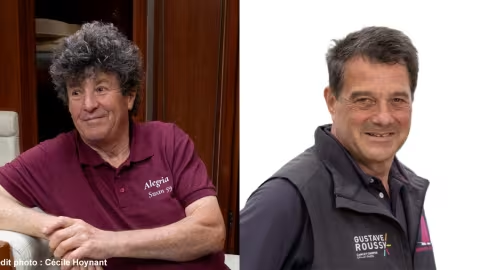
Route du Rhum 2026 Jean Le Cam and Christophe Rateau to sail for Gustave Roussy
For the Route du Rhum - Destination Guadeloupe 2026, Jean Le Cam and Christophe Rateau will sail under the colors of Gustave Roussy, the leading cancer center in France and Europe. Competing respectively in the Vintage and Class40 categories, the two skippers will carry the Institute's mission to the general public, supporting cancer research and raising awareness of prevention, innovation and patient care.
-
Owkin and Gustave Roussy partner to bring K Pro into real-world clinical practice
Owkin and Gustave Roussy, Europe's leading cancer center, today announced a partnership to test K Pro directly within the hospital's real-world clinical and research workflows.