
Welcome to the new Gustave Roussy website
A new website designed to offer you a simpler, clearer, and more intuitive experience. Patients, caregivers, healthcare professionals, and donors: find information, news, and services more easily.
ESMO 2022 - Internal vectorised radiotherapy is effective in neuroendocrine tumours of the pancreas
On
Changed on
12th September 2022
ESMO 2022
Internal vectorised radiotherapy is effective in neuroendocrine tumours of the pancreas
The OCCLURANDOM trial is the first phase II randomised study to demonstrate the clinical superiority of internal vectorised radiotherapy (Octreotate-DOTA-Lutetium 177) in comparison with standard therapy in advanced pancreatic neuroendocrine tumours. This novel therapy results in a one-year survival rate without disease progression in 80% of patients eligible for treatment, compared with a value of 40% in those treated with standard therapy (sunitinib) in the “internal control” arm. This internal radiotherapy has European marketing authorisation in grade 1-2 gastrointestinal tract and pancreatic neuroendocrine tumours, but, in the absence of randomised trial results, has not yet obtained entitlement to reimbursement of costs for advanced pancreatic neuroendocrine tumours. By virtue of this study, the level of proof of efficacy is now higher, giving rise to the hope that French patients may be able to access this treatment.
Study presented Monday 12th September at 4.40 pm in an oral session of the ESMO (European Society for Medical Oncology) Congress by Dr Eric Baudin, head of the neuroendocrine tumour team at Gustave Roussy.
Pancreatic neuroendocrine tumours represent a disease that is distinct from adenocarcinoma of the pancreas. On average, they affect one individual in 100,000 per year, around half of cases being metastatic. This rare cancer has a very variable survival rate ranging from 5 to 15 years. The neuroendocrine tumour cells possess the characteristic of over-expressing somatostatin hormone receptors. These receptors mean that the tumour cells can capture and internalise Octreotate-DOTA-Lutetium, consisting of a hormonal vector (octreotate, a peptide analogue of somatostatin) to which is attached a radioisotope (lutetium) which results in internal delivery of radiation to the tumour cells.
The OCCLURANDOM trial, sponsored by Gustave Roussy and conducted in collaboration with the French Network for management of neuroendocrine tumours (Endocan Renaten), studied this novel internal radiotherapy (Octreotate-DOTA-Lutetium 177) (injected intravenously).
Although this treatment has been accorded European marketing authorisation, French patients do not have access to it, as the authorisation was based on a retrospective study, which does not allow for the possibility of reimbursement of costs.
Superiority of a novel internal vectorised radiotherapy
In this phase II randomised multicentre trial, internal vectorised radiotherapy, Octreotate-DOTA-Lutetium 177 was compared to sunitinib, a well-known targeted therapy in oncological practice which has been tested and shown to be effective in advanced progressive pancreatic neuroendocrine tumours over a period of one year. 84 patients with aggressive, progressive pancreatic neuroendocrine tumours with metastases were recruited over a five year period and randomly distributed between the two arms of the study. Patients were enrolled only if isotope scanning was positive for somatostatin receptors, with isotope uptake within the tumours. The patients had already received a number of therapies.
The first group received an injection of Octreotate-Lutetium at the hospital at 2-month intervals for a total of 4 doses; the second group one 37.5 mg tablet of sunitinib daily. The median period of follow-up was 40 months.
The findings presented at the ESMO 2022 Congress showed that at one year the disease had not progressed in 80% of the patients who had received internal octreotate-lutetium radiotherapy, compared with 43% in the sunitinib control arm. “This is the first phase II prospective randomised study to have delivered such a level of proof of the value of this therapy in progressive metastatic pancreatic neuroendocrine tumours,” explained Dr Baudin.
Unwanted effects of the therapies were also studied. Up to this point, there has been no excess of radiotherapy-induced cancers, one of the side effects of this type of radiotherapy. Monitoring of the treated patients is continuing.
“This trial may help speed up reimbursement of this treatment in France. Further studies and results are needed, in particular to define the place of this novel treatment in the sequence of therapy. But this first randomised study shows that it is possible to recommend this therapeutic approach in preference to sunitinib in this category of patients,” concluded Dr Baudin.
Abstract n°8870
First multicentre randomized phase II trial investigating the antitumor efficacy of peptide receptor radionuclide therapy with 177Lutetium – Octreotate (OCLU) in unresectable progressive neuroendocrine pancreatic tumor: results of the OCCLURANDOM trial
Proffered paper session
Monday 12th September | 16h40 – 16h50
Press contact
If you are a journalist and have a question, please contact:
Claire Parisel or Léona Pinto
Tel. +33 1 42 11 50 59
Tel. +33 1 42 11 63 59
Mob. +33 6 17 66 00 26
Email
The Media Team cannot respond to patient inquiries.
Last press releases
-
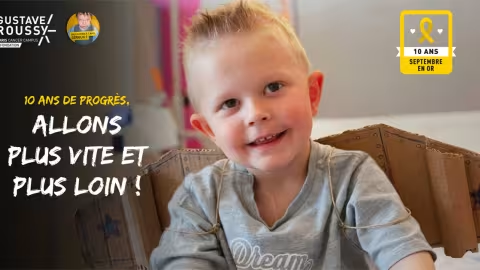
Gold september: two new research programmes launched to tackle childhood cancers
Two of Gustave Roussy’s four new medical and scientific programmes are dedicated to childhood cancers. The first, DECRIPT, aims to improve understanding of the role played by genetics in the development of certain childhood cancers, as well as second cancers that may occur in adulthood. The second, INSPIRE, will draw on the knowledge and techniques already developed at the Institute to create organoids, with the aim of deciphering the mechanisms underlying metastasis and resistance to treatment.
-
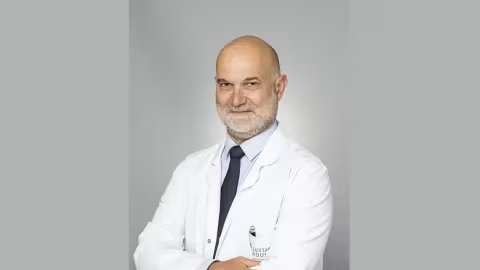
Prof. Fabrice Barlesi reappointed at the head of Gustave Roussy, the leading cancer center in France and Europe
By order of Ms. Stéphanie Rist, Minister of Health, Families, Autonomy and Persons with Disabilities, dated 27 July 2026, Professor Fabrice Barlesi has been reappointed as Director General of Gustave Roussy, effective 1 August 2026. At the helm of the Institute for five more years, Prof. Barlesi will continue the transformations undertaken during his first term. This renewal reflects the confidence placed in the project led by the institution to accelerate progress in the fight against cancer, foster and support the development of innovations set to change the future of oncology, and strengthen the influence of one of the world's leading cancer centers.
-
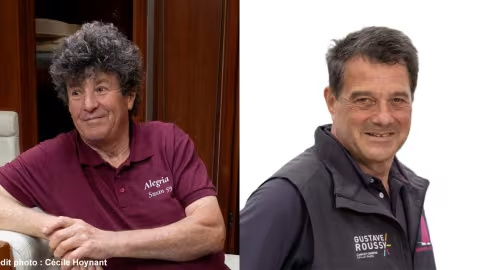
Route du Rhum 2026 Jean Le Cam and Christophe Rateau to sail for Gustave Roussy
For the Route du Rhum - Destination Guadeloupe 2026, Jean Le Cam and Christophe Rateau will sail under the colors of Gustave Roussy, the leading cancer center in France and Europe. Competing respectively in the Vintage and Class40 categories, the two skippers will carry the Institute's mission to the general public, supporting cancer research and raising awareness of prevention, innovation and patient care.
-
Owkin and Gustave Roussy partner to bring K Pro into real-world clinical practice
Owkin and Gustave Roussy, Europe's leading cancer center, today announced a partnership to test K Pro directly within the hospital's real-world clinical and research workflows.