
Welcome to the new Gustave Roussy website
A new website designed to offer you a simpler, clearer, and more intuitive experience. Patients, caregivers, healthcare professionals, and donors: find information, news, and services more easily.
Revue Nature - Une vision innovante de la classification des cancers est indispensable pour la recherche et les patients
On
Villejuif, 31st January 2024
Nature journal
An innovative vision of cancer classification is indispensible for research and for patients
From hospital organization to oncologists’ specialties, to the structuring of learned societies, regulatory agencies or clinical trials, the totality of oncology today is based on the segmentation of patients based on the organ in which the disease appeared first. A person is diagnosed with liver cancer, lung cancer, or pancreatic cancer, even if the disease has spread to other organs. In a comment published in the Nature journal, medical researchers from Gustave Roussy and Paris-Saclay University explain why it is mandatory to evolve toward a biological classification of metastatic cancers, and how the current segmentation sometimes prevents access to new therapies for millions of patients across the world.
On line article: https://www.nature.com/articles/d41586-024-00216-3
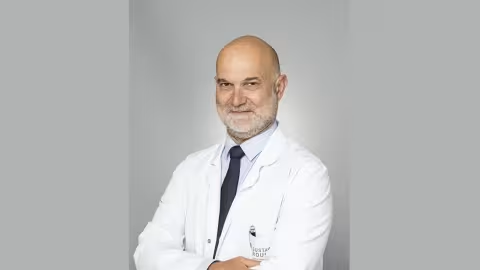
“The authoritative classification in oncology, which is based on the organ in which cancer has first appeared, no longer aligns with therapeutic advances discovered in recent years. At worst, it is sometimes an obstacle, which forbids some patients from having access to an adapted treatment. More than 80 years after the TNM classification’s creation by Pierre Denoix, former head of Gustave Roussy, it is today crucial to adopt a molecular-based approach to metastatic cancers, based on research advances”, explains Professor Fabrice Barlesi, general director of Gustave Roussy.
With the development of precision oncology, based on the molecular profiling of the tumor and its biological and immune characterization to determine treatments, the current classification, which separates cancers based on the organ of origin, shows its limits. Numerous research has enlightened common characteristics shared by various types of organ cancers, such as the mutation of the tumor suppressor gene TP53, which controls the growth and division of cells.
Thus, within a single type of organ cancer, several subgroups matching a different molecular and biological reality of the disease coexist. Among lung cancer patients, some bear a mutation of the MET gene, others of EGFR, and so on. Concerning treatments, antibody-conjugates, which target membrane proteins expressed in several types of cancer to deliver chemotherapy to cancer cells, have already shown encouraging results in phase I and phase II clinical trials, to treat patients who over-express the HER2 protein. This is without taking into account the cancer’s organ of origin. All these arguments support the necessary requalification of metastatic cancers, i.e. those spread at a distance, away from the organ of origin, and which account for 60 to 90 % of cancer deaths every year.
In addition to showing certain limits, the current classification forbids millions of patients from access to innovative treatments. We can take the example of olaparib. It is a PARP inhibitor, which was for the first time tested in a phase I pan-tumor clinical trial in 2014, during which it showed signs of effectiveness among patients with a BRCA mutation. In 2014, the FDA gave the treatment approval, but only for ovarian cancers, an approval that has been broadened in 2018 to breast cancers and in 2020 only to pancreatic and prostate cancers. These delays in the approval process can be explained by the segmentation of clinical trials, which needs to prove their effectiveness organ of origin by organ of origin. The clinical trials for anti-PD1/PDL1, an immunotherapy particularly active among patients whose cancer cells express a high level of the PD-L1 protein, have also been segmented by organ of origin after phase I, delaying the marketing approval for thousands of patients.
What this new classification implies
Phase III clinical trials, which grant marketing authorizations, require a significant number of patients. It can be hard to recruit a sufficient number of patients who all have the same biological specificity combined with histology in a similar organ of origin, to achieve a significant statistical power. Transforming the classification of cancers will help to rationalize and limit the number of clinical trials, and will lead to a new way of teaching oncology, with a major simplification for future students and patients alike.
Nevertheless, classifying cancers based on their molecular reality implies giving patients and medical researchers effective and affordable molecular profiling methods. The “France Médecine Génomique 2025” plan and the deployment of sequencing platforms across France all go in this dynamic. Artificial intelligence can play a role there. In the future, it will be able to identify at low cost genetic abnormalities from patient histology. Changing the way in which cancers are classified is the first step towards precision oncology for everyone, opening up a vast field of research for a deeper biological understanding of cancer mechanisms.
Source
Nature
The way we name cancers needs to change
Comment published January, 31st 2024
DOI : 10.1038/d41586-024-00216-3
pr-nature-innovative-cancer-classification-010224.pdf
Press contact
If you are a journalist and have a question, please contact:
Claire Parisel or Léona Pinto
Tel. +33 1 42 11 50 59
Tel. +33 1 42 11 63 59
Mob. +33 6 17 66 00 26
Email
The Media Team cannot respond to patient inquiries.
Last press releases
-
Gold september: two new research programmes launched to tackle childhood cancers
Two of Gustave Roussy’s four new medical and scientific programmes are dedicated to childhood cancers. The first, DECRIPT, aims to improve understanding of the role played by genetics in the development of certain childhood cancers, as well as second cancers that may occur in adulthood. The second, INSPIRE, will draw on the knowledge and techniques already developed at the Institute to create organoids, with the aim of deciphering the mechanisms underlying metastasis and resistance to treatment.

-
Prof. Fabrice Barlesi reappointed at the head of Gustave Roussy, the leading cancer center in France and Europe
By order of Ms. Stéphanie Rist, Minister of Health, Families, Autonomy and Persons with Disabilities, dated 27 July 2026, Professor Fabrice Barlesi has been reappointed as Director General of Gustave Roussy, effective 1 August 2026. At the helm of the Institute for five more years, Prof. Barlesi will continue the transformations undertaken during his first term. This renewal reflects the confidence placed in the project led by the institution to accelerate progress in the fight against cancer, foster and support the development of innovations set to change the future of oncology, and strengthen the influence of one of the world's leading cancer centers.
-
Route du Rhum 2026 Jean Le Cam and Christophe Rateau to sail for Gustave Roussy
For the Route du Rhum - Destination Guadeloupe 2026, Jean Le Cam and Christophe Rateau will sail under the colors of Gustave Roussy, the leading cancer center in France and Europe. Competing respectively in the Vintage and Class40 categories, the two skippers will carry the Institute's mission to the general public, supporting cancer research and raising awareness of prevention, innovation and patient care.

-
Owkin and Gustave Roussy partner to bring K Pro into real-world clinical practice
Owkin and Gustave Roussy, Europe's leading cancer center, today announced a partnership to test K Pro directly within the hospital's real-world clinical and research workflows.