Welcome to the new Gustave Roussy website
A new website designed to offer you a simpler, clearer, and more intuitive experience. Patients, caregivers, healthcare professionals, and donors: find information, news, and services more easily.
U1287 - Hematopoietic Stem Cells and the Development of Malignant Hematologic Disorders
- Thematic(s)
- Onco-hematology
- Director(s)
- Isabelle Plo
- Institutional connection
-
Gustave Roussy, Inserm, Paris-Saclay University
Summary
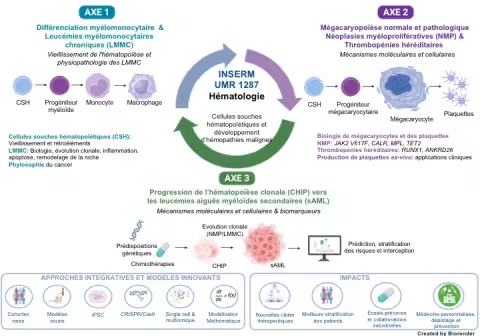
Unit 1287 consists of two teams conducting research in oncohematology focused on myeloid blood disorders. Its work is organized around three main areas: i) myelomonocytic differentiation during the aging of the hematopoietic system and the pathophysiology of chronic myelomonocytic leukemias (CMML) (Team 1); ii) normal and pathological megakaryopoiesis, including myeloproliferative neoplasms (MPNs) and hereditary thrombocytopenias (Team 2); iii) a cross-cutting research area dedicated to studying the progression of clonal hematopoiesis of undetermined significance (CHIP) toward secondary leukemias (post-chemotherapy, genetic predispositions, progression of MPNs, and LMMC) and its role in solid tumors.
The goal is to understand the cellular and molecular mechanisms involved in order to identify new therapeutic targets, improve patient stratification, and advance personalized medicine.
Drawing on innovative models (rare cohorts, mouse models, iPSCs, CRISPR/Cas9) and advanced genomic approaches (single-cell analysis, multi-omics, modeling), the unit has made major advances. In particular, it has demonstrated the reactivation of transposable elements during the aging of hematopoietic stem cells, as well as the role of inflammatory and apoptotic mechanisms in CML. It has contributed to the characterization and functional understanding of key mutations in NMPs (JAK2V617F, TET2, CALR) and to the understanding of their clonal evolution and leukemic transformation (TP53, chronic inflammation). Advances have also been made in hereditary thrombocytopenias and megakaryocytic disorders with leukemic risk (RUNX1, ANKRD26, trisomy 21).
This research is rapidly being translated into clinical practice through early-phase trials and opens up new possibilities in personalized medicine, screening, and prevention.
Research team
Contacts
- Phone
- 01.42.11.54.93