Welcome to the new Gustave Roussy website
A new website designed to offer you a simpler, clearer, and more intuitive experience. Patients, caregivers, healthcare professionals, and donors: find information, news, and services more easily.
Genome Dynamics and Stability
- Thematic(s)
- Data & AI, Genetics / Genomics, Precision Medicine, Innovative Therapies, AFM
- Attachment unit
- UMR9019 - Genome Integrity and Cancer
- Manager(s)
- Gabriel Matos Rodrigues
- Institutional connection
-
Gustave Roussy, CNRS, Paris-Saclay University
Summary
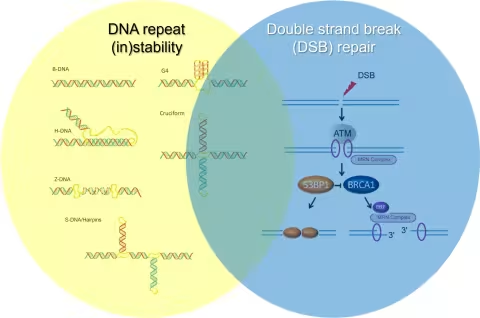
The “Genome Dynamics and Stability” team aims to understand how alterations in metabolism and genome stability influence tumorigenesis, cancer progression, treatment selection, and aging.
The team’s projects employ a wide range of experimental approaches, including cellular models derived from mice and patients, whole-genome sequencing using short- and long-read technologies, functional genomic analyses (e.g., CRISPR screens, ChIP-seq, END-seq, RNA-seq), and big data analysis.
-
Project 1 – Mechanisms of DNA triplex formation and targeting in cancer. Our research has shown that cancer cells exhibit high levels of DNA triplexes (H-DNA)—alternative DNA structures formed during replication that promote genomic instability. Our group’s objectives are: to understand the mechanisms underlying the formation of DNA triplexes in cancer cells; to identify the types of tumors and biological contexts in which DNA triplexes can be targeted for therapeutic purposes; and to use or develop small molecules that bind to DNA triplexes and stabilize them in order to selectively eliminate cancer cells.
-
Project 2 – MSI Cancers: Repeat Instability and New Therapeutic Interventions. Our goal is to identify additional vulnerabilities in MSI tumors in order to develop therapeutic strategies that could make dMMR/MSI tumors fully treatable. In our laboratory, we have set the following objectives: to develop sequencing protocols to characterize repeat instability in dMMR/MSI tumors; to elucidate the mechanisms underlying repeat instability in MSI tumors; and to develop theoretical frameworks and diagnostic tools to better identify patients likely to benefit from new therapies
-
Project 3 – The selection of the double-strand break (DSB) repair pathway and its role in tumorigenesis. Our research addresses the following questions: What mechanisms govern the selection of the double-strand break (DSB) repair pathway? Does a deficiency in homologous recombination (HR) inherently lead to tumorigenesis, or does it contribute to it by promoting alternative repair mechanisms that are prone to errors? How are inflammation and aging linked to defective HR-mediated DNA repair?
Team members
-
MATOS-RODRIGUES Gabriel - Team Leader
Researcher and Equivalents, CNRS
BEKKOUCHE Louisa
Engineering Assistant or equivalent, CNRS
COELHO-BASTO Clara
Postdoctoral Researcher, CNRS
Elodie DARDILLAC
Design Engineer or equivalent, CNRS
GUEDET, Marine
Engineering Assistant or equivalent, CNRS
Cathy SAAB
Postdoctoral Researcher, CNRS
Key publications
Contacts