
Welcome to the new Gustave Roussy website
A new website designed to offer you a simpler, clearer, and more intuitive experience. Patients, caregivers, healthcare professionals, and donors: find information, news, and services more easily.
Ovarian Cancer
Director
Dr. Patricia Pautier
Contact
Tel.: +33 (0)1 42 11 66 99
Understanding the Disease
Ovarian cancer develops from the various cells that make up the ovaries. There are two main types of ovarian cancer:
-
Ovarian adenocarcinoma (90% of cases), in which the tumor affects the cells on the outer surface (epithelial cells) of the organ.
-
Non-epithelial ovarian tumors (10% of cases), which are rare malignant ovarian tumors (RMOT). These tumors affect the stromal or germ cells of the ovary and include the following conditions:
-
Sex cord tumors.
-
Germ cell tumors.
-
Clear cell adenocarcinomas.
-
Mucinous adenocarcinomas of the ovary.
-
Borderline or low-grade malignant tumors.
-
Small-cell carcinoma.
-
Ovarian and uterine carcinosarcomas.
-
Low-grade serous tumors.
-
Ovarian carcinoma is the eighth leading cause of cancer in women in France, with approximately 5,200 new cases per year. The median age of patients at diagnosis is 62 years, according to data from the National Cancer Institute.
Non-epithelial tumors, or rare malignant ovarian tumors (RMOTs), affect young women, including adolescents and even children. Nevertheless, they are generally detected at an early stage and are often chemotherapy-sensitive, which means that many have a good prognosis when properly treated.
ROMTs must be treated at expert centers accredited by the National Cancer Institute (INCa), such as Gustave Roussy (a national expert center).
What are the ovaries?
The ovaries are two small organs located on either side of the uterus, in the lower abdomen. They are part of the female reproductive system. They play an essential role: they produce oocytes, also known as eggs, which can be fertilized to result in pregnancy, and they secrete hormones—primarily estrogen and progesterone—that regulate the menstrual cycle and contribute to the body’s proper functioning.
Prevention and Risk Factors
The main risk factor for developing ovarian cancer is a mutation in the BRCA1 or BRCA2 genes. Hereditary genetic abnormalities are thus implicated in 15 to 20 percent of high-grade ovarian cancers.
Other factors have been identified as increasing the risk of developing ovarian cancer:
-
Age, with a diagnosis typically made at an average age of 65.
-
Being overweight or obese.
-
Early onset of menstruation.
-
Late menopause.
-
Never having been pregnant.
Symptoms
Ovarian cancer can be asymptomatic for a long time. That is why, unfortunately, it is often diagnosed at an advanced stage, when the cancer cells have spread to other nearby organs and tissues. However, certain symptoms may be indicative of the disease, such as abdominal discomfort, abdominal swelling, urinary problems, or pelvic or back pain.
Diagnosis and Treatment
Gustave Roussy provides diagnosis and management of suspected ovarian masses or peritoneal carcinomatosis, as well as treatment for ovarian cancer. The Institute also treats patients who have already received a diagnosis.
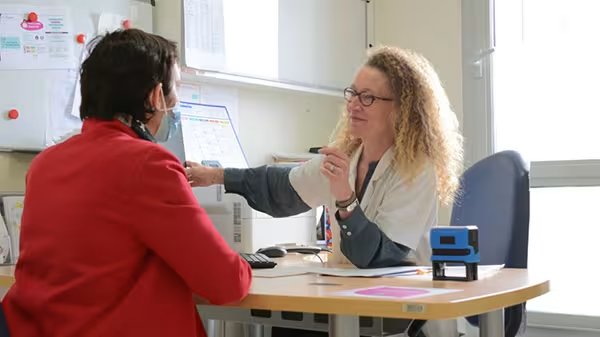
During the initial consultation, the patient is interviewed to learn more about her personal and family medical history. In particular, the doctor will inquire about other cases of cancer in the patient’s family. This helps identify any potential hereditary predispositions to developing cancer (15% of ovarian carcinomas are linked to a gene that predisposes individuals to ovarian cancer).
A general physical, gynecological, and abdominal examination is then performed to check for any unusual masses.
Depending on the suspected condition, its stage, and its aggressiveness, various tests may be recommended: a thoraco-abdominal-pelvic CT scan, an ultrasound, a CT scan, or a pelvic MRI.
A diagnostic laparoscopy is often performed prior to surgical resection to refine the diagnosis and assess the extent of the disease.
Decisions regarding cancer treatment plans are made during weekly multidisciplinary team meetings (MDTs). These meetings involve several physicians from different specialties—medical oncologists, surgeons, radiation oncologists, radiologists, and pathologists—in collaboration with primary care physicians. For each major decision, a recommendation is issued.
InstaDiag
Spotlight on InstaDiag Gynecology
Gustave Roussy offers an InstaDiag Gynecology program designed to diagnose and provide prompt, appropriate care to patients with suspicious results from an examination performed at a local clinic.

Treatments
Various treatments can be used to treat ovarian cancer.
Surgery is a major step in the treatment of ovarian cancer. It is performed with the goal of completely removing the tumor lesions from the ovary and/or the adjacent fallopian tube. Because the disease often spreads widely, surgery for ovarian cancer requires the expertise of specialized surgeons, who are available at Gustave Roussy.
→ Learn more about gynecologic surgery [note: link to be added]
Chemotherapy is often an essential part of the adjunctive treatment of aggressive or advanced-stage ovarian cancers. It is recommended as an adjunct to surgery if complete removal of the tumor is not possible, or before surgery if surgery is not an option from the outset, in order to enable complete removal of the tumor. Chemotherapy involves the administration of anticancer drugs that act throughout the body (systemic treatment).
→ Learn more about chemotherapy [note: link to be added]
Depending on the histological type, molecular abnormalities of the tumor, and the extent of the disease, maintenance therapy—administered intravenously or orally—may be considered after chemotherapy to consolidate the effects of previous treatments.
These treatments will be decided upon during a multidisciplinary tumor board meeting, based on the histopathological results and the assessment of disease spread.
Fertility Preservation
Treatment for gynecologic cancer can often lead to infertility, particularly as a result of surgery. That is why the teams at Gustave Roussy pay special attention to preserving patients’ fertility and have been working to improve treatment practices for the past two decades.
In certain situations where the tumor is localized or particularly sensitive to chemotherapy (especially for germ cell tumors in young women), fertility-sparing treatment may be considered. This requires specific expertise in pathology—such as that offered at Gustave Roussy (review of slides or case management at the Institute)—as well as surgical expertise (surgery, comprehensive care, review of slides, etc.).
This fertility preservation is systematically discussed whenever it can be safely offered to the patient in conjunction with treatment. It may combine procedures to preserve the uterus and at least part of one ovary during surgery, as well as procedures to retrieve oocytes or ovarian cortex prior to surgery. We raise this issue during the initial consultation and support patients throughout their fertility preservation journey until it is completed.
Clinical Trials and Therapeutic Innovation
Depending on the characteristics and stage of the cancer, doctors at Gustave Roussy may offer patients the opportunity to participate in clinical research trials. If appropriate, referral to a clinical trial will be discussed with patients during their care with their referring oncologist, allowing them to access innovative treatments.
→ View ongoing clinical trials for gynecologic cancers [notes: link to be added]
Appointments and Second Opinions

-
Les questions à poser si l’on m’annonce un cancer de l’ovaire
Le cancer de l’ovaire touche environ 5 200 femmes chaque année en France. À l’occasion de Septembre Turquoise, la Dr Patricia Pautier, cheffe du service d'oncologie gynécologique de Gustave Roussy, répond aux questions qui peuvent apparaître à l’annonce du diagnostic.

-
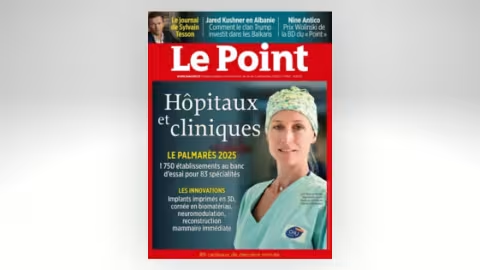
Classement du Point : Gustave Roussy progresse parmi les meilleurs hôpitaux français en cancérologie
Gustave Roussy progresse dans le classement des meilleurs hôpitaux français publié par le magazine Le Point. L’Institut figure 11 fois dans le top 10 pour plusieurs spécialités en cancérologie, dont 8 fois dans le top 5. À noter : Gustave Roussy est premier pour la prise en charge des cancers ORL depuis plus d’une décennie. Une performance qui reflète l’engagement quotidien de l’ensemble des équipes de Gustave Roussy.
-
Journée mondiale du cancer de l’ovaire
La Journée mondiale du cancer de l’ovaire met en lumière ce 8e cancer le plus fréquent chez la femme, souvent asymptomatique et diagnostiqué tardivement.
-
L’immunothérapie : un nouvel espoir pour les femmes atteintes de cancers gynécologiques
L’immunothérapie, stratégie thérapeutique déjà efficace dans le traitement des mélanomes, certains cancers du poumon, ORL, digestifs ou les lymphomes de Hodgkin s’avère prometteuse dans les cancers gynécologiques. Tour d’horizon des récentes avancées.