Welcome to the new Gustave Roussy website
A new website designed to offer you a simpler, clearer, and more intuitive experience. Patients, caregivers, healthcare professionals, and donors: find information, news, and services more easily.
Gustave Roussy is launching a groundbreaking cancer screening program—the first of its kind in France
The Gustave Roussy Interception Program aims to identify, as early as possible, individuals at increased risk for various cancers, in order to offer them personalized prevention strategies and provide them with better care, as part of a city-hospital collaboration. It also aims to develop, in the coming years, new screening and prevention methods tailored to these individuals, with the goal of eradicating cancer before it becomes clinically detectable. By fully committing to the field of prevention in this innovative way, Gustave Roussy is setting a new goal alongside its three founding missions: patient care, research, and education. Interception is the future of prevention!
On
Changed on
More than 19 million¹ new cases of cancer were diagnosed worldwide in 2020, including nearly 500,000² in France. Cancer is not only the leading cause of death in Western countries, but also a major cause of morbidity and long-term effects among survivors.
Because approximately 30 to 40% of people who develop cancer could have been identified as being at increased risk in the years leading up to their diagnosis, Gustave Roussy is launching Interception, a program developed and led by Dr. Suzette Delaloge, an oncologist at Gustave Roussy. “Prevention is a major challenge for our societies. Current approaches targeting the general population have identified limitations. Personalized prevention and screening based on individual cancer risk—to eradicate cancer before it reaches the clinical stage—now appear to be a major path forward,” comments Dr. Delaloge.
The primary objective of Interception is to identify and provide better care—through a city-hospital collaboration—for individuals identified by their primary care physician or at the hospital as being at increased risk of developing certain cancers. Identifying these individuals now makes it possible to raise their awareness and provide them with appropriate information on screening options and specific preventive measures.
“ By equipping those affected with knowledge, our goal is to help participants make informed choices about prevention and screening, improving their adherence and ensuring they actually follow through with their follow-up care, thereby supporting primary care physicians in their prevention efforts—without replacing them,” explains Suzette Delaloge. “Prevention takes many forms. We systematically offer a nutritional assessment and personalized advice on nutrition and physical activity. The prevention measures we offer can also be more medically focused, or even surgical in certain specific cases, such as when there is a predisposition to breast or ovarian cancer. We also provide them with information on potential symptoms of the disease.”
The Interception program also aims to develop, in the coming years, next-generation screening methods and tailored, personalized prevention strategies.
Several clinical studies are already shaping the Interception program, such as the MyPeBS study on personalized breast cancer screening, the European 4-in-the-lung-run study, which refines lung cancer screening using CT scans, and the LEAH study, which will be launched soon and evaluates the role of circulating DNA in screening. “Our teams are committed to advancing research to identify new risk biomarkers, new screening methods, prevention strategies, and nutritional interventions. We are also continuing to explore the role of immunity and the microbiome, and seeking to develop a better understanding of the sociopsychological impacts,” adds the doctor.
Should new advances emerge, participants and their doctors will be informed so that the follow-up plan can be adjusted.
Early intervention is crucial to the success of this program. The Institute is committed to responding to all diagnostic requests within two business days in the event of suspicious symptoms, or to providing therapeutic care in the event of a confirmed cancer diagnosis.
“Interception is the prevention of tomorrow, giving us the best possible chance to detect cancers earlier so we can treat them more effectively and with fewer long-term effects,” concludes Dr. Delaloge. The impact and benefits of these early interventions will be evaluated over the long term.
The Interception program was created by oncologists, geneticists, gynecologists, radiologists, palliative care specialists, epidemiologists, healthcare providers, and surgeons, in collaboration with patient advocacy groups.
Interception is the first example of the flagship projects within Gustave Roussy’s institutional strategic plan for the next five years, which the institute is currently finalizing. It is part of the Institute’s new ambitions to address all phases of the disease, from precancerous factors to the post-cancer period.
The Interception Program in Practice
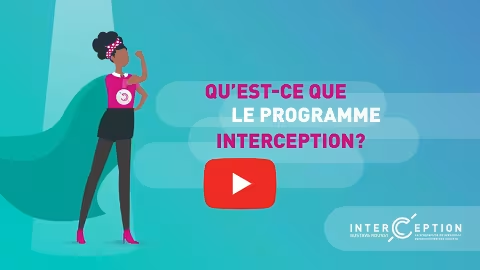
What is the Interception Program?
The Interception Program is based on the identification by physicians in private practice or at hospitals of situations involving an increased risk of certain cancers. It is part of a personalized prevention approach designed to tailor screening and prevention to each individual.
Who can benefit from it?
People identified as being at increased risk for certain cancers. This identification is dynamic. A person is considered to be at increased risk for a given cancer when, generally speaking, their probability of developing that cancer is at least 2 to 3 times higher than that of other people. This may be the case, for example, with a significant family history and hereditary predisposition, precancerous lesions, or high exposure to certain toxins.
As part of the Interception program, there are currently several specific care pathways for people at increased risk of breast cancer, colorectal cancer, cancers linked to toxic exposures (tobacco, childhood cancer treatments), or those who carry rare predisposing genetic abnormalities.
How does it work?

The Interception program consists of several steps:
- Identification of specific, confirmed risks in patients seen in private practice or at the hospital. To this end, Gustave Roussy provides physicians with an online calculator that allows them to identify situations of increased cancer risk with just a few clicks. This software takes into account hereditary predispositions, the presence of precancerous lesions, high exposure to certain toxins, and more. When an increased risk of cancer is identified, the doctor can enroll their patient in the Interception program if they wish.
- An “Interception” day at Gustave Roussy consists of individual consultations and awareness-raising and educational workshops in groups of people with similar profiles.
- Personalized and tailored prevention and screening follow-up. Following the Interception day at Gustave Roussy, the patient’s follow-up care is organized in close collaboration with their primary care physician, in accordance with the participant’s wishes and those of their doctor (imaging, addiction treatment, nutrition, colonoscopy, gynecological follow-up, etc.).
- Adjustments to the follow-up plan in the event of new screening or prevention methods.
- Early intervention in the event of suspected or diagnosed cancer. Since early intervention is crucial to the success of this program, Interception is committed to responding within two business days to all requests for diagnosis in the event of suspicious symptoms, or to ensuring therapeutic care in the event of confirmed cancer among those under our care.
1,192,927 new cases worldwide in 2020 - https://gco.iarc.fr/today/online-analysis-treemap?v=2020&mode=cancer&mode_population=continents&population=900&populations=900&key=asr&sex=0&cancer=39&type=0&statistic=5&prevalence=0&population_group=0&ages_group%5B%5D=0&ages_group%5B%5D=17&group_cancer=1&include_nmsc=1&include_nmsc_other=1&reloaded
2,246,796 new cases in France in 2020 - https://gco.iarc.fr/today/data/factsheets/populations/250-france-fact-sheets.pdf
▶
cp-interception-prevention-02022021.pdf
Press contact
If you are a journalist and have a question, please contact:
Claire Parisel or Léona Pinto
Tel. +33 1 42 11 50 59
Tel. +33 1 42 11 63 59
Mob. +33 6 17 66 00 26
Email
The Media Team cannot respond to patient inquiries.
Last press releases
-
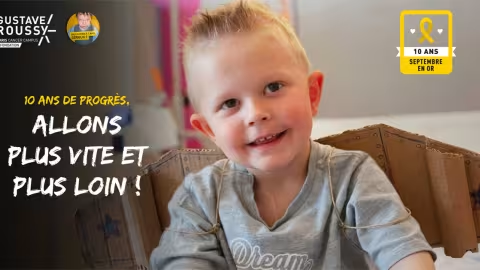
Gold september: two new research programmes launched to tackle childhood cancers
Two of Gustave Roussy’s four new medical and scientific programmes are dedicated to childhood cancers. The first, DECRIPT, aims to improve understanding of the role played by genetics in the development of certain childhood cancers, as well as second cancers that may occur in adulthood. The second, INSPIRE, will draw on the knowledge and techniques already developed at the Institute to create organoids, with the aim of deciphering the mechanisms underlying metastasis and resistance to treatment.
-
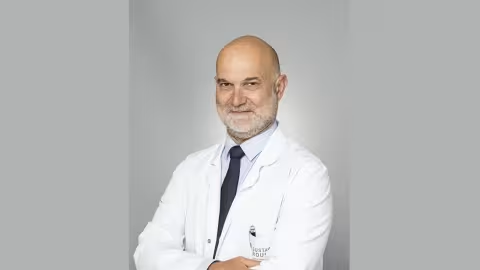
Prof. Fabrice Barlesi reappointed at the head of Gustave Roussy, the leading cancer center in France and Europe
By order of Ms. Stéphanie Rist, Minister of Health, Families, Autonomy and Persons with Disabilities, dated 27 July 2026, Professor Fabrice Barlesi has been reappointed as Director General of Gustave Roussy, effective 1 August 2026. At the helm of the Institute for five more years, Prof. Barlesi will continue the transformations undertaken during his first term. This renewal reflects the confidence placed in the project led by the institution to accelerate progress in the fight against cancer, foster and support the development of innovations set to change the future of oncology, and strengthen the influence of one of the world's leading cancer centers.
-
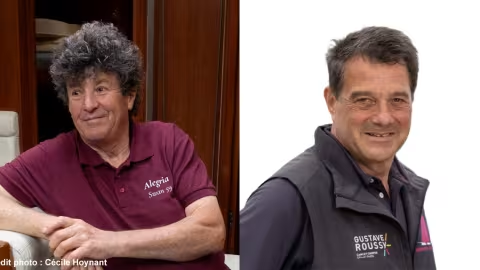
Route du Rhum 2026 Jean Le Cam and Christophe Rateau to sail for Gustave Roussy
For the Route du Rhum - Destination Guadeloupe 2026, Jean Le Cam and Christophe Rateau will sail under the colors of Gustave Roussy, the leading cancer center in France and Europe. Competing respectively in the Vintage and Class40 categories, the two skippers will carry the Institute's mission to the general public, supporting cancer research and raising awareness of prevention, innovation and patient care.
-
Owkin and Gustave Roussy partner to bring K Pro into real-world clinical practice
Owkin and Gustave Roussy, Europe's leading cancer center, today announced a partnership to test K Pro directly within the hospital's real-world clinical and research workflows.