
Welcome to the new Gustave Roussy website
A new website designed to offer you a simpler, clearer, and more intuitive experience. Patients, caregivers, healthcare professionals, and donors: find information, news, and services more easily.
Robotic Surgery
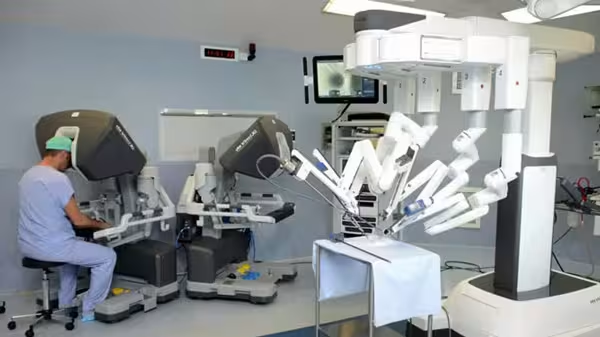
Robot-assisted surgery is an innovative technique that allows surgeons to perform procedures with a very high degree of precision while minimizing surgical trauma. At Gustave Roussy, a pioneer in robotic surgery for cancer treatment, this technique is used across many specialties to offer increasingly less invasive treatments and preserve patients’ quality of life as much as possible.
Learn About Robotic Surgery at Gustave Roussy
What is robot-assisted surgery?
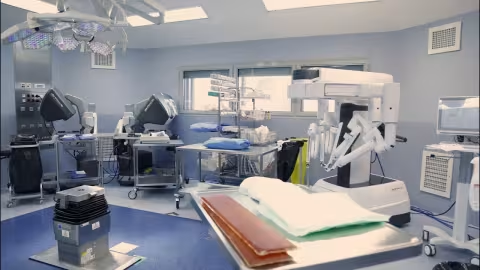
Robot-assisted surgery relies on the use of a surgical robot controlled in real time by the surgeon. The robot is not autonomous: it replicates with extreme precision the movements performed from a control console.
Since surgery is one of the primary curative treatments for cancer, Gustave Roussy has chosen to develop this technology to expand the possibilities of minimally invasive surgery. This approach combines the advantages of open surgery with those of laparoscopy, thanks to very small incisions.
The system used at Gustave Roussy offers the following benefits:
- high-definition 3D visualization;
- high precision in surgical maneuvers;
- easier access to hard-to-reach anatomical areas;
- minimally invasive approaches that limit the size of incisions;
- complementary technologies such as fluorescence or on-board ultrasound to guide certain complex procedures
Key Takeaways
The robot does not perform any movements on its own: every movement is controlled by the surgeon throughout the procedure.
What are the benefits for patients?
Robot-assisted surgery often makes it possible to reduce the size of incisions and minimize trauma associated with the procedure.
This approach may help reduce postoperative pain, shorten the length of hospital stay, and allow for a faster return to daily activities.
The robotic system provides stabilized three-dimensional imaging and instruments capable of performing extremely precise movements, even in complex anatomical areas.
In certain situations, using the robot can minimize the cosmetic impact of the procedure. This is particularly true for certain breast or thyroid surgeries.
A technology used in many fields
Robotic surgery is used at Gustave Roussy in several areas:
- breast cancer;
- ENT and head and neck cancers;
- thyroid surgery;
- gynecologic cancers;
- gastrointestinal and liver cancers.
Innovation in Cancer Treatment
Installed at Gustave Roussy in 2014, the Da Vinci Xi robot features high-definition imaging and a wide range of motion for surgical instruments. It has enabled the development of numerous innovations in oncology and has helped make Gustave Roussy one of the pioneering centers for robotic surgery in Europe.
This new generation of robots makes it possible to perform certain procedures through a single incision. This advancement paves the way for increasingly less invasive procedures and faster recovery.
The robotic system can be combined with fluorescence imaging and intraoperative ultrasound. These tools provide the surgeon with real-time information to guide certain complex procedures, particularly in liver surgery.
-
Robotic surgery: a French first in oesophageal cancer
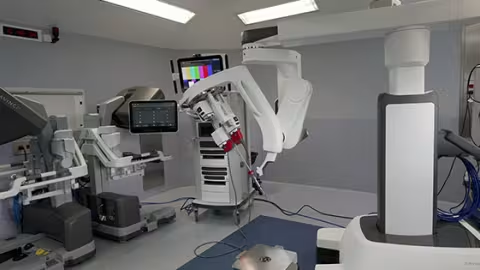
Following several pioneering procedures carried out in 2025 on the colon, pharynx and liver, the teams from the Department of Anaesthesia, Surgery and Interventional Medicine (DACI) at Gustave Roussy are continuing to drive innovation in robotic surgery. Using the da Vinci Single Port system, they successfully removed a patient’s diseased oesophagus without opening the chest, accessing it via a subcostal approach—an unprecedented achievement in France.
-
Chirurgie robotique : première française en chirurgie digestive avec le robot da Vinci Single Port
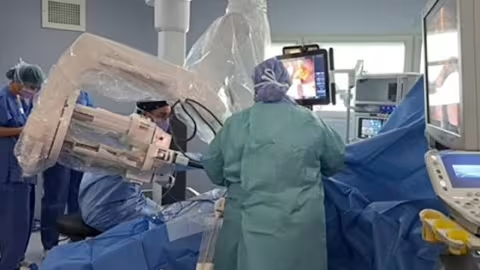
Arrivé à Gustave Roussy en janvier, l’appareil de chirurgie robot-assistée da Vinci Single Port permet la réalisation d’actes chirurgicaux mini-invasifs via une seule incision ou un orifice naturel. Il réunit en un système unique une caméra et trois bras opérateurs.


Recognized expertise
Gustave Roussy has been developing robot-assisted surgery for more than ten years and is one of the French centers most committed to this technology as applied to cancer treatment. More than 150 robot-assisted procedures were already being performed each year at the Institute, notably using the Da Vinci Xi robot, with the number of procedures steadily increasing.
Recognized expertise in:
- robot-assisted ENT surgery;
- robotic gastrointestinal surgery;
- robotic gynecologic surgery;
- robot-assisted thyroid surgery;
- minimally invasive breast surgery.
Expert Opinion
Dr. Léonor Benhaim
Surgeon specializing in digestive and esophagogastric surgery
“Robotic surgery now allows us to perform procedures that are increasingly less invasive, while maintaining the precision essential for cancer treatment. Our goal is to minimize the impact of surgery on patients’ recovery and quality of life.”
