Welcome to the new Gustave Roussy website
A new website designed to offer you a simpler, clearer, and more intuitive experience. Patients, caregivers, healthcare professionals, and donors: find information, news, and services more easily.
Robotic surgery: a French first in oesophageal cancer
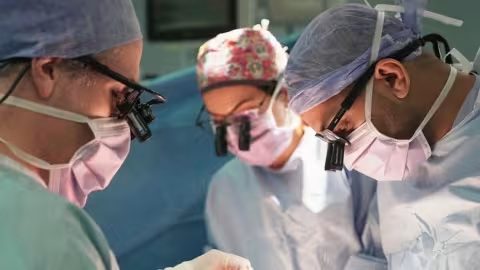
Following several pioneering procedures carried out in 2025 on the colon, pharynx and liver, the teams from the Department of Anaesthesia, Surgery and Interventional Medicine (DACI) at Gustave Roussy are continuing to drive innovation in robotic surgery. Using the da Vinci Single Port system, they successfully removed a patient’s diseased oesophagus without opening the chest, accessing it via a subcostal approach—an unprecedented achievement in France.
Published on
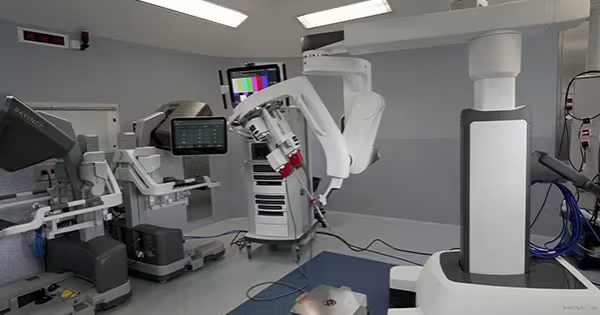
Following several pioneering procedures carried out in 2025 on the colon, pharynx and liver, the teams from the Department of Anaesthesia, Surgery and Interventional Medicine (DACI) at Gustave Roussy are continuing to drive innovation in robotic surgery. Using the da Vinci Single Port system, they successfully removed a patient’s diseased oesophagus without opening the chest, accessing it via a subcostal approach—an unprecedented achievement in France.
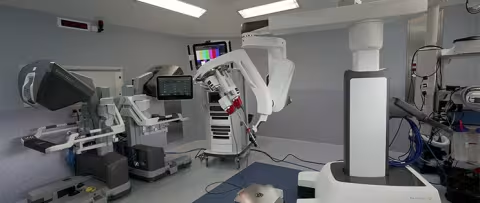
Gustave Roussy was among the first centres in France to be equipped with the da Vinci Single Port surgical system in early 2025. This technology makes it possible to perform complex procedures through a single incision of just a few centimetres, or even via natural orifices where feasible.
Supported by this technology, Dr Léonor Benhaim and her team performed a transdiaphragmatic oesophagectomy in April on a patient with oesophageal cancer. The procedure aimed to remove the diseased organ and reconstruct the digestive tract using a gastric pull-up.
Typically, access to the thoracic oesophagus requires several incisions between the ribs, an invasive approach that can be painful and is associated with a risk of postoperative pulmonary complications. In this case, thanks to the da Vinci Single Port system, the operation was carried out through a single incision of just a few centimetres at the level of the diaphragm, the muscle beneath the lungs and rib cage that separates the chest from the abdomen.
This significantly less invasive robotic approach helped reduce surgery-related complications. “Postoperative recovery was straightforward, with very little pain associated with this new approach,” notes Dr Léonor Benhaim. “This French first highlights the potential of robotic surgery to reduce postoperative complications and to offer patients increasingly less invasive treatments,” she concludes.
Last news
-
Breast Cancer: Gustave Roussy Ranked No. 1 in France for Breast Surgery and Breast Reconstruction
On the occasion of Breast Cancer Awareness Month, the 2025 data from Visuchir, the national surgical activity monitoring tool of the French Health Insurance system, places Gustave Roussy in first position for both breast surgery and breast reconstruction. Beyond this ranking, these figures highlight that reconstruction is now an integral part of breast cancer treatment. It is considered at every stage of care: from tumor removal surgery, whether lumpectomy or mastectomy, through to the post-cancer period, helping to restore the body and support women in regaining their physical integrity and quality of life.
-
Newsweek Ranking: Gustave Roussy Named Europe’s Leading Cancer Centre and Third Best Worldwide
The 2027 edition of Newsweek’s World's Best Specialized Hospitals ranking once again recognises Gustave Roussy as the leading cancer centre in France and Europe, and the third best worldwide. This distinction highlights the excellence of the Institute’s care and research, as well as the daily commitment of all its professionals.

-
Living with and beyond cancer: the promises and challenges of digital health
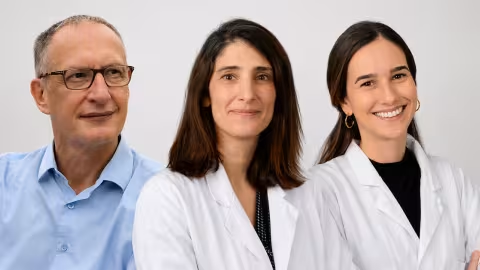
In a Viewpoint article published in The Lancet Digital Health, Drs Ines Vaz-Luis and Maria Alice Franzoi, together with Emmanuel Mussault, a patient partner at the PRISM University Hospital Institute, examine the role that digital tools can play in supporting people living with and beyond cancer. Their central message is that these technologies can support more personalised and accessible care, but their value depends primarily on how they are integrated into care pathways, the human support provided, their ability to address individual needs and their evaluation in real-world settings.
-
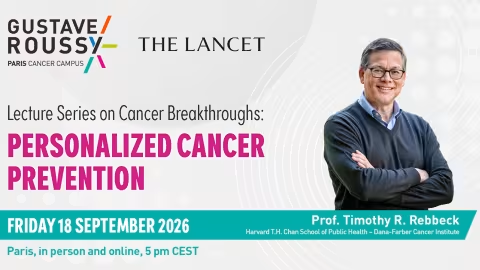
Gustave Roussy and The Lancet launch an international lecture series on innovations transforming cancer care
The inaugural lecture in the “Lecture Series on Cancer Breakthroughs” will take place on Friday 18 September at 5:00 pm. It will be delivered by Professor Timothy R. Rebbeck, a leading cancer prevention specialist at Harvard University and the Dana-Farber Cancer Institute.