Welcome to the new Gustave Roussy website
A new website designed to offer you a simpler, clearer, and more intuitive experience. Patients, caregivers, healthcare professionals, and donors: find information, news, and services more easily.
Research Focus: Three Other Advances to Watch
This quarter, we also learned that the immune system is a true conductor of the body’s inner workings, that AI can support physicians in tailoring treatments, and that a therapeutic combination could represent a new option for rare thymic cancers.
Published on
This quarter, we also learned that the immune system is a true conductor of the body’s inner workings, that AI can support physicians in tailoring treatments, and that a therapeutic combination could represent a new option for rare thymic cancers.
The other face of the immune system: conductor of the human body
Traditionally, the immune system is seen as a defensive shield protecting the organism. Yet, a growing body of research shows that its role extends well beyond simple protection.
In an article published in the prestigious journal Science, Prof. Florent Ginhoux (Gustave Roussy), together with Matthias Nahrendorf (Massachusetts General Hospital and Harvard University) and Filip Swirski (Mount Sinai Hospital), sheds light on the close links between the immune system and the overall functioning of the body. Present in all tissues and able to circulate between organs, immune cells do more than combat external threats: they communicate with nerve cells, muscle cells and endocrine cells, thereby contributing to the maintenance of physiological balance.
The authors review striking examples: in the brain, immune cells influence memory; in the heart, they support mitochondrial metabolism and electrical conduction; in the gut and liver, they regulate motility and regeneration; in bones and muscles, they orchestrate repair and remodelling. Even metabolism, pregnancy and lactation appear to be modulated by their action.
This work reminds us that the immune system is not peripheral, but central. It is a full participant in physiology, weaving a communication network that shapes the functioning of the entire human body.
Immune system influence on physiology
Matthias Nahrendorf et al., Science, 389, 594–599 (2025)
Using artificial intelligence to tailor treatments for women with breast cancer
This study, published in the Journal of Clinical Oncology, was conducted in collaboration with Institut Curie and coordinated by Prof. Fabrice André. It concerns women with HR-positive, HER2-negative breast cancer. It assessed a prognostic test based on artificial intelligence, developed by the start-up Spotlight Medical, in which Gustave Roussy Transfert is a shareholder.
For patients classified as high-risk within this subtype of the disease, the standard therapeutic approach relies on chemotherapy and CDK4/6 inhibitors. However, the test developed by Spotlight Medical suggests that among these women, some will not benefit from treatment intensification, as they are in fact at low risk of relapse.
To reach this conclusion, researchers relied on two cohorts of high-risk patients. The Spotlight Medical test, which analyses 10 histological or biological criteria using digitalised tumour slides, demonstrated that one patient in five was in fact at low risk of relapse. These findings were confirmed in real-world data, with 95.4% of the identified women showing no relapse after nine years of follow-up.
This test could ultimately help personalise treatment for these patients.
Identifying Patients With Low Relapse Rate Despite High-Risk Estrogen Receptor–Positive/Human Epidermal Growth Factor Receptor 2–Negative Early Breast Cancer: Development and Validation of a Clinicopathologic Assay
François-Clément Bidard et al., Journal of Clinical Oncology, 43, 3090–3101 (2025)
A new therapeutic hope for patients with treatment-resistant thymic cancer
Thymic cancers, located in a small gland situated in the upper thorax, are rare. For patients with advanced type B3 thymoma or thymic carcinoma, two subtypes of the disease, there are unfortunately no standard therapies after the failure of platinum-based treatments.
The PECATI phase II trial, which is still ongoing, is recruiting patients with these indications in 11 hospitals in France, Italy, and Spain, to assess the antitumour activity and safety of lenvatinib, a targeted therapy that prevents tumours from forming new blood vessels, combined with pembrolizumab, an immunotherapy. All participating patients had experienced disease progression after an initial cycle of platinum-based chemotherapy.
Following the initial follow-up, the trial has already reached its primary objective, with 88.4% of patients showing no disease progression at five months, alongside observed adverse effects. These results suggest that the lenvatinib-pembrolizumab combination could offer a new therapeutic option for patients with no remaining alternatives, provided that toxicity is closely monitored.
Lenvatinib plus pembrolizumab in pretreated metastatic B3 thymoma and thymic carcinoma (PECATI): a single-arm, phase 2 trial
Remon, Jordi et al., The Lancet Oncology, Volume 26, Issue 9, 1215–1226
Last news
-
Breast Cancer: Gustave Roussy Ranked No. 1 in France for Breast Surgery and Breast Reconstruction
On the occasion of Breast Cancer Awareness Month, the 2025 data from Visuchir, the national surgical activity monitoring tool of the French Health Insurance system, places Gustave Roussy in first position for both breast surgery and breast reconstruction. Beyond this ranking, these figures highlight that reconstruction is now an integral part of breast cancer treatment. It is considered at every stage of care: from tumor removal surgery, whether lumpectomy or mastectomy, through to the post-cancer period, helping to restore the body and support women in regaining their physical integrity and quality of life.
-
Newsweek Ranking: Gustave Roussy Named Europe’s Leading Cancer Centre and Third Best Worldwide
The 2027 edition of Newsweek’s World's Best Specialized Hospitals ranking once again recognises Gustave Roussy as the leading cancer centre in France and Europe, and the third best worldwide. This distinction highlights the excellence of the Institute’s care and research, as well as the daily commitment of all its professionals.

-
Living with and beyond cancer: the promises and challenges of digital health
In a Viewpoint article published in The Lancet Digital Health, Drs Ines Vaz-Luis and Maria Alice Franzoi, together with Emmanuel Mussault, a patient partner at the PRISM University Hospital Institute, examine the role that digital tools can play in supporting people living with and beyond cancer. Their central message is that these technologies can support more personalised and accessible care, but their value depends primarily on how they are integrated into care pathways, the human support provided, their ability to address individual needs and their evaluation in real-world settings.
-
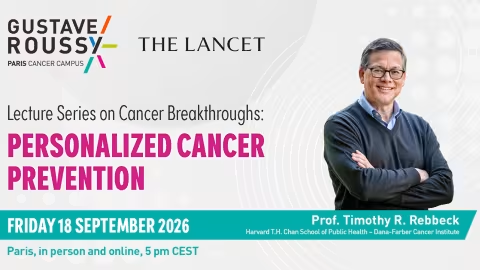
Gustave Roussy and The Lancet launch an international lecture series on innovations transforming cancer care
The inaugural lecture in the “Lecture Series on Cancer Breakthroughs” will take place on Friday 18 September at 5:00 pm. It will be delivered by Professor Timothy R. Rebbeck, a leading cancer prevention specialist at Harvard University and the Dana-Farber Cancer Institute.