Understand the molecular medecine effect on acute myeloid leukaemia thanks to "Family Trees"
For the first time, a team of international researchers have mapped the family trees of cancer cells in acute myeloid leukaemia (AML) to understand how this blood cancer responds to a new drug.
Published on
For the first time, a team of international researchers have mapped the family trees of cancer cells in acute myeloid leukaemia (AML) to understand how this blood cancer responds to a new drug. The work also explains what happens when a patient stops responding to the treatment, providing important clues about how to combine enasidenib with other anti-cancer drugs to produce longer-lasting remissions and to prevent relapse.
The study published in Nature Medicine today (Monday), is an international collaboration between researchers from the Gustave Roussy Cancer Campus and Inserm in Paris (France), the MRC Molecular Haematology Unit and the MRC Weatherall Institute of Molecular Medicine at the University of Oxford (UK), Memorial Sloan Kettering Cancer Center (USA) and Celgene (USA).
Acute myeloid leukaemia (AML) is the most common and aggressive blood cancer in adults and is incurable in most patients. About 12-15% of AML patients have a mutation in the IDH2 gene that stops bone marrow cells from differentiating, or maturing, into blood cells that are required for life. Instead these immature cells accumulate in the bone marrow and blood, which is a hallmark of AML. Previous research from the same team showed that enasidenib prompts blood cell differentiation and restores normal blood cell production.
As AML is caused by errors in DNA sequence, or mutations, in blood cells, the team studied the genetic make-up of AML cells from 37 patients. They found that AML cells from the same patient can be grouped into families which share genetic mutations, called clones. Cells belonging to the same clone or family, come from the same ancestor cell. Understanding how clones relate to each other is important as they provide information as to how the AML started in the first place.
The cancer returned in almost all the patients in the clinical trial, and the team was able to show for the first time that the leukaemic cells stop responding to the drug when some of the clones develop additional mutations. These new sub-clones are resistant to enasidenib, providing clues about the mechanism of drug resistance. This may help in designing future therapy trials to overcome therapy resistance. It may also mean that enasidenib needs to be combined with other anti-cancer drugs to prevent relapse, and clinical trials have already started investigating whether patients respond to these combinations, for how long and whether they are likely to relapse.
- For more informations, read the press release
Last news
-
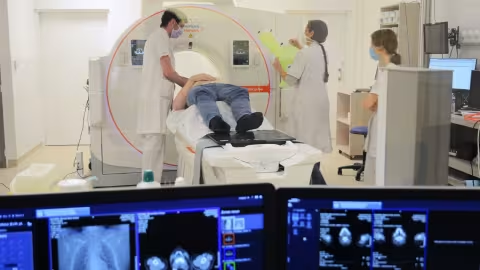
Two photon-counting CT scanners now equip Gustave Roussy's imaging department
Since September 2026, Gustave Roussy's Department of Medical Imaging has been equipped with a second photon-counting CT scanner, delivering higher image resolution while reducing the doses of X-rays and contrast agent administered to patients. This technology recently enabled the Institute to perform an iodine-free pulmonary CT angiogram, a world first.

-
Prevention and screening: getting ahead of lung cancer
To mark Thoracic Cancer Awareness Month and Tobacco-Free Month, two campaigns focusing on lung cancer, Gustave Roussy highlights its initiatives to advance prevention and screening among people at increased risk. Since its creation in 2021, the Institute’s Interception Lung programme has welcomed more than 900 participants, supporting them to stop smoking and offering personalised screening for the disease.
-
Gustave Roussy Meets His Audience
As part of its awareness-raising and fundraising efforts, Gustave Roussy is currently conducting a door-to-door outreach campaign in several towns in Val-de-Marne (Fresnes, Vitry-sur-Seine, Nogent-sur-Marne, Bry-sur-Marne, Le Kremlin-Bicêtre) from Monday through Saturday, 1:30 p.m. to 8:00 p.m.

-
Mens November: Take care of your jewelry its precious!
November is the month dedicated to raising awareness and promoting prevention of male cancers, which include prostate, testicular, and penile cancers. The goal is to raise public awareness of these diseases—which account for approximately 63,000 new cases in France each year—and to encourage men to perform testicular self-exams, a simple step that can help detect a lump, the nature of which must then be determined through further medical examinations. Gustave Roussy has extensive expertise in the treatment of male cancers, particularly through its Genitourinary Oncology Committee, which is deeply involved in research on these diseases.