Welcome to the new Gustave Roussy website
A new website designed to offer you a simpler, clearer, and more intuitive experience. Patients, caregivers, healthcare professionals, and donors: find information, news, and services more easily.
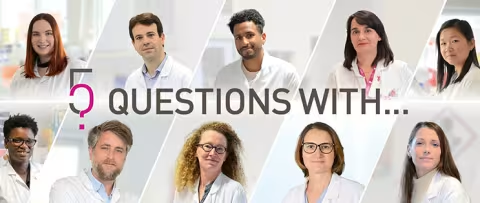
5 questions with Prof Alexandra Leary on pragmatic trials
Pragmatic trials are simple, affordable trials aiming to inform or change practice broadly. Prof Alexandra Leary, MD, Ph.D., a medical oncologist at Gustave Roussy and deputy head of the Medical Oncology Department, explains these trials in five questions.
Published on

Pragmatic trials are simple, affordable trials aiming to inform or change practice broadly. Prof Alexandra Leary, MD, Ph.D., a medical oncologist at Gustave Roussy and deputy head of the Medical Oncology Department, explains these trials in five questions.
What motivates pragmatic trials?

Today oncology is increasingly complex, with targeted therapies, bio-therapeutics, immune modulation, T-cell therapies, etc. This is great news for patients, but this complexification means that the latest breakthroughs in oncology may not be available everywhere for every patient. I believe that there is still room for research that starts from the practice.
Pragmatic trials are looking to answer simple questions, questions that clinicians ask themselves every week during multi-disciplinary team meetings. If positive, pragmatic trials can change practice broadly across clinical settings and in both high- and low-resource areas.
What are they looking to evaluate specifically?
Pragmatic trials are not clinical trials that seek approval of a new drug. Instead, they may compare two standard-of-care treatments, or evaluate therapeutic de-escalation. For example, when radiotherapy is systematically offered after surgery: is this empirical practice or evidence-based? If this strategy is not scientifically proven, a pragmatic trial comparing post-operative radiotherapy to observation could inform clinical practice.
Pragmatic trials can also be used to de-escalate medical treatments by decreasing duration or dose with the aim of reducing toxicities and cost while maintaining efficacy.
What criteria must they respect?
A pragmatic trial aims to answer one simple question; the tested strategy must be affordable and feasible across clinical settings and in ‘real-life’ patients so that the results may be broadly applicable. The extra trial-related procedures, such as blood tests and imaging, must be kept to a minimum and be as close as possible to standard of care. Data collected should be limited and CRFs as short and simple as possible.
What are their main advantages?
Since the tested strategy is simple and affordable, pragmatic trials can be practice changing immediately and everywhere.
Many novel trials are targeting smaller and smaller subset of molecularly selected patients. In addition, they often have very strict inclusion/exclusion criteria, recruiting an idealised patient population, with perfect organ function and no co-morbidities. This makes sense when testing a new drug. In contrast, pragmatic trials are tested in a ‘real-life’ population with loose inclusion criteria, so that their results can be broadly applicable to patients with cancer.
Pragmatic trials are light: the simple intervention being tested, the minimal extra trial-related procedures and short CRF mean these trials require low-level research infrastructure.
Do you have any examples of pragmatic trials led by Gustave Roussy?
Gustave Roussy is strongly committed to pragmatic trials and has been for 20 years. For example, investigators demonstrated the benefits for patients of telephone follow-up by nurses (CAPRI study). In 2021, the Lung ART study showed that postoperative radiotherapy could be safely omitted in patients with completely resected non-small cell lung cancer and positive mediastinal lymph nodes. This trial changed practice.
Other pragmatic trials are currently underway. The PULSE trial, led by Prof Benjamin Besse, is designed to compare the efficacy and safety of a standard dose of 200mg of pembrolizumab (immunotherapy) every 3 weeks versus every 6 weeks in non-small cell lung cancer. The RAINBO-MMRd GREEN trial is comparing post-operative chemotherapy to hormonal therapy in patients with hormone receptor-positive endometrial cancer. If the trial shows that hormonal therapy is as effective as chemotherapy, the quality of life of these patients, who are elderly and have difficulty tolerating chemotherapy, will be greatly improved.
Last news
-
Breast Cancer: Gustave Roussy Ranked No. 1 in France for Breast Surgery and Breast Reconstruction
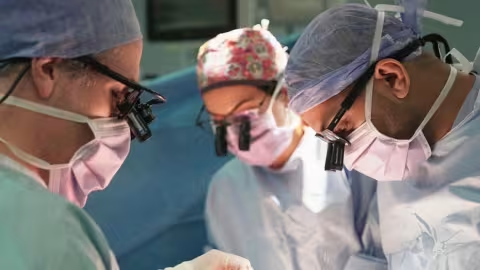
On the occasion of Breast Cancer Awareness Month, the 2025 data from Visuchir, the national surgical activity monitoring tool of the French Health Insurance system, places Gustave Roussy in first position for both breast surgery and breast reconstruction. Beyond this ranking, these figures highlight that reconstruction is now an integral part of breast cancer treatment. It is considered at every stage of care: from tumor removal surgery, whether lumpectomy or mastectomy, through to the post-cancer period, helping to restore the body and support women in regaining their physical integrity and quality of life.
-
Newsweek Ranking: Gustave Roussy Named Europe’s Leading Cancer Centre and Third Best Worldwide
The 2027 edition of Newsweek’s World's Best Specialized Hospitals ranking once again recognises Gustave Roussy as the leading cancer centre in France and Europe, and the third best worldwide. This distinction highlights the excellence of the Institute’s care and research, as well as the daily commitment of all its professionals.

-
Living with and beyond cancer: the promises and challenges of digital health
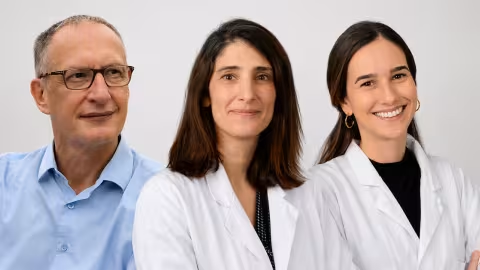
In a Viewpoint article published in The Lancet Digital Health, Drs Ines Vaz-Luis and Maria Alice Franzoi, together with Emmanuel Mussault, a patient partner at the PRISM University Hospital Institute, examine the role that digital tools can play in supporting people living with and beyond cancer. Their central message is that these technologies can support more personalised and accessible care, but their value depends primarily on how they are integrated into care pathways, the human support provided, their ability to address individual needs and their evaluation in real-world settings.
-
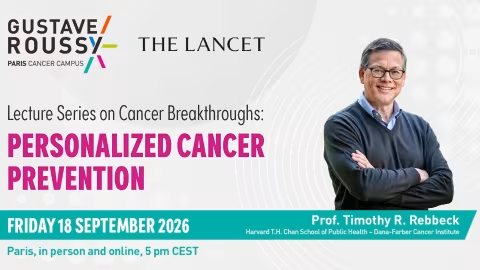
Gustave Roussy and The Lancet launch an international lecture series on innovations transforming cancer care
The inaugural lecture in the “Lecture Series on Cancer Breakthroughs” will take place on Friday 18 September at 5:00 pm. It will be delivered by Professor Timothy R. Rebbeck, a leading cancer prevention specialist at Harvard University and the Dana-Farber Cancer Institute.